Topallı, Damla

Loading...
Profile Picture
Name Variants
D.,Topallı
Topallı,D.
Damla, Topalli
Topalli, D.
D., Topalli
Topallı, Damla
D.,Topalli
T.,Damla
Topalli,D.
Damla, Topallı
D., Topallı
Topalli, Damla
T., Damla
Job Title
Doktor Öğretim Üyesi
Email Address
damla.topalli@atilim.edu.tr
Main Affiliation
Information Systems Engineering
Status
Website
ORCID ID
Scopus Author ID
Turkish CoHE Profile ID
Google Scholar ID
WoS Researcher ID

Sustainable Development Goals

9

INDUSTRY, INNOVATION AND INFRASTRUCTURE
INDUSTRY, INNOVATION AND INFRASTRUCTURE Logo

0

Research Products

5

GENDER EQUALITY
GENDER EQUALITY Logo

0

Research Products

2

ZERO HUNGER
ZERO HUNGER Logo

0

Research Products

4

QUALITY EDUCATION
QUALITY EDUCATION Logo

11

Research Products

11

SUSTAINABLE CITIES AND COMMUNITIES
SUSTAINABLE CITIES AND COMMUNITIES Logo

0

Research Products

17

PARTNERSHIPS FOR THE GOALS
PARTNERSHIPS FOR THE GOALS Logo

1

Research Products

16

PEACE, JUSTICE AND STRONG INSTITUTIONS
PEACE, JUSTICE AND STRONG INSTITUTIONS Logo

0

Research Products

3

GOOD HEALTH AND WELL-BEING
GOOD HEALTH AND WELL-BEING Logo

0

Research Products

12

RESPONSIBLE CONSUMPTION AND PRODUCTION
RESPONSIBLE CONSUMPTION AND PRODUCTION Logo

0

Research Products

15

LIFE ON LAND
LIFE ON LAND Logo

0

Research Products

8

DECENT WORK AND ECONOMIC GROWTH
DECENT WORK AND ECONOMIC GROWTH Logo

1

Research Products

14

LIFE BELOW WATER
LIFE BELOW WATER Logo

0

Research Products

10

REDUCED INEQUALITIES
REDUCED INEQUALITIES Logo

0

Research Products

7

AFFORDABLE AND CLEAN ENERGY
AFFORDABLE AND CLEAN ENERGY Logo

0

Research Products

1

NO POVERTY
NO POVERTY Logo

0

Research Products

6

CLEAN WATER AND SANITATION
CLEAN WATER AND SANITATION Logo

0

Research Products

13

CLIMATE ACTION
CLIMATE ACTION Logo

0

Research Products
Documents

14

Citations

266

h-index

6

Documents

0

Citations

0

Scholarly Output

38

Articles

12

Views / Downloads

20/0

Supervised MSc Theses

12

Supervised PhD Theses

3

WoS Citation Count

193

Scopus Citation Count

263

WoS h-index

6

Scopus h-index

6

Patents

0

Projects

0

WoS Citations per Publication

5.08

Scopus Citations per Publication

6.92

Open Access Source

5

Supervised Theses

15

Google Analytics Visitor Traffic

JournalCount
9th Annual International Conference of Education, Research and Innovation (iCERi) -- NOV 14-16, 2016 -- Seville, SPAIN4
9th International Conference on Education and New Learning Technologies (EDULEARN) -- JUL 03-05, 2017 -- Barcelona, SPAIN2
2016 Medical Technologies National Conference, TIPTEKNO 2016 -- 2016 Medical Technologies National Conference, TIPTEKNO 2016 -- 27 October 2016 through 29 October 2016 -- Antalya -- 1266332
Journal of Eye Movement Research2
Medical Technologies National Conference (TIPTEKNO) -- OCT 27-29, 2016 -- Antalya, TURKEY2
Current Page: 1 / 3

Scopus Quartile Distribution

Competency Cloud

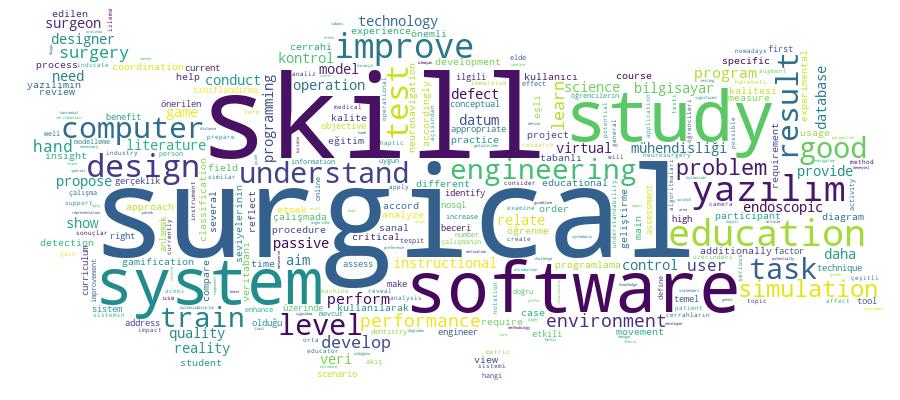
GCRIS Competency Cloud

Scholarly Output Search Results

Now showing 1 - 2 of 2
  • Article
    Citation - Scopus: 1
    A User Task Design Notation for Improved Software Design
    (PeerJ Inc., 2021) Ozcan,E.; Topalli,D.; Tokdemir,G.; Cagiltay,N.E.
    System design is recognized as one of the most critical components of a software system that bridges system requirements and coding. System design also has a significant impact on testing and maintenance activities, and on further improvements during the lifespan of the software system. Software design should reflect all necessary components of the requirements in a clear and understandable manner by all stakeholders of the software system. To distinguish system elements, separation of concerns in software design is suggested. In this respect, identification of the user tasks, i.e., the tasks that need to be performed by the user, is not currently reflected explicitly in system design documents. Our main assumption in this study is that software quality can be improved significantly by clearly identifying the user tasks from those that need to be performed by the computer system itself. Additionally, what we propose has the potential to better reflect the user requirements and main objectives of the system on the software design and thereby to improve software quality. The main aim of this study is to introduce a novel notation for software developers in the frame of UML Activity Diagram (UMLAD) that enables designers to identify the user tasks and define them separately from the system tasks. For this purpose, an extension of UML-AD, named UML-ADE (UML-Activity Diagram Extended) was proposed. Afterwards, it was implemented in a serious game case for which the specification of user tasks is extremely important. Finally, its effectiveness was analyzed and compared to UML-AD experimentally with 72 participants. The defect detection performance of the participants on both diagrams with two real-life serious game scenarios was evaluated. Results show a higher level of understandability for those using UML-ADE, which in turn may indicate a better design and higher software quality. The results encourage researchers to develop specific design representations dedicated to task design to improve system quality and to conduct further evaluations of the impact of these design on each of the above mentioned potential benefits for the software systems. © Copyright 2021 Ozcan et al.
  • Article
    A User Task Design Notation for Improved Software Design
    (Peerj inc, 2021) Ozcan, Eda; Topalli, Damla; Tokdemir, Gul; Cagiltay, Nergiz Ercil
    System design is recognized as one of the most critical components of a software system that bridges system requirements and coding. System design also has a significant impact on testing and maintenance activities, and on further improvements during the lifespan of the software system. Software design should reflect all necessary components of the requirements in a clear and understandable manner by all stakeholders of the software system. To distinguish system elements, separation of concerns in software design is suggested. In this respect, identification of the user tasks, i.e., the tasks that need to be performed by the user, is not currently reflected explicitly in system design documents. Our main assumption in this study is that software quality can be improved significantly by clearly identifying the user tasks from those that need to be performed by the computer system itself. Additionally, what we propose has the potential to better reflect the user requirements and main objectives of the system on the software design and thereby to improve software quality. The main aim of this study is to introduce a novel notation for software developers in the frame of UML Activity Diagram (UML-AD) that enables designers to identify the user tasks and define them separately from the system tasks. For this purpose, an extension of UML-AD, named UML-ADE (UML-Activity Diagram Extended) was proposed. Afterwards, it was implemented in a serious game case for which the specification of user tasks is extremely important. Finally, its effectiveness was analyzed and compared to UML-AD experimentally with 72 participants. The defect detection performance of the participants on both diagrams with two real-life serious game scenarios was evaluated. Results show a higher level of understandability for those using UML-ADE, which in turn may indicate a better design and higher software quality. The results encourage researchers to develop specific design representations dedicated to task design to improve system quality and to conduct further evaluations of the impact of these design on each of the above mentioned potential benefits for the software systems.