Sürücü, Özge

Loading...
Profile Picture
Name Variants
Bayrakll Ö.
O., Surucu
Bayrakli O.
Bayrakli, Ozge
O.,Surucu
Surucu, Ozge
Ö.,Sürücü
Ozge, Surucu
Sürücü, Özge
Ö., Sürücü
Bayraklı Sürücü Ö.
Özge, Sürücü
Sürücü,Ö.
Surucu, O. Bayrakli
Bayrakli Sürücü O.
Bayraklı Ö.
Surucu,O.
Bayrakli Surucu O.
Bayrakli Ö.
Sürücü Ö.
S.,Ozge
Bayrakli, O.
S., Özge
S., Ozge
S.,Özge
Bayrakli Surucu, Ozge
Surucu O.
Surucu, O.
Bayrakli Sürücü Ö.
Job Title
Doçent Doktor
Email Address
ozge.surucu@atilim.edu.tr
Main Affiliation
Electrical-Electronics Engineering
Status
Website
Scopus Author ID
Turkish CoHE Profile ID
Google Scholar ID
WoS Researcher ID

Sustainable Development Goals

5

GENDER EQUALITY
GENDER EQUALITY Logo

0

Research Products

14

LIFE BELOW WATER
LIFE BELOW WATER Logo

0

Research Products

10

REDUCED INEQUALITIES
REDUCED INEQUALITIES Logo

0

Research Products

3

GOOD HEALTH AND WELL-BEING
GOOD HEALTH AND WELL-BEING Logo

0

Research Products

2

ZERO HUNGER
ZERO HUNGER Logo

0

Research Products

9

INDUSTRY, INNOVATION AND INFRASTRUCTURE
INDUSTRY, INNOVATION AND INFRASTRUCTURE Logo

0

Research Products

16

PEACE, JUSTICE AND STRONG INSTITUTIONS
PEACE, JUSTICE AND STRONG INSTITUTIONS Logo

0

Research Products

11

SUSTAINABLE CITIES AND COMMUNITIES
SUSTAINABLE CITIES AND COMMUNITIES Logo

0

Research Products

8

DECENT WORK AND ECONOMIC GROWTH
DECENT WORK AND ECONOMIC GROWTH Logo

0

Research Products

13

CLIMATE ACTION
CLIMATE ACTION Logo

0

Research Products

4

QUALITY EDUCATION
QUALITY EDUCATION Logo

0

Research Products

6

CLEAN WATER AND SANITATION
CLEAN WATER AND SANITATION Logo

0

Research Products

1

NO POVERTY
NO POVERTY Logo

0

Research Products

15

LIFE ON LAND
LIFE ON LAND Logo

0

Research Products

17

PARTNERSHIPS FOR THE GOALS
PARTNERSHIPS FOR THE GOALS Logo

0

Research Products

7

AFFORDABLE AND CLEAN ENERGY
AFFORDABLE AND CLEAN ENERGY Logo

13

Research Products

12

RESPONSIBLE CONSUMPTION AND PRODUCTION
RESPONSIBLE CONSUMPTION AND PRODUCTION Logo

0

Research Products
This researcher does not have a Scopus ID.
Documents

55

Citations

834

Scholarly Output

44

Articles

41

Views / Downloads

14/0

Supervised MSc Theses

1

Supervised PhD Theses

0

WoS Citation Count

614

Scopus Citation Count

615

WoS h-index

15

Scopus h-index

15

Patents

0

Projects

0

WoS Citations per Publication

13.95

Scopus Citations per Publication

13.98

Open Access Source

5

Supervised Theses

1

Google Analytics Visitor Traffic

JournalCount
Journal of Materials Science: Materials in Electronics7
Applied Physics A4
Materials Letters3
Materials Science in Semiconductor Processing3
Physica Scripta3
Current Page: 1 / 5

Scopus Quartile Distribution

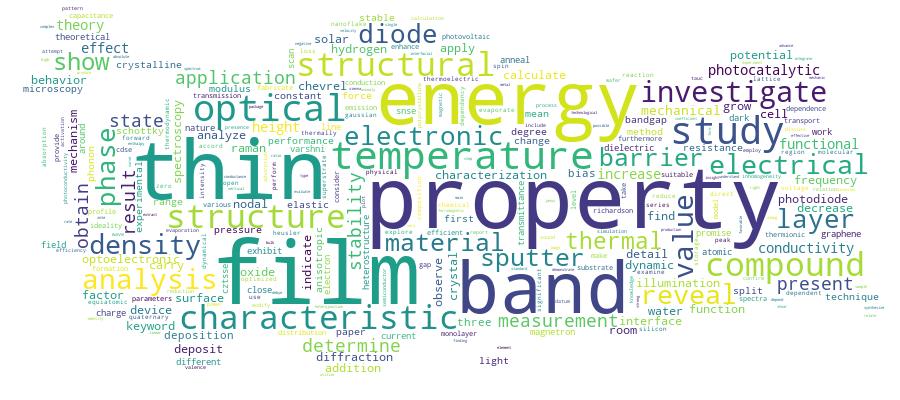
Competency Cloud

GCRIS Competency Cloud

Scholarly Output Search Results

Now showing 1 - 5 of 5
  • Article
    Citation - WoS: 24
    Citation - Scopus: 24
    Anisotropic mechanical properties of Tl4Ag18Te11 compound with low thermal conductivity
    (Academic Press inc Elsevier Science, 2020) Gencer, Aysenur; Surucu, Ozge; Surucu, Gokhan; Deligoz, Engin
    The anisotropic mechanical properties of Tl4Ag18Te11 compound was investigated elaborately for the first time by using Density Functional Theory calculations with the Vienna Ab-initio Simulation Package in this work. Tl4Ag18Te11 compound was optimized in the I4mm space group and the formation energy was determined as a negative value that is the indication of the experimental synthesizability of this compound. The optimized crystal structure was employed for the calculations of the elastic constants and the obtained values revealed the mechanical stability of Tl4Ag18Te11 compound. The polycrystalline properties were determined such as shear modulus, Poisson's ratio, etc. In addition, the anisotropic elastic properties were presented. The direction dependent sound waves velocities, polarization of the sound waves, enhancement factor and the power flow angle were determined. The thermal conductivity studies were performed and the minimum thermal conductivity (0.259 W m(-1)K(-1)) and the diffusion thermal conductivity (0.202 W m(-1)K(-1)) were calculated. This study illustrates the capability of this compound for the thermoelectric materials.
  • Article
    Citation - WoS: 1
    Citation - Scopus: 1
    Penta-Graphene/SnS2 Heterostructures with Z-Scheme Charge Transfer for Efficient Photocatalytic Water Splitting
    (Amer Chemical Soc, 2025) Nasoz, Duygu Lale; Surucu, Ozge; Wang, Xiaotian; Surucu, Gokhan; Sarac, Yasemin; Gencer, Aysenur
    The present study explores the photocatalytic potential of penta-graphene (PG) and SnS2 monolayers, along with their heterostructures (PG/SnS2), using Density Functional Theory (DFT). Structural analysis confirms that the PG/SnS2 heterostructure exhibits enhanced stability, efficient charge separation, and suitable band alignment. Optimized lattice parameters (3.66 & Aring; for PG and 3.88 & Aring; for SnS2) closely matched literature values, while ab initio molecular dynamics (AIMD) confirmed thermodynamic stability at 300 K. The heterostructure's band gap of 2.75 eV (HSE method) supports visible light absorption, and the band edge positions enable hydrogen and oxygen evolution reactions across pH 0 to 6. Optical analysis reveals significant visible-light absorption with an optical band gap of 1.43 eV. Additionally, this study identifies a Z-scheme charge transfer mechanism in the PG/SnS2 heterostructure, facilitated by an internal built-in electric field that drives directional charge migration, effectively enhancing electron-hole separation and suppressing recombination losses. This Z-scheme mechanism optimizes redox reactions, making PG/SnS2 a highly efficient photocatalyst for solar-driven hydrogen production. Furthermore, the effect of water solvent is investigated, and it reveals that this heterostructure is stable under water solvent, having suitable band edges for the photocatalytic water splitting. These findings highlight the PG/SnS2 heterostructure as a promising candidate for sustainable hydrogen generation, offering a new perspective for the design of next-generation 2D photocatalytic materials.
  • Article
    Citation - WoS: 8
    Citation - Scopus: 8
    Complex Nodal Structure Phonons Formed by Open and Closed Nodal Lines in Coass and Na2cup Solids
    (Royal Soc Chemistry, 2022) Ding, Guangqian; Sun, Tingting; Surucu, Gokhan; Surucu, Ozge; Gencer, Aysenur; Wang, Xiaotian
    Topological phononic states with nodal lines not only have updated our knowledge of the phases of matter in a fundamental way, but also have become a major frontier research direction in condensed matter physics. From a mathematical perspective, nodal line phonons can be divided into open and closed types. The present attempt is a report on the coexistence of such open and closed nodal line phonons in two realistic solids, CoAsS and Na2CuP, based on first-principles calculations. Furthermore, it is shown that the closed and the open nodal line states in CoAsS and Na2CuP have touching points and can form a complex nodal structure phonon in a momentum space. Due to the topologically non-trivial behavior of the complex nodal structure in both phonons, evident phononic surface states occur in the projected surfaces of both materials. In this way, these states, arising from the projected crossing points, can benefit experimental detection in follow-up studies. It has been stated that the open and closed nodal line states are formed by the crossings of two phonon branches and, hence, these two types of nodal line phonons are coupled with each other. The results obtained here could be considered as a breakthrough in clearly demonstrating the coexistence of the open and closed nodal line states in phonons and, for this reason, may inspire researchers seeking materials with such topological states in other bosons, such as photons.
  • Article
    Citation - WoS: 51
    Citation - Scopus: 51
    Lattice Dynamical and Thermo-Elastic Properties of M2alb (m = V, Nb, Ta) Max Phase Borides
    (Elsevier Science Sa, 2020) Surucu, Gokhan; Gencer, Aysenur; Wang, Xiaotian; Surucu, Ozge
    The structural, electronic, dynamic, and thermo-elastic properties of M2AlB (X = V, Nb, Ta) MAX phase borides were investigated using first principle calculations as implemented in the Vienna Ab-initio Simulation Package (VASP) with the generalized gradient approximation (GGA). The obtained structural properties and formation energies showed the thermodynamic stability and synthesizability of M2AlB. The electronic band structures were determined and they revealed that these compounds had a metallic character. The dynamic stability of M2AlB compounds were investigated with phonon dispersion curves and these compounds were found to be dynamically stable. The elastic constants were also calculated to determine the mechanical stability and to obtain the polycrystalline properties such as bulk modulus, shear modulus, etc. The thermo-elastic properties (thermal expansion coefficient, heat capacity, entropy, and free energy) were studied in a temperature range in between 0 and 1000 K and a pressure range in between 0 and 30 GPa. In addition, the direction dependent sound wave velocities were studied in three dimensions. Moreover, the minimum thermal conductivities and the diffusion thermal conductivities of these compounds were determined. This work is the processor study for the investigation of the main physical properties of M2AlB (M = V, Nb, Ta) ceramic compounds to date. (C) 2019 Elsevier B.V. All rights reserved.
  • Article
    Citation - WoS: 35
    Citation - Scopus: 36
    Enhanced Hydrogen Storage of a Functional Material: Hf2cf2< Mxene With Li Decoration
    (Elsevier, 2021) Gencer, Aysenur; Aydin, Sezgin; Surucu, Ozge; Wang, Xiaotian; Deligoz, Engin; Surucu, Gokhan
    In this paper, the hydrogen storage properties of the Li-decorated stable Hf2CF2 MXene layer, obtained by the exfoliation of Al from Hf2AlC and F-termination, are considered by using first-principles calculations based on Density Functional Theory. First, the stability characteristics of the host structure (Hf2CF2 layer) are examined by investigating bulk Hf2AlC. To enhance the adsorbed number of H-2 molecules, the well-defined initial H-2 coordinates are constructed by CLICH (Cap-Like Initial Conditions for Hydrogens) and Monte Carlo-based algorithms. After the geometry optimizations of the designed H-2 systems on the Li/Hf2CF2 layer, the adsorption energies of nH(2)/Li/Hf2CF2 n = 1-10, 15, 20 and 25 systems are calculated, and the suitable values (0.2-0.6 eV/H-2) are obtained up to 15H(2). For n = 20 and 25 systems, which have adsorption energies of 0.15 eV/H-2 and 0.16 eV/H-2, respectively. The structural properties and adsorption geometries of these molecules are analyzed. Additionally, the partial density of the states, electron density difference maps, and Mulliken atomic charges are presented to identify the actual binding mechanism of the systems. The results reveal that the Li-decorated Hf2CF2 MXene layer can be preferred for the hydrogen storage applications due to its stable nature and the convenient adsorption characteristics.