Turhan, Cihan

Loading...
Profile Picture
Name Variants
Cihan, Turhan
T.,Cihan
Turhan, Cihan
C., Turhan
T., Cihan
Turhan, C.
C.,Turhan
Turhan,C.
Turhan C.
Job Title
Doçent Doktor
Email Address
cihan.turhan@atilim.edu.tr
Main Affiliation
Energy Systems Engineering
Status
Website
ORCID ID
Scopus Author ID
Turkish CoHE Profile ID
Google Scholar ID
WoS Researcher ID

Sustainable Development Goals

2

ZERO HUNGER
ZERO HUNGER Logo

0

Research Products

11

SUSTAINABLE CITIES AND COMMUNITIES
SUSTAINABLE CITIES AND COMMUNITIES Logo

15

Research Products

14

LIFE BELOW WATER
LIFE BELOW WATER Logo

0

Research Products

6

CLEAN WATER AND SANITATION
CLEAN WATER AND SANITATION Logo

0

Research Products

1

NO POVERTY
NO POVERTY Logo

0

Research Products

5

GENDER EQUALITY
GENDER EQUALITY Logo

3

Research Products

9

INDUSTRY, INNOVATION AND INFRASTRUCTURE
INDUSTRY, INNOVATION AND INFRASTRUCTURE Logo

1

Research Products

16

PEACE, JUSTICE AND STRONG INSTITUTIONS
PEACE, JUSTICE AND STRONG INSTITUTIONS Logo

0

Research Products

17

PARTNERSHIPS FOR THE GOALS
PARTNERSHIPS FOR THE GOALS Logo

0

Research Products

15

LIFE ON LAND
LIFE ON LAND Logo

0

Research Products

10

REDUCED INEQUALITIES
REDUCED INEQUALITIES Logo

1

Research Products

7

AFFORDABLE AND CLEAN ENERGY
AFFORDABLE AND CLEAN ENERGY Logo

11

Research Products

8

DECENT WORK AND ECONOMIC GROWTH
DECENT WORK AND ECONOMIC GROWTH Logo

1

Research Products

4

QUALITY EDUCATION
QUALITY EDUCATION Logo

5

Research Products

12

RESPONSIBLE CONSUMPTION AND PRODUCTION
RESPONSIBLE CONSUMPTION AND PRODUCTION Logo

4

Research Products

3

GOOD HEALTH AND WELL-BEING
GOOD HEALTH AND WELL-BEING Logo

1

Research Products

13

CLIMATE ACTION
CLIMATE ACTION Logo

1

Research Products
Documents

45

Citations

727

h-index

15

Documents

40

Citations

634

Scholarly Output

47

Articles

31

Views / Downloads

248/1418

Supervised MSc Theses

7

Supervised PhD Theses

0

WoS Citation Count

478

Scopus Citation Count

551

WoS h-index

13

Scopus h-index

14

Patents

0

Projects

0

WoS Citations per Publication

10.17

Scopus Citations per Publication

11.72

Open Access Source

18

Supervised Theses

7

Google Analytics Visitor Traffic

JournalCount
Buildings4
Energy and Buildings4
Mugla Journal of Science and Technology2
Sustainability2
Journal of Building Engineering2
Current Page: 1 / 7

Scopus Quartile Distribution

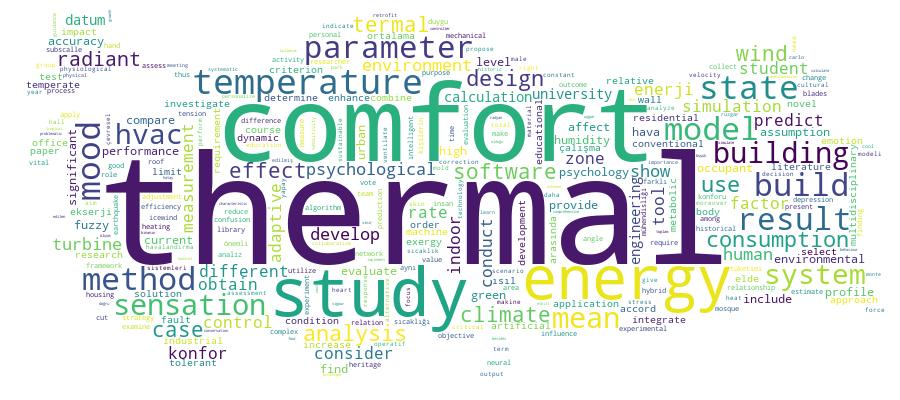
Competency Cloud

GCRIS Competency Cloud

Scholarly Output Search Results

Now showing 1 - 4 of 4
  • Article
    Citation - WoS: 16
    Citation - Scopus: 18
    A Comprehensive Comparison and Accuracy of Different Methods To Obtain Mean Radiant Temperature in Indoor Environment
    (Elsevier, 2022) Ozbey, Mehmet Furkan; Turhan, Cihan
    Thermal comfort is defined as "the state of mind which expresses satisfaction with the thermal environment" by the American Society of Heating, Refrigerating and Air Conditioning Engineers in the standard of the ASHRAE55. Thermal comfort is affected by six main parameters which are split into two categories; personal (basic clothing insulation value and metabolic rate) and environmental (air temperature, relative humidity, air velocity, and mean radiant temperature) parameters. The mean radiant temperature is a problematic parameter in thermal comfort studies due to its complexity. The mean radiant temperature approaches are based on different techniques such as calculation methods, measurement methods, and assumptions. Although the assumptions are utilized by researchers to abstain complexity, their accuracies are uncertain. To this aim, this study purposes to find the accuracies of calculation and assumption methods by comparing with reference measurement method. An office building in a temperate climate zone is selected as a case study. Two calculation methods and eight assumptions on obtaining mean radiant temperature are compared via in-situ measurements. The results revealed that using assumptions or calculation methods to obtain the mean radiant temperature caused a significant error compared to the reference method and researchers should consider accuracies of these methods before utilizing them in their applications.
  • Conference Object
    Citation - Scopus: 1
    Comfort Based Investigation on Historic Libraries for User Satisfaction and Preservation of Paper-Based Collections
    (IOP Publishing Ltd, 2021) Turhan,C.; Topan,C.; Durmus Arsan,Z.; Goksal Ozbalta,T.; Gok en Akkurt,G.
    Historic libraries preserve cultural heritage values while housing rare manuscripts and paper-based collections. The collections in the libraries are deteriorated chemically, biologically and mechanically due to inappropriate indoor environment conditions such as temperature and relative humidity fluctuations and microbiological conditions. Apart from preserving vulnerable paper-based collections, accommodating of a considerable thermal comfort level for visitors is essential in historic libraries. The aim of this study is to analyse indoor environment of a historic library in terms of thermal comfort and preventive conservation of paper-based collections. Izmir National Library, built in 1933, is selected as a case study. Indoor air temperature, relative humidity and air velocity in the library were monitored with a one-year measurement campaign. Meanwhile, thermal comfort of the visitors was assessed with PMV/PPD indices and thermal sensation surveys. The results show that high chemical degradation risk is detected in the library while biological and mechanical degradations are in the low risk zone. On the other hand, 87% and 93% of the visitors feel thermally satisfied in heating and cooling seasons, respectively. © Published under licence by IOP Publishing Ltd.
  • Article
    Citation - WoS: 7
    Citation - Scopus: 6
    The Importance of the Calculation of Angle Factors To Determine the Mean Radiant Temperature in Temperate Climate Zone: a University Office Building Case
    (Sage Publications Ltd, 2022) Ozbey, Mehmet Furkan; Turhan, Cihan
    Thermal comfort depends on four environmental (air velocity, relative humidity, air temperature, mean radiant temperature) and two personal (clothing insulation and metabolic rate) parameters. Among all parameters, the mean radiant temperature (t(r)) is the most problematic variable in thermal comfort studies due to its complexity. Measurement methods, calculation methods and assumptions are mostly used to obtain the t(r). Researchers mainly prefer to obtain the t(r) via measurement methods or assumptions due to their easiness compared to the calculation methods. Besides, some researchers use constant values of angle factors in calculation methods. However, using constant values is not proper for every indoor environment, and it causes wrong estimations in the t(r) and thus the thermal comfort. This paper gives the importance of calculation of angle factors, with an example of a university office building in temperate climate zone, according to the ISO 7726. The angle factors of the room were calculated for a seated occupant from the centre of gravity in three different locations and compared with the constant angle factors. The results indicate that a significant difference (MAPE of 1.02) was found in the t(r) values, which were obtained by calculation of constant values of angle factors.
  • Article
    Citation - WoS: 15
    Citation - Scopus: 11
    The Relation Between Thermal Comfort and Human-Body Exergy Consumption in a Temperate Climate Zone
    (Elsevier Science Sa, 2019) Turhan, Cihan; Akkurt, Gulden Gokcen
    Human body exergy balance calculation method gives minimum human body exergy consumption rates at thermal neutrality (TSV = 0) providing more information on human thermal responses than other methods. The literature is lacking the verification of this method in various climatic zones. The aim of this study is to investigate the relationship between thermal comfort and human body exergy consumption in a temperate climate zone. A small office building in Izmir Institute of Technology campus, Izmir/Turkey, was chosen as a case building and equipped with measurement devices. The occupant was subjected to a survey via a mobile application to obtain his Thermal Sensation Votes. Objective data were collected via sensors and used for predicting occupant thermal comfort and for exergy balance calculations. Under given conditions, the results show that Thermal Sensation Votes are generally zero at a T-i range of 21-23 degrees C and, are mostly lower than Predicted Mean Votes in summer while the opposite is observed in winter. Predicted Mean Votes at minimum Human Body Exergy Consumption rates were on slightly warm side while Thermal Sensation Votes are zero. It means that for given case, the HBexC rate calculation gave a better prediction of the environmental parameters for the best thermal comfort. (C) 2019 Elsevier B.V. All rights reserved.