Qasrawı, Atef Fayez Hasan

Loading...
Profile Picture
Name Variants
Qasrawi, Atef Fayez
Atef Fayez Hasan, Qasrawı
Qasrawı,A.F.H.
Qasrawi,A.F.H.
Q., Atef Fayez Hasan
Q.,Atef Fayez Hasan
Atef Fayez Hasan, Qasrawi
Qasrawi, Atef Fayez Hasan
A.F.H.Qasrawı
A.F.H.Qasrawi
A., Qasrawi
A.,Qasrawı
Qasrawı, Atef Fayez Hasan
Qasrawi, A. F.
Qasrawi,A.F.
Qasrawi, AF
Qasrawi, Atef F.
Qasrawi, Atef A.
Qasrawi, Atef Fayez
Qasrawi, Atef F.
Qasrawi, Atef A.
Qasrawi, Atef
Job Title
Doçent Doktor
Email Address
atef.qasrawi@atilim.edu.tr
Main Affiliation
Department of Electrical & Electronics Engineering
Status
Former Staff
Website
ORCID ID
Scopus Author ID
Turkish CoHE Profile ID
Google Scholar ID
WoS Researcher ID

Sustainable Development Goals

2

ZERO HUNGER
ZERO HUNGER Logo

0

Research Products

11

SUSTAINABLE CITIES AND COMMUNITIES
SUSTAINABLE CITIES AND COMMUNITIES Logo

0

Research Products

14

LIFE BELOW WATER
LIFE BELOW WATER Logo

0

Research Products

6

CLEAN WATER AND SANITATION
CLEAN WATER AND SANITATION Logo

0

Research Products

1

NO POVERTY
NO POVERTY Logo

0

Research Products

5

GENDER EQUALITY
GENDER EQUALITY Logo

0

Research Products

9

INDUSTRY, INNOVATION AND INFRASTRUCTURE
INDUSTRY, INNOVATION AND INFRASTRUCTURE Logo

0

Research Products

16

PEACE, JUSTICE AND STRONG INSTITUTIONS
PEACE, JUSTICE AND STRONG INSTITUTIONS Logo

1

Research Products

17

PARTNERSHIPS FOR THE GOALS
PARTNERSHIPS FOR THE GOALS Logo

0

Research Products

15

LIFE ON LAND
LIFE ON LAND Logo

0

Research Products

10

REDUCED INEQUALITIES
REDUCED INEQUALITIES Logo

0

Research Products

7

AFFORDABLE AND CLEAN ENERGY
AFFORDABLE AND CLEAN ENERGY Logo

17

Research Products

8

DECENT WORK AND ECONOMIC GROWTH
DECENT WORK AND ECONOMIC GROWTH Logo

0

Research Products

4

QUALITY EDUCATION
QUALITY EDUCATION Logo

0

Research Products

12

RESPONSIBLE CONSUMPTION AND PRODUCTION
RESPONSIBLE CONSUMPTION AND PRODUCTION Logo

0

Research Products

3

GOOD HEALTH AND WELL-BEING
GOOD HEALTH AND WELL-BEING Logo

0

Research Products

13

CLIMATE ACTION
CLIMATE ACTION Logo

0

Research Products
This researcher does not have a Scopus ID.
This researcher does not have a WoS ID.
Scholarly Output

222

Articles

218

Views / Downloads

642/0

Supervised MSc Theses

0

Supervised PhD Theses

0

WoS Citation Count

1887

Scopus Citation Count

1907

WoS h-index

21

Scopus h-index

21

Patents

0

Projects

0

WoS Citations per Publication

8.50

Scopus Citations per Publication

8.59

Open Access Source

17

Supervised Theses

0

Google Analytics Visitor Traffic

JournalCount
Journal of Electronic Materials15
Crystal Research and Technology13
physica status solidi (a)12
Journal of Alloys and Compounds11
Materials Science in Semiconductor Processing11
Current Page: 1 / 11

Scopus Quartile Distribution

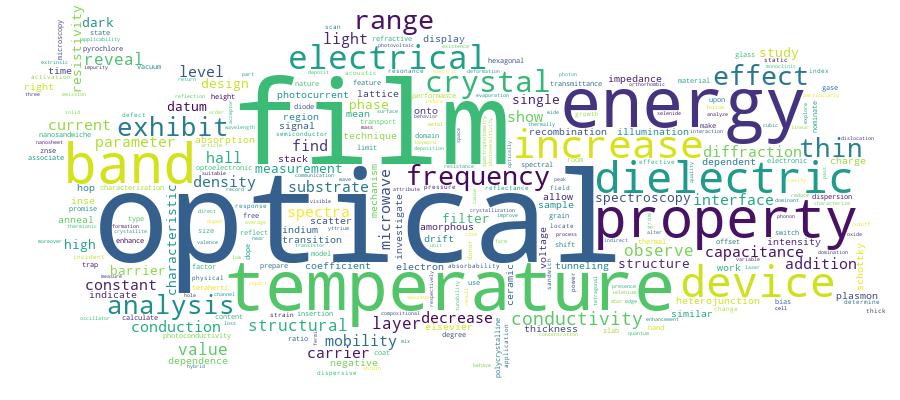
Competency Cloud

GCRIS Competency Cloud

Scholarly Output Search Results

Now showing 1 - 4 of 4
  • Article
    Citation - WoS: 6
    Citation - Scopus: 6
    Dielectric Dispersion at the Mn/Znpc Interfaces
    (Wiley-v C H verlag Gmbh, 2020) Qasrawi, Atef F.; Zyoud, Hadeel M.
    Herein, the effects of manganese transparent (150 nm) substrates on the structural, nonlinear optical, and dielectric properties of zinc phthalocyanine are explored. ZnPc thin films are observed to exhibit deformed crystal structure associated with remarkable enhancement in the light absorbability by 21 times at 2.62 eV and by 173 times in the near-infrared (NIR) region of light upon replacement of glass by transparent Mn substrates. The Mn layer also causes a redshift in the energy bandgap, allows generation of free carrier absorption process and increases the dielectric constant by more than 169% in the NIR region. The interaction between the manganese substrates with the organic ZnPc thin layers decreases the free holes density, widens the plasmon frequency range, and improves the drift mobility of holes. The nonlinear dielectric response with the highly improved light absorbability in the NIR range of light nominates the Mn/ZnPc thin films for optoelectronic applications.
  • Article
    Citation - WoS: 3
    Citation - Scopus: 3
    Ytterbium Induced Structural Phase Transitions and Their Effects on the Optical and Electrical Properties of Znpc Thin Films
    (Springer, 2020) Qasrawi, A. F.; Zyoud, Hadeel M.
    In this work, the effects of ytterbium substrates of thicknesses of 150 (Yb-150) and 1000 nm (Yb-1000) on the structural, optical and electrical properties of zinc phthalocyanine (ZnPc) are investigated. While the Yb-150/ZnPc exhibited strained monoclinic structure, the Yb-1000/ZnPc thin films are observed to exhibit phase transitions from monoclinic to triclinic structure. Analysis which targeted observatories of the effects of the Yb-150 substrate on the optical properties indicated that the transparent Yb-150 substrate enhanced the light absorbability by more than 11 times at 1.27 eV. On the other hand, the impedance spectroscopy measurements on the nontransparent Yb-1000/ZnPc/Ag sandwiched structures have shown that these devices could exhibit negative capacitance (NC) effect in the frequency domain of 0.244-1.800 GHz. The NC effect is associated with resonance-anti-resonance response at 0.235 and 0.244 GHz, respectively. The structural, optical and electrical properties of the Yb/ZnPc interfaces indicate its applicability as optoelectronic and/or radio/microwave components.
  • Article
    Citation - WoS: 5
    Citation - Scopus: 4
    Thickness and Annealing Effects on the Structural and Optical Conductivity Parameters of Zinc Phthalocyanine Thin Films
    (inst Materials Physics, 2020) Alharbi, S. R.; Qasrawi, A. F.; Khusayfan, N. M.; Department of Electrical & Electronics Engineering
    In this work, the effects of the thin film thicknesses on the structural, optical absorption, energy band gap, dielectric spectra and optical conductivity parameters of the Zinc phthalocyanine thin films are considered. Thin films of ZnPc of thicknesses of 50-600 nm which are coated onto glass substrates are observed to exhibit amorphous nature of growth. The polycrystalline monoclinic ZnPc phase of the films is obtained via annealing the films at 200 degrees C in a vacuum atmosphere. Increasing the ZnPc films thickness shrunk the energy band gap in the B- and Q- bands and decreased both of the optical conductivities and free holes density in the Q-band. The increase in the film thickness is also observed to decrease the plasmon frequency and the drift mobility of holes in the films. The highest dielectric constant is obtained for films of thicknesses of 100 nm. The annealing process enhanced the optical absorption, redshifts the energy band gap value and the critical energy of the absolute maxima of dielectric constant. In addition, while the heat treatment enhanced both of the scattering times at femtosecond level and the drift mobility, it reduced the free holes density, and the plasmon frequency.
  • Article
    Citation - WoS: 6
    Citation - Scopus: 6
    Fabrication of (au, Mn)/Znpc Interfaces as Radiowave/Microwave Band Filters
    (Wiley-v C H verlag Gmbh, 2020) Qasrawi, Atef Fayez; Zyoud, Hadeel Mohammad
    Herein, zinc phthalocyanine (ZnPc) layers are used as an active material to fabricated radiowave/microwave band filters. The thin layers of ZnPc are coated onto Au and Mn thin-film substrates to form ohmic and Schottky interfaces, respectively. The Au/ZnPc and Mn/ZnPc devices are structurally and electrically characterized by means of X-ray diffraction and impedance spectroscopy techniques in the frequency domain of 0.01-1.80 GHz, respectively. The structural investigations show that both interfaces exhibit strained structures of the monoclinic phase of ZnPc. It is also observed that while the Au/ZnPc/Ag devices display negative capacitance (NC) effects in the microwave region above 1.46 GHz, the Mn/ZnPc/Ag devices show resonance-antiresonance capacitive response in the radiowave region accompanied with NC effects in the range of 0.06-1.80 GHz. In addition, analyses of the reflection coefficient spectra have shown the ability of the (Mn, Au)/ZnPc/Ag interfaces to behave as a typical high-/low-bandpass filters. The filters can be operated in microwaves and radiowave ranges. The return loss spectral investigations on these filters have shown their ability to reach the market standards.