Işık, Mehmet

Loading...
Profile Picture
Name Variants
Mehmet, Işık
M.,Işık
Isik, Mehmet
Mehmet, Isik
I., Mehmet
I.,Mehmet
Işık,M.
Isik,M.
I.,Mehmet
M.,Isik
Işık, Mehmet
M., Isik
Isik, M.
Job Title
Profesör Doktor
Email Address
mehmet.isik@atilim.edu.tr
Main Affiliation
Department of Electrical & Electronics Engineering
Status
Former Staff
Website
ORCID ID
Scopus Author ID
Turkish CoHE Profile ID
Google Scholar ID
WoS Researcher ID

Sustainable Development Goals

2

ZERO HUNGER
ZERO HUNGER Logo

0

Research Products

11

SUSTAINABLE CITIES AND COMMUNITIES
SUSTAINABLE CITIES AND COMMUNITIES Logo

0

Research Products

14

LIFE BELOW WATER
LIFE BELOW WATER Logo

1

Research Products

6

CLEAN WATER AND SANITATION
CLEAN WATER AND SANITATION Logo

0

Research Products

1

NO POVERTY
NO POVERTY Logo

0

Research Products

5

GENDER EQUALITY
GENDER EQUALITY Logo

0

Research Products

9

INDUSTRY, INNOVATION AND INFRASTRUCTURE
INDUSTRY, INNOVATION AND INFRASTRUCTURE Logo

0

Research Products

16

PEACE, JUSTICE AND STRONG INSTITUTIONS
PEACE, JUSTICE AND STRONG INSTITUTIONS Logo

0

Research Products

17

PARTNERSHIPS FOR THE GOALS
PARTNERSHIPS FOR THE GOALS Logo

0

Research Products

15

LIFE ON LAND
LIFE ON LAND Logo

1

Research Products

10

REDUCED INEQUALITIES
REDUCED INEQUALITIES Logo

0

Research Products

7

AFFORDABLE AND CLEAN ENERGY
AFFORDABLE AND CLEAN ENERGY Logo

11

Research Products

8

DECENT WORK AND ECONOMIC GROWTH
DECENT WORK AND ECONOMIC GROWTH Logo

0

Research Products

4

QUALITY EDUCATION
QUALITY EDUCATION Logo

0

Research Products

12

RESPONSIBLE CONSUMPTION AND PRODUCTION
RESPONSIBLE CONSUMPTION AND PRODUCTION Logo

0

Research Products

3

GOOD HEALTH AND WELL-BEING
GOOD HEALTH AND WELL-BEING Logo

1

Research Products

13

CLIMATE ACTION
CLIMATE ACTION Logo

0

Research Products
This researcher does not have a Scopus ID.
This researcher does not have a WoS ID.
Scholarly Output

173

Articles

169

Views / Downloads

442/794

Supervised MSc Theses

3

Supervised PhD Theses

0

WoS Citation Count

1806

Scopus Citation Count

1861

WoS h-index

20

Scopus h-index

20

Patents

0

Projects

0

WoS Citations per Publication

10.44

Scopus Citations per Publication

10.76

Open Access Source

11

Supervised Theses

3

Google Analytics Visitor Traffic

JournalCount
Optical Materials17
Physica B: Condensed Matter16
Journal of Luminescence15
Materials Science in Semiconductor Processing14
Journal of Materials Science: Materials in Electronics12
Current Page: 1 / 10

Scopus Quartile Distribution

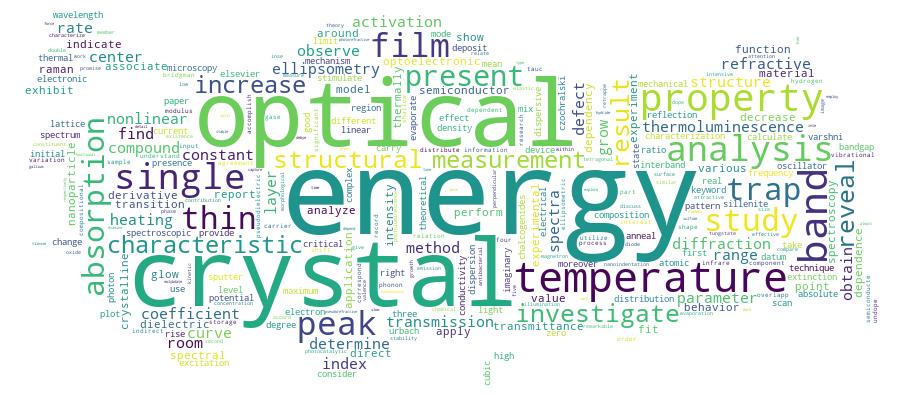
Competency Cloud

GCRIS Competency Cloud

Scholarly Output Search Results

Now showing 1 - 4 of 4
  • Article
    Citation - WoS: 1
    Citation - Scopus: 1
    Growth and Optical Properties of (na0.5bi0.5< (x=0.25) Single Crystal: a Potential Candidate for Optoelectronic Devices
    (Springer, 2024) Guler, I.; Isik, M.; Gasanly, N.
    Double tungstates (DT) and double molybdates (DM) have significant importance because of their optoelectronic applications. Regarding the importance of DT and DM, we investigated experimentally structural and optical properties of (Na0.5Bi0.5)(Mo1-xWx)O-4 (x = 0.25) crystal that belongs to the NaBi-DT and DM crystals group. Czochralski method was used to grow the single crystals. The structure of the crystal was identified using X-ray diffraction (XRD) measurements. Two sharp peaks associated with tetragonal crystal structure appeared in the pattern. Vibrational modes of the studied crystal were obtained from the Raman experiments. By the help of the Fourier transform infrared spectrophotometer (FTIR) measurements, infrared transmittance spectrum of the studied compound was recorded. Band gap energy wase found around 3.04 eV using two methods, Tauc and derivative analysis, based on transmission spectrum. Based on the analysis of absorption coefficient, Urbach energy was obtained as 0.22 eV. The revealed structural and optical properties of the crystal indicated that the material may be a candidate for optoelectronic devices in which NaBi(MoO4)(2) and NaBi(WO4)(2) materials are utilized.
  • Article
    Citation - WoS: 2
    Citation - Scopus: 2
    Optical Characterization of Nabi(moo4)2< Crystal by Spectroscopic Ellipsometry
    (Springer Heidelberg, 2024) Guler, I.; Isik, M.; Gasanly, N. M.
    The compound NaBi(MoO4)(2) has garnered significant interest in optoelectronic fields. This study employs spectroscopic ellipsometry to thoroughly examine the linear and nonlinear optical characteristics of NaBi(MoO4)(2) crystals, offering detailed insights into their optical behavior. Our investigation presents a precise method for discerning the crystal's spectral features, revealing the spectral variations of key optical parameters such as refractive index, extinction coefficient, dielectric function, and absorption coefficient within the 1.2-5.0 eV range. Through analysis, we determined optical attributes including bandgap energy, critical point energy, and single oscillator parameters. Additionally, we explored the nonlinear optical properties of NaBi(MoO4)(2), unveiling potential applications such as optoelectronic devices, frequency conversion, and optical sensors. This study enhances comprehension of optical properties of NaBi(MoO4)(2), underscoring its significance in future optical and electronic advancements.
  • Article
    Citation - WoS: 7
    Citation - Scopus: 7
    Temperature dependent bandgap in NaBi(WO4)2 single crystals
    (Elsevier Gmbh, 2022) Isik, M.; Gasanly, N. M.; Darvishov, N. H.; Bagiev, V. E.
    The double tungstates have been an attractive research interest due to their optoelectronic applications. In the present work, NaBi(WO4)(2), one of the members of double tungstates family, was grown by Czochralski method as single crystal form and optically investigated. X-ray diffraction pattern presented three peaks associated with tetragonal scheelite crystalline structure. Optical properties of the crystal were studied by performing temperature-dependent transmission measurements between 10 and 300 K. The shift of the absorption edge to higher energies was observed with decrease of temperature. The analyses indicated that direct band gap energy increases from 3.50 to 3.60 eV when the temperature was decreased from room temperature to 10 K. The temperature dependency of bandgap was studied considering the Varshni model and fitting of the experimental data under the light of model presented the optical parameters of band gap energy at 0 K, rate of band gap change with temperature and Debye temperature as E-g(0) = 3.61 eV, gamma = 8.83 x 10(-4) eV/K and beta = 456 K, respectively. Urbach energies were also determined from the analyses as 122 and 113 meV for 10 and 300 K experimental data, respectively.
  • Article
    Citation - WoS: 3
    Citation - Scopus: 2
    Characterization of Linear and Nonlinear Optical Properties of Nabi(wo4)2 Crystal by Spectroscopic Ellipsometry
    (Elsevier, 2024) Isik, M.; Işık, Mehmet; Guler, I.; Gasanly, N. M.; Işık, Mehmet; Department of Electrical & Electronics Engineering; Department of Electrical & Electronics Engineering
    NaBi(WO4)2 compound has been a material of considerable attention in optoelectronic applications. The present research, in which we examined the linear and nonlinear optical properties of NaBi(WO4)2 crystal using the spectroscopic ellipsometry method, elucidates the optical behavior of the crystal in detail. Our work provides a sensitive approach to determine the spectral characteristic of the crystal. The spectral dependence of various optical parameters such as refractive index, extinction coefficient, dielectric function and absorption coefficient was reported in the range of 1.2-5.0 eV. Optical values such as bandgap energy, critical point energy, single oscillator parameters were obtained as a result of the analyses. In addition to linear optical properties, we also investigated the nonlinear optical behavior of NaBi(WO4)2 and shed new light on the potential applications of the crystal. Absorbance and photoluminescence spectra of the crystal were also reported to characterize optical, electronic and emission behavior of the compound. Our findings may form the basis for a number of technological applications such as optoelectronic devices, frequency conversion, and optical sensors. This research contributes to a better understanding of the optical properties of NaBi(WO4)2 crystal, highlighting the material's role in future optical and electronic technologies.