
Işık, Mehmet
Loading...

Profile URL
Name Variants
Mehmet, Işık
M.,Işık
Isik, Mehmet
Mehmet, Isik
I., Mehmet
I.,Mehmet
Işık,M.
Isik,M.
I.,Mehmet
M.,Isik
Işık, Mehmet
M., Isik
Isik, M.
M.,Işık
Isik, Mehmet
Mehmet, Isik
I., Mehmet
I.,Mehmet
Işık,M.
Isik,M.
I.,Mehmet
M.,Isik
Işık, Mehmet
M., Isik
Isik, M.
Job Title
Profesör Doktor
Email Address
mehmet.isik@atilim.edu.tr
Main Affiliation
Department of Electrical & Electronics Engineering
Status
Former Staff
Website
ORCID ID
Scopus Author ID
Turkish CoHE Profile ID
Google Scholar ID
WoS Researcher ID
Sustainable Development Goals
2
ZERO HUNGER

0
Research Products
11
SUSTAINABLE CITIES AND COMMUNITIES

0
Research Products
14
LIFE BELOW WATER

1
Research Products
6
CLEAN WATER AND SANITATION

0
Research Products
1
NO POVERTY

0
Research Products
5
GENDER EQUALITY

0
Research Products
9
INDUSTRY, INNOVATION AND INFRASTRUCTURE

0
Research Products
16
PEACE, JUSTICE AND STRONG INSTITUTIONS

0
Research Products
17
PARTNERSHIPS FOR THE GOALS

0
Research Products
15
LIFE ON LAND

1
Research Products
10
REDUCED INEQUALITIES

0
Research Products
7
AFFORDABLE AND CLEAN ENERGY

11
Research Products
8
DECENT WORK AND ECONOMIC GROWTH

0
Research Products
4
QUALITY EDUCATION

0
Research Products
12
RESPONSIBLE CONSUMPTION AND PRODUCTION

0
Research Products
3
GOOD HEALTH AND WELL-BEING

1
Research Products
13
CLIMATE ACTION

0
Research Products

This researcher does not have a Scopus ID.

This researcher does not have a WoS ID.

Scholarly Output
173
Articles
169
Views / Downloads
442/798
Supervised MSc Theses
3
Supervised PhD Theses
0
WoS Citation Count
1810
Scopus Citation Count
1870
WoS h-index
20
Scopus h-index
20
Patents
0
Projects
0
WoS Citations per Publication
10.46
Scopus Citations per Publication
10.81
Open Access Source
11
Supervised Theses
3
Google Analytics Visitor Traffic
| Journal | Count |
|---|---|
| Optical Materials | 17 |
| Physica B: Condensed Matter | 16 |
| Journal of Luminescence | 15 |
| Materials Science in Semiconductor Processing | 14 |
| Journal of Materials Science: Materials in Electronics | 12 |
Current Page: 1 / 10
Scopus Quartile Distribution
Competency Cloud
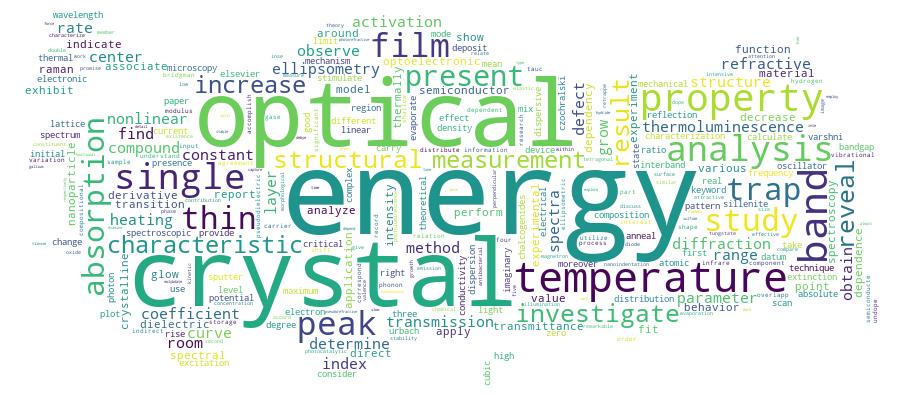
53 results
Scholarly Output Search Results
Now showing 1 - 10 of 53
Article Citation - WoS: 1Citation - Scopus: 1Growth and Optical Properties of (na0.5bi0.5< (x=0.25) Single Crystal: a Potential Candidate for Optoelectronic Devices(Springer, 2024) Guler, I.; Isik, M.; Gasanly, N.Double tungstates (DT) and double molybdates (DM) have significant importance because of their optoelectronic applications. Regarding the importance of DT and DM, we investigated experimentally structural and optical properties of (Na0.5Bi0.5)(Mo1-xWx)O-4 (x = 0.25) crystal that belongs to the NaBi-DT and DM crystals group. Czochralski method was used to grow the single crystals. The structure of the crystal was identified using X-ray diffraction (XRD) measurements. Two sharp peaks associated with tetragonal crystal structure appeared in the pattern. Vibrational modes of the studied crystal were obtained from the Raman experiments. By the help of the Fourier transform infrared spectrophotometer (FTIR) measurements, infrared transmittance spectrum of the studied compound was recorded. Band gap energy wase found around 3.04 eV using two methods, Tauc and derivative analysis, based on transmission spectrum. Based on the analysis of absorption coefficient, Urbach energy was obtained as 0.22 eV. The revealed structural and optical properties of the crystal indicated that the material may be a candidate for optoelectronic devices in which NaBi(MoO4)(2) and NaBi(WO4)(2) materials are utilized.Article Citation - WoS: 13Citation - Scopus: 14Linear and Nonlinear Optical Properties of Bi12geo20 Single Crystal for Optoelectronic Applications(Elsevier Sci Ltd, 2023) Isik, M.; Gasanly, N. M.The present paper aims at presenting linear and nonlinear optical properties of Bi12GeO20 single crystals grown by Czochralski method. Transmission and reflection measurements were performed in the 400-1000 nm region. The recorded spectra were analyzed considering well-known optical models. Spectral dependencies of absorption coefficient, skin depth, refractive index, real and imaginary components of dielectric function were presented. The analyses performed on absorption coefficient showed direct bandgap and Urbach energies as 2.56 and 0.22 eV, respectively. The first-and third-order nonlinear susceptibilities and nonlinear refractive index of the crystal were also reported in the present work. The results of the present paper would provide valuable information for optoelectronic device applications of Bi12GeO20.Article Citation - WoS: 23Citation - Scopus: 25Investigation of Optical Properties of Bi12geo20< Sillenite Crystals by Spectroscopic Ellipsometry and Raman Spectroscopy(Elsevier Sci Ltd, 2020) Isik, M.; Delice, S.; Gasanly, N. M.; Darvishov, N. H.; Bagiev, V. E.Bi12GeO20 (BGO) compound is one of the fascinating members of sillenites group due to its outstanding photorefractive and photocatalytic characteristics. The present paper aims at investigating optical properties of BGO crystals by means of spectroscopic ellipsometry and Raman spectroscopy measurements. Bi12GeO20 single crystals grown by Czochralski method were structurally characterized by X-ray diffraction (XRD) experiments and the analyses showed that studied crystals have cubic crystalline structure. Raman spectrum exhibited 15 peaks associated with A, E and F modes. Spectroscopic ellipsometry measurement data achieved in the energy region between 1.2 and 6.2 eV were used in the air/sample optical model to get knowledge about complex pseudodielectric constant, pseudorefractive index, pseudoextinction and absorption coefficients of the crystals. Spectral change of real and imaginary part of complex pseudodielectric constant were discussed in detail. Band gap energy of Bi12GeO20 single crystals was calculated to be 3.18 eV using absorption coefficient dependency on photon energy. Critical point energies at which photons are strongly absorbed were determined by utilizing the second energy derivative spectra of components of complex pseudodielectric function. Fitting of both spectra resulted in the presence of four interband transitions with energies of 3.49, 4.11, 4.67 and 5.51 eV.Article Citation - WoS: 3Citation - Scopus: 4Optical Properties of Cu3in5< Single Crystals by Spectroscopic Ellipsometry(Elsevier Gmbh, 2018) Isik, M.; Nasser, H.; Ahmedova, F.; Guseinov, A.; Gasanly, N. M.Cu3In5S9 single crystals were investigated by structural methods of x-ray diffraction and energy dispersive spectroscopy and optical techniques of ellipsometry and reflection carried out at room temperature. The spectral dependencies of optical constants; dielectric function, refractive index and extinction coefficient, were plotted in the range of 1.2-6.2 eV from ellipsometric data. The spectra of optical constants obtained from ellipsometry analyses and reflectance spectra presented a sharp change around 1.55 and 1.50 eV, respectively, which are associated with band gap energy of the crystal. The critical point (interband transition) energies were also found from the analyses of second-energy derivative of real and imaginary components of dielectric function. The analyses indicated the presence of four critical points at 2.73, 135, 4.04 and 4.98 eV.Article Citation - WoS: 9Citation - Scopus: 11Spectroscopic Ellipsometry Investigation of Optical Properties of Β-ga2s3< Single Crystals(Elsevier Science Bv, 2018) Isik, M.; Gasanly, N. M.; Gasanova, L.Ga2S3 single crystals were studied by x-ray diffraction (XRD), energy dispersive spectroscopy and spectroscopic ellipsometry measurements. XRD pattern of the sample is well-matched with reported hexagonal structure of beta-Ga2S3 . The spectra of real and imaginary parts of complex dielectric function (epsilon = epsilon(1) + epsilon(2)) and refractive index (N = n + ik) were plotted in the 1.2-6.2 eV range according to results of ellipsometric data. The e 2 -spectrum and analyses of absorption coefficient pointed out that studied sample has band gap energy of 2.48 eV which is consistent with that of beta-Ga(2)S(3)2. Critical point energies of beta-Ga2S3 were also reported in the present study.Article Citation - WoS: 10Citation - Scopus: 9Structural and temperature-tuned band gap energy characteristics of PbMoO4 single crystals(Elsevier, 2022) Isik, M.; Gasanly, N. M.; Darvishov, N. H.; Bagiev, V. E.PbMoO4 is one of the member of the molybdate materials and has been a significant research interest due to its photocatalytic and optoelectronic applications. In the present paper, the structural and optical properties of PbMoO4 single crystals grown by Czochralski technique were investigated. X-ray diffraction pattern presented well-defined and intensive peaks associated with tetragonal scheelite structure. Energy dispersive spectroscopy analyses presented the atomic compositional ratio of constituent elements as consistent with chemical formula of PbMoO4. Raman and infrared transmittance spectra were reported to give information about the vibrational characteristics of the compound. Room temperature transmission spectrum was analyzed by derivative spectroscopy technique and band gap energy was found as 3.07 eV. Temperature-tuned band gap energy characteristics of the single crystal were investigated by performing transmission measurements at different temperatures between 10 and 300 K. The analyses indicated that band gap energy of the PbMoO4 single crystal increases to 3.24 eV when the temperature was decreased to 10 K. Temperature-band gap energy dependency was studied considering Varshni and Bose-Einstein models. The successful fitting processes under the light of applied models presented various optical parameters like absolute zero band gap energy, variation rate of band gap with temperature and Debye temperature.Article Citation - WoS: 3Citation - Scopus: 6Structural and Optical Properties of Thermally Evaporated Cu-Ga (cgs) Thin Films(Elsevier, 2018) Gullu, H. H.; Isik, M.; Gasanly, N. M.The structural and optical properties of thermally evaporated Cu-Ga-S (CGS) thin films were investigated by Xray diffraction (XRD), energy dispersive X-ray spectroscopy (EDS), atomic force microscopy (AFM) and optical transmittance measurements. The effect of annealing temperature on the results of applied techniques was also studied in the present paper. EDS results revealed that each of the elements, Cu, Ga and S are presented in the films and Cu and Ga concentration increases whereas S concentration decreases within the films as annealing temperature is increased. XRD pattern exhibited four diffraction peaks which are well-matched with those of tetragonal CuGaS2 compound. AFM images were recorded to get knowledge about the surface morphology and roughness of deposited thin films. Transmittance measurements were applied in the wavelength region of 300-1000 nm. Analyses of the absorption coefficient derived from transmittance data resulted in presence of three distinct transition regions in each thin films with direct transition type. Crystal-field and spin-orbit splitting energies existing due to valence band splitting were also calculated using quasicubic model.Article Citation - WoS: 22Citation - Scopus: 24Synthesis and Temperature-Tuned Band Gap Characteristics of Magnetron Sputtered Znte Thin Films(Elsevier, 2020) Isik, M.; Gullu, H. H.; Parlak, M.; Gasanly, N. M.Zinc telluride (ZnTe) is one of the attractive semiconducting compounds used in various optoelectronic devices. The usage of ZnTe in optoelectronic applications directs researchers to search its optical characteristics in great detail. For this purpose, structural and optical properties of magnetron sputtered ZnTe thin films were studied by means of x-ray diffraction and transmission spectroscopy measurements. Structural analyses indicated that ZnTe thin films having cubic crystalline structure were successfully grown on soda-lime glass substrates. Transmittance spectra in the 400-1000 nm were recorded in between 10 and 300 K temperature region. The analyses of absorption coefficient spectra resulted in band gap energies decreasing from around 2.31 (10 K) to 2.26 eV (300 K). Temperature dependency of gap energy was studied by Varshni and O'Donnell-Chen relations to determine various optical parameters like absolute zero temperature band gap energy, change of gap energy with temperature, phonon energy.Article Citation - WoS: 6Citation - Scopus: 6Sns2 and Ho-Doped Sns2 Thin Films: Synergistic, Dft, Photocatalytic, and Antibacterial Studies(Elsevier Sci Ltd, 2024) Radja, Imane; Khane, Yasmina; Oliveira, Marisa C.; Longo, Elson; Ribeiro, Renan A. P.; Isik, Mehmit; Khan, Mohammad MansoobThis study investigates Ho-doped tin disulfide (Ho-SnS2) thin films prepared via spray coating, focusing on varying Ho doping levels (0 at. %, 2 at. %, and 4 at. %). Structural analysis through XRD and SEM showcased enhanced crystallinity and morphology in Ho-SnS2 films. Raman and XPS studies provided insight into the film's composition and chemical states. The antibacterial properties of the films were investigated using a bacterial growth inhibition assay. The results showed significant antibacterial activity against Gram-positive and Gram-negative bacteria, highlighting the potential applications of Ho-SnS2 thin films in antibacterial coatings. Ho-SnS2 films exhibited superior photocatalytic activity and antibacterial properties compared to SnS2 films, attributed to efficient charge separation. DFT analysis proposed a mechanism for the antibacterial activity. These findings highlight the efficacy of the spray coating technique in producing Ho-SnS2 films and the potential of Ho-SnS2 films for diverse applications like photocatalysis and antibacterial coatings.Article Citation - WoS: 8Citation - Scopus: 9Electronic, Optical and Thermodynamic Characteristics of Bi12sio20 Sillenite: First Principle Calculations(Elsevier Science Sa, 2021) Isik, M.; Surucu, G.; Gencer, A.; Gasanly, N. M.Bi12XO20 (X: Si, Ge, Ti) ternary semiconducting compounds are known as sillenites and take a remarkable attention thanks to their attractive photorefractive properties. The present paper reports electronic, optical and thermodynamic characteristics of Bi12SiO20 by means of density functional theory (DFT) calculations. The crystalline structure of the compound was revealed as cubic with lattice constant of 10.135 angstrom. XRD pattern obtained from DFT calculations were compared with experimental data and there is a good consistency between them. The electronic band structure and density of state plots were presented in detail. The band gap energy of the compound was determined from electronic band structure and spectra of optical constants. The spectral dependencies of real and imaginary components of dielectric function, refractive index, extinction coefficient, absorption coefficient and loss function were plotted in the 0-12 eV spectral range. The revealed structural, electronic and optical characteristics were discussed taking into account the previously reported theoretical and experimental studies on the Bi12SiO20 sillenite.
