Dalveren, Gonca Gökçe Menekşe

Loading...
Profile Picture
Name Variants
Gonca Gökçe Menekşe, Dalveren
Dalveren, Gonca Gokce Menekse
G., Dalveren
G.,Dalveren
D.,Gonca Gökçe Menekşe
Gonca Gokce Menekse, Dalveren
Dalveren, Gonca Gökçe Menekşe
G.G.M.Dalveren
D.,Gonca Gokce Menekse
D., Gonca Gokce Menekse
Dalveren,G.G.M.
Job Title
Doktor Öğretim Üyesi
Email Address
gonca.menekse@atilim.edu.tr
Main Affiliation
Information Systems Engineering
Status
Former Staff
Website
ORCID ID
Scopus Author ID
Turkish CoHE Profile ID
Google Scholar ID
WoS Researcher ID

Sustainable Development Goals

NO POVERTY1
NO POVERTY
0
Research Products
ZERO HUNGER2
ZERO HUNGER
0
Research Products
GOOD HEALTH AND WELL-BEING3
GOOD HEALTH AND WELL-BEING
0
Research Products
QUALITY EDUCATION4
QUALITY EDUCATION
5
Research Products
GENDER EQUALITY5
GENDER EQUALITY
0
Research Products
CLEAN WATER AND SANITATION6
CLEAN WATER AND SANITATION
0
Research Products
AFFORDABLE AND CLEAN ENERGY7
AFFORDABLE AND CLEAN ENERGY
1
Research Products
DECENT WORK AND ECONOMIC GROWTH8
DECENT WORK AND ECONOMIC GROWTH
0
Research Products
INDUSTRY, INNOVATION AND INFRASTRUCTURE9
INDUSTRY, INNOVATION AND INFRASTRUCTURE
1
Research Products
REDUCED INEQUALITIES10
REDUCED INEQUALITIES
0
Research Products
SUSTAINABLE CITIES AND COMMUNITIES11
SUSTAINABLE CITIES AND COMMUNITIES
0
Research Products
RESPONSIBLE CONSUMPTION AND PRODUCTION12
RESPONSIBLE CONSUMPTION AND PRODUCTION
1
Research Products
CLIMATE ACTION13
CLIMATE ACTION
0
Research Products
LIFE BELOW WATER14
LIFE BELOW WATER
0
Research Products
LIFE ON LAND15
LIFE ON LAND
0
Research Products
PEACE, JUSTICE AND STRONG INSTITUTIONS16
PEACE, JUSTICE AND STRONG INSTITUTIONS
3
Research Products
PARTNERSHIPS FOR THE GOALS17
PARTNERSHIPS FOR THE GOALS
0
Research Products
This researcher does not have a Scopus ID.
This researcher does not have a WoS ID.
Scholarly Output

29

Articles

19

Views / Downloads

133/992

Supervised MSc Theses

3

Supervised PhD Theses

1

WoS Citation Count

217

Scopus Citation Count

303

Patents

0

Projects

0

WoS Citations per Publication

7.48

Scopus Citations per Publication

10.45

Open Access Source

15

Supervised Theses

4

JournalCount
IEEE Access5
Sustainability2
2018 International Symposium on Networks, Computers and Communications, ISNCC 2018 -- 2018 International Symposium on Networks, Computers and Communications, ISNCC 2018 -- 19 June 2018 through 21 June 2018 -- Rome -- 1424272
Journal of Eye Movement Research2
Avrupa Bilim ve Teknoloji Dergisi1
Current Page: 1 / 4

Scopus Quartile Distribution

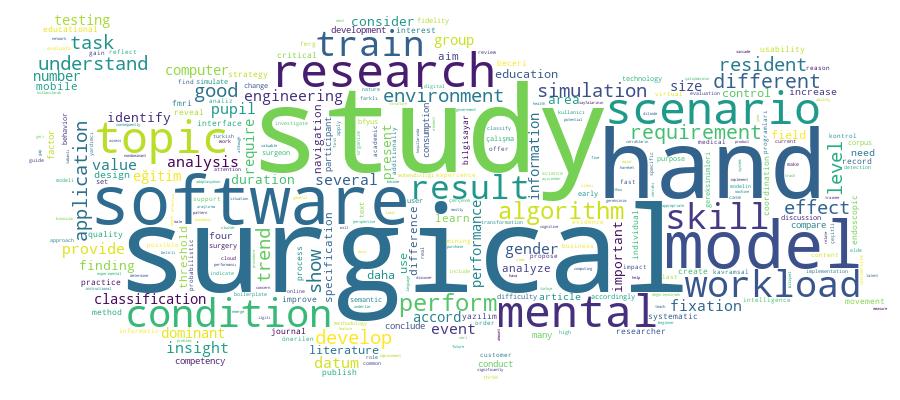
Competency Cloud

GCRIS Competency Cloud

Scholarly Output Search Results

Now showing 1 - 3 of 3
  • Conference Object
    Citation - WoS: 6
    Simulation-Based Environments for Surgical Practice
    (Ieee, 2017) Dalveren, Gonca Gokce Menekse; Cagiltay, Nergiz Ercil; Ozcelik, Erol; Maras, Hakan
    Modeling and simulation environments provide several insights about the real situations such as endoscopic surgery. Endoscopic surgery requires both hand skills, so, understanding the effect of using dominant or non dominant hand on mental workload is important to better design, develop and implement modeling and simulation environments to support real-life implementations of surgical procedures. This experimental study presents a simulation application of eye-tracking approach to understand mental workload in different hand conditions: dominant hand, non-dominant hand and both hand. The results of the study show that, performing simulated surgical tasks by both hands compared to dominant hand, increases mental workload which is evident by higher pupil size. Accordingly, to manage the mental-load problems of surgeons while performing complex tasks that require both hand usage simulation-based environments can be used. Consequently, collection of detailed information such as eye-data, can give several insights about the behaviors of the surgeons. Also, their required skills can be improved by development of simulation and training environments.
  • Article
    Citation - WoS: 9
    Citation - Scopus: 7
    The Underlying Reasons of the Navigation Control Effect on Performance in a Virtual Reality Endoscopic Surgery Training Simulator
    (Taylor & Francis inc, 2019) Cagiltay, Nergiz Ercil; Ozcelik, Erol; Berker, Mustafa; Dalveren, Gonca Gokce Menekse; Menekse Dalveren, Gonca Gokce
    Navigation control skills of surgeons become very critical for surgical procedures. Strategies improving these skills are important for developing higher-quality surgical training programs. In this study, the underlying reasons of the navigation control effect on performance in a virtual reality-based navigation environment are evaluated. The participants' performance is measured in conditions: navigation control display and paper-map display. Performance measures were collected from 45 beginners and experienced residents. The results suggest that navigation display significantly improved performance of the participants. Also, navigation was more beneficial for beginners than experienced participants. The underlying reason of the better performance in the navigation condition was due to lower number of looks to the map, which causes attention shifts between information sources. Accordingly, specific training scenarios and user interfaces can be developed to improve the navigation skills of the beginners considering some strategies to lower their number of references to the information sources.
  • Article
    Citation - WoS: 23
    Citation - Scopus: 27
    Insights From Pupil Size To Mental Workload of Surgical Residents: Feasibility of an Educational Computer-Based Surgical Simulation Environment (ece) Considering the Hand Condition
    (Sage Publications inc, 2018) Dalveren, Gonca Gokce Menekse; Cagiltay, Nergiz Ercil; Ozcelik, Erol; Maras, Hakan; Menekse Dalveren, Gonca Gokce
    The advantage of simulation environments is that they present various insights into real situations, where experimental research opportunities are very limited-for example, in endoscopic surgery. These operations require simultaneous use of both hands. For this reason, surgical residents need to develop several motor skills, such as eye-hand coordination and left-right hand coordination. While performing these tasks, the hand condition (dominant, nondominant, both hands) creates different degrees of mental workload, which can be assessed through mental physiological measures-namely, pupil size. Studies show that pupil size grows in direct proportion to mental workload. However, in the literature, there are very limited studies exploring this workload through the pupil sizes of the surgical residents under different hand conditions. Therefore, in this study, we present a computer-based simulation of a surgical task using eye-tracking technology to better understand the influence of the hand condition on the performance of skill-based surgical tasks in a computer-based simulated environment. The results show that under the both-hand condition, the pupil size of the surgical residents is larger than the one under the dominant and nondominant hand conditions. This indicates that when the computer-simulated surgical task is performed with both hands, it is considered more difficult than in the dominant and nondominant hand conditions. In conclusion, this study shows that pupil size measurements are sufficiently feasible to estimate the mental workload of the participants while performing surgical tasks. The results of this study can be used as a guide by instructional system designers of skill-based training programs.