Dalveren, Gonca Gökçe Menekşe

Loading...
Profile Picture
Name Variants
Gonca Gökçe Menekşe, Dalveren
Dalveren, Gonca Gokce Menekse
G., Dalveren
G.,Dalveren
D.,Gonca Gökçe Menekşe
Gonca Gokce Menekse, Dalveren
Dalveren, Gonca Gökçe Menekşe
G.G.M.Dalveren
D.,Gonca Gokce Menekse
D., Gonca Gokce Menekse
Dalveren,G.G.M.
Job Title
Doktor Öğretim Üyesi
Email Address
gonca.menekse@atilim.edu.tr
Main Affiliation
Information Systems Engineering
Status
Former Staff
Website
ORCID ID
Scopus Author ID
Turkish CoHE Profile ID
Google Scholar ID
WoS Researcher ID

Sustainable Development Goals

2

ZERO HUNGER
ZERO HUNGER Logo

0

Research Products

11

SUSTAINABLE CITIES AND COMMUNITIES
SUSTAINABLE CITIES AND COMMUNITIES Logo

0

Research Products

14

LIFE BELOW WATER
LIFE BELOW WATER Logo

0

Research Products

6

CLEAN WATER AND SANITATION
CLEAN WATER AND SANITATION Logo

0

Research Products

1

NO POVERTY
NO POVERTY Logo

0

Research Products

5

GENDER EQUALITY
GENDER EQUALITY Logo

0

Research Products

9

INDUSTRY, INNOVATION AND INFRASTRUCTURE
INDUSTRY, INNOVATION AND INFRASTRUCTURE Logo

1

Research Products

16

PEACE, JUSTICE AND STRONG INSTITUTIONS
PEACE, JUSTICE AND STRONG INSTITUTIONS Logo

3

Research Products

17

PARTNERSHIPS FOR THE GOALS
PARTNERSHIPS FOR THE GOALS Logo

0

Research Products

15

LIFE ON LAND
LIFE ON LAND Logo

0

Research Products

10

REDUCED INEQUALITIES
REDUCED INEQUALITIES Logo

0

Research Products

7

AFFORDABLE AND CLEAN ENERGY
AFFORDABLE AND CLEAN ENERGY Logo

1

Research Products

8

DECENT WORK AND ECONOMIC GROWTH
DECENT WORK AND ECONOMIC GROWTH Logo

0

Research Products

4

QUALITY EDUCATION
QUALITY EDUCATION Logo

5

Research Products

12

RESPONSIBLE CONSUMPTION AND PRODUCTION
RESPONSIBLE CONSUMPTION AND PRODUCTION Logo

1

Research Products

3

GOOD HEALTH AND WELL-BEING
GOOD HEALTH AND WELL-BEING Logo

0

Research Products

13

CLIMATE ACTION
CLIMATE ACTION Logo

0

Research Products
This researcher does not have a Scopus ID.
This researcher does not have a WoS ID.
Scholarly Output

28

Articles

18

Views / Downloads

127/918

Supervised MSc Theses

3

Supervised PhD Theses

1

WoS Citation Count

196

Scopus Citation Count

273

WoS h-index

9

Scopus h-index

10

Patents

0

Projects

0

WoS Citations per Publication

7.00

Scopus Citations per Publication

9.75

Open Access Source

14

Supervised Theses

4

Google Analytics Visitor Traffic

JournalCount
IEEE Access5
Sustainability2
2018 International Symposium on Networks, Computers and Communications, ISNCC 2018 -- 2018 International Symposium on Networks, Computers and Communications, ISNCC 2018 -- 19 June 2018 through 21 June 2018 -- Rome -- 1424272
Journal of Eye Movement Research2
Avrupa Bilim ve Teknoloji Dergisi1
Current Page: 1 / 4

Scopus Quartile Distribution

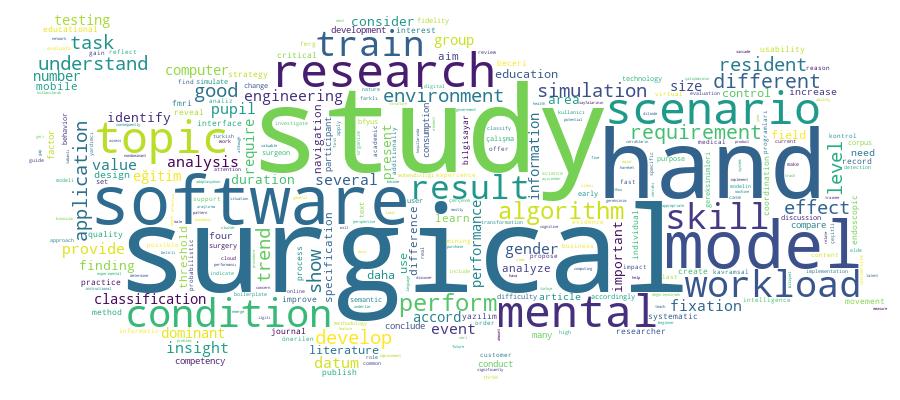
Competency Cloud

GCRIS Competency Cloud

Scholarly Output Search Results

Now showing 1 - 3 of 3
  • Article
    Citation - WoS: 27
    Citation - Scopus: 43
    Digital Transformation Strategies, Practices, and Trends: a Large-Scale Retrospective Study Based on Machine Learning
    (Mdpi, 2023) Gurcan, Fatih; Boztas, Gizem Dilan; Dalveren, Gonca Gokce Menekse; Derawi, Mohammad
    The purpose of this research is to identify the areas of interest, research topics, and application areas that reflect the research nature of digital transformation (DT), as well as the strategies, practices, and trends of DT. To accomplish this, the Latent Dirichlet allocation algorithm, a probabilistic topic modeling technique, was applied to 5350 peer-reviewed journal articles on DT published in the last ten years, from 2013 to 2022. The analysis resulted in the discovery of 34 topics. These topics were classified, and a systematic taxonomy for DT was presented, including four sub-categories: implementation, technology, process, and human. As a result of time-based trend analysis, "Sustainable Energy", "DT in Health", "E-Government", "DT in Education", and "Supply Chain" emerged as top topics with an increasing trend. Our findings indicate that research interests are focused on specific applications of digital transformation in industrial and public settings. Based on our findings, we anticipate that the next phase of DT research and practice will concentrate on specific DT applications in government, health, education, and economics. "Sustainable Energy" and "Supply Chain" have been identified as the most prominent topics in current DT processes and applications. This study can help researchers and practitioners in the field by providing insights and implications about the evolution and applications of DT. Our findings are intended to serve as a guide for DT in understanding current research gaps and potential future research topics.
  • Article
    Citation - WoS: 9
    Citation - Scopus: 20
    Business Intelligence Strategies, Best Practices, and Latest Trends: Analysis of Scientometric Data From 2003 To 2023 Using Machine Learning
    (Mdpi, 2023) Gurcan, Fatih; Ayaz, Ahmet; Dalveren, Gonca Gokce Menekse; Derawi, Mohammad
    The widespread use of business intelligence products, services, and applications piques the interest of researchers in this field. The interest of researchers in business intelligence increases the number of studies significantly. Identifying domain-specific research patterns and trends is thus a significant research problem. This study employs a topic modeling approach to analyze domain-specific articles in order to identify research patterns and trends in the business intelligence field over the last 20 years. As a result, 36 topics were discovered that reflect the field's research landscape and trends. Topics such as "Organizational Capability", "AI Applications", "Data Mining", "Big Data Analytics", and "Visualization" have recently gained popularity. A systematic taxonomic map was also created, revealing the research background and BI perspectives based on the topics. This study may be useful to researchers and practitioners interested in learning about the most recent developments in the field. Topics generated by topic modeling can also be used to identify gaps in current research or potential future research directions.
  • Article
    Citation - WoS: 2
    Citation - Scopus: 4
    Mobile Application Software Requirements Specification From Consumption Values
    (Mdpi, 2023) Derawi, Mohammad; Dalveren, Gonca Gokce Menekse; Cagiltay, Nergiz Ercil
    In today's society, mobile applications are becoming more popular and providing several advantages. However, users will resist using a product regardless of how well-tested or solid it is if the wrong requirements are implemented. Understanding the factors that influence the purchase of mobile applications can provide useful information for mobile application design and development. Hence, the purpose of this research is to better understand the impact of consumption values on customers in order to identify the software requirements for a mobile application. This study analyzes the possible behavioral changes of similar groups of university students in a five-year period. For this purpose, a questionnaire is administered to engineering faculty students in 2017 (46 females and 66 males) and 2021 (45 females and 90 males) to better understand customer behavioral changes. The findings highlight the significance of conditional value in customer behavior when purchasing mobile applications. Even though the other consumption values were found to have a negligible effect, there is some evidence indicating that the impact of consumption values on different target customer groups may vary considering their gender and familiarity with apps. Further research needs to be conducted to better understand the possible impact of age, cultural differences, education levels, and special considerations such as visually impaired people. Therefore, this study encourages mobile application designers and developers to raise awareness for the effect of consumption values such as conditional value on their customers' mobile application purchasing behaviors. The possible impact of the consumption values needs to be deeply understood, specifically for the target customer groups, and it should be considered in the software requirements specification (SRS), which is one of the important principles that allow software under consideration for development to function. As a result, a better understanding of consumption values will help developers design and develop better applications by specifying software requirements and marketing strategies.