Kılıç, Özkan

Loading...
Profile Picture
Name Variants
K.,Ozkan
Kilic,O.
K.,Özkan
Özkan, Kılıç
Kilic, Ozkan
Kılıç,Ö.
Ö.,Kılıç
O.,Kilic
O., Kilic
Kılıç, Özkan
Ozkan, Kilic
K., Ozkan
Job Title
Öğretim Görevlisi
Email Address
Main Affiliation
Computer Engineering
Status
Former Staff
Website
ORCID ID
Scopus Author ID
Turkish CoHE Profile ID
Google Scholar ID
WoS Researcher ID

Sustainable Development Goals

SDG data is not available
This researcher does not have a Scopus ID.
This researcher does not have a WoS ID.
Scholarly Output

5

Articles

3

Views / Downloads

5/6

Supervised MSc Theses

0

Supervised PhD Theses

1

WoS Citation Count

38

Scopus Citation Count

60

Patents

0

Projects

0

WoS Citations per Publication

7.60

Scopus Citations per Publication

12.00

Open Access Source

1

Supervised Theses

1

JournalCount
European Journal of Engineering Education1
Journal of Systems and Software1
Proceedings of the IADIS International Conference Information Systems 2012, IS 2012 -- IADIS International Conference on Information Systems 2012, IS 2012 -- 10 March 2012 through 12 March 2012 -- Berlin -- 1144451
TEM Journal1
Current Page: 1 / 1

Scopus Quartile Distribution

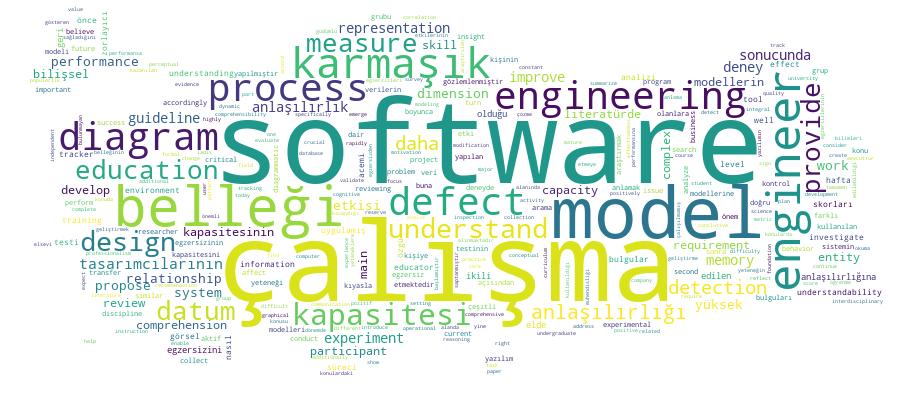
Competency Cloud

GCRIS Competency Cloud

Scholarly Output Search Results

Now showing 1 - 2 of 2
  • Conference Object
    Citation - Scopus: 1
    How Engineers Understand Entity Relationship Diagrams (erd): Insights From Eye Tracker Data
    (IADIS, 2012) Tokdemir,G.; Cagiltay,N.E.; Kilic,O.
    Entity Relationship Diagram (ERD) is one of the main tools used in software design process. This representation enables software engineers to understand system data requirements at a more comprehensive level. Designing and understanding of ERD and hence system data requirements is a critical issue for the success of software projects. In this study we are introducing an experiment environment which would be used to understand the behaviors of software engineers during designing and understanding these representations. This experimental setting is planned to be used to measure the software engineers' performance during ERD defect detection process. We believe such an environment can be used to develop some reviewing guidelines for the software engineers to improve their reviewing process in ERD which in turn will provide some tools for the educators to improve design and review skills of future software engineers. The results of this study would also provide recommendations for the researchers in similar experiments. © 2012 IADIS.
  • Article
    Citation - WoS: 15
    Citation - Scopus: 21
    Software Engineering Education: Some Important Dimensions
    (Taylor & Francis Ltd, 2007) Mishra, Alok; Cagiltay, Nergiz Ercil; Kilic, Ozkan; Ercil Cagiltay, Nergiz
    Software engineering education has been emerging as an independent and mature discipline. Accordingly, various studies are being done to provide guidelines for curriculum design. The main focus of these guidelines is around core and foundation courses. This paper summarizes the current problems of software engineering education programs. It also proposes some important dimensions as integral parts of software engineering education: interdisciplinary skills, practice experience, communication, skills on continuing education and professionalism. In the current guidelines and studies these dimensions are not addressed specifically. Although there could be other dimensions to be considered in software engineering education, we believe that the proposed ones are very crucial as software engineering is evolving more rapidly than any other engineering discipline. This study also provides a survey of some major universities' undergraduate software engineering programs to evaluate these dimensions.