
Şengül, Gökhan
Loading...
Profile URL
Name Variants
Gokhan, Sengul
Sengul, Gokhan
Sengul,G.
Gökhan, Şengül
Engul G.
Şengül G.
Şengül, Gökhan
G.,Sengul
Sengul, G.
S.,Gokhan
Sengul G.
Ş., Gökhan
G.,Şengül
G., Sengul
Şengül,G.
G., Şengül
S., Gokhan
Ş.,Gökhan
Sengul, Gokhan
Sengul,G.
Gökhan, Şengül
Engul G.
Şengül G.
Şengül, Gökhan
G.,Sengul
Sengul, G.
S.,Gokhan
Sengul G.
Ş., Gökhan
G.,Şengül
G., Sengul
Şengül,G.
G., Şengül
S., Gokhan
Ş.,Gökhan
Job Title
Profesor Doktor
Email Address
gokhan.sengul@atilim.edu.tr
Main Affiliation
Computer Engineering
Status
Website
ORCID ID
Scopus Author ID
Turkish CoHE Profile ID
Google Scholar ID
WoS Researcher ID
Sustainable Development Goals
 1
1NO POVERTY
0
Research Products
 2
2ZERO HUNGER
0
Research Products
 3
3GOOD HEALTH AND WELL-BEING
4
Research Products
 4
4QUALITY EDUCATION
1
Research Products
 5
5GENDER EQUALITY
1
Research Products
 6
6CLEAN WATER AND SANITATION
0
Research Products
 7
7AFFORDABLE AND CLEAN ENERGY
1
Research Products
 8
8DECENT WORK AND ECONOMIC GROWTH
0
Research Products
 9
9INDUSTRY, INNOVATION AND INFRASTRUCTURE
2
Research Products
 10
10REDUCED INEQUALITIES
0
Research Products
 11
11SUSTAINABLE CITIES AND COMMUNITIES
1
Research Products
 12
12RESPONSIBLE CONSUMPTION AND PRODUCTION
0
Research Products
 13
13CLIMATE ACTION
0
Research Products
 14
14LIFE BELOW WATER
1
Research Products
 15
15LIFE ON LAND
0
Research Products
 16
16PEACE, JUSTICE AND STRONG INSTITUTIONS
1
Research Products
 17
17PARTNERSHIPS FOR THE GOALS
0
Research Products

Documents
40
Citations
343
h-index
12

Documents
17
Citations
105

Scholarly Output
83
Articles
49
Views / Downloads
104/171
Supervised MSc Theses
9
Supervised PhD Theses
3
WoS Citation Count
216
Scopus Citation Count
331
Patents
0
Projects
0
WoS Citations per Publication
2.60
Scopus Citations per Publication
3.99
Open Access Source
18
Supervised Theses
12
| Journal | Count |
|---|---|
| Biomedical Research (India) | 5 |
| UBMK 2018 - 3rd International Conference on Computer Science and Engineering -- 3rd International Conference on Computer Science and Engineering, UBMK 2018 -- 20 September 2018 through 23 September 2018 -- Sarajevo -- 143560 | 4 |
| 3rd International Conference on Computer Science and Engineering (UBMK) -- SEP 20-23, 2018 -- Sarajevo, BOSNIA & HERCEG | 2 |
| 2016 24th Signal Processing and Communication Application Conference, SIU 2016 - Proceedings -- 24th Signal Processing and Communication Application Conference, SIU 2016 -- 16 May 2016 through 19 May 2016 -- Zonguldak -- 122605 | 2 |
| International Journal of Engineering Education | 2 |
Current Page: 1 / 9
Scopus Quartile Distribution
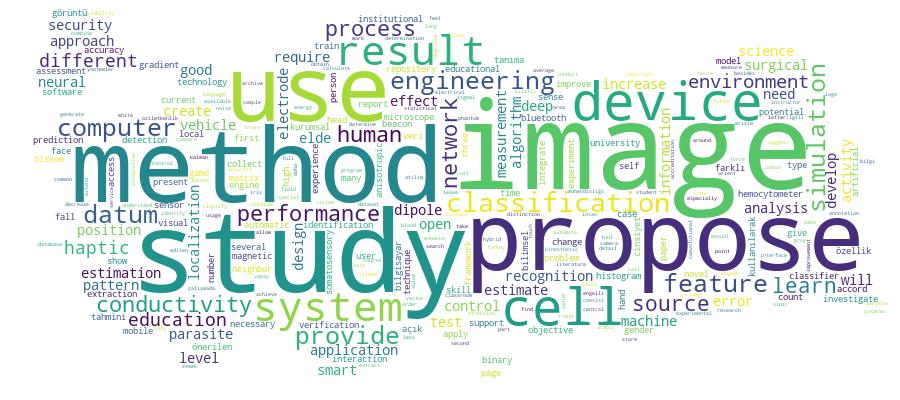
Competency Cloud
80 results
Scholarly Output Search Results
Now showing 1 - 10 of 80
Conference Object Deep Learning and Current Trends in Machine Learning(Institute of Electrical and Electronics Engineers Inc., 2018) Bostan,A.; Ekin,C.; Sengul,G.; Karakaya,M.; Tirkes,G.Academic interest and commercial attention can be used to identify how much potential a novel technology may have. Since the prospective advantages in it may help solving some problems that are not solved yet or improving the performance of readily available ones. In this study, we have investigated the Web of Science (WOS) indexing service database for the publications on Deep Learning (DL), Machine Learning (ML), Convolutional Neural Networks (CNN), and Image Processing to reveal out the current trend. The figures indicate the strong potential in DL approach especially in image processing domain. © 2018 IEEE.Article Determination of Measurement Noise, Conductivity Errors and Electrode Mislocalization Effects To Somatosensory Dipole Localization(Biomedical Research, 2012) Şengül, Gökhan; Baysal, UğurCalculating the spatial locations, directions and magnitudes of electrically active sources of human brain by using the measured scalp potentials is known as source localization. An accu rate source localization method requires not only EEG data but also the 3-D positions and number of measurement electrodes, the numerical head model of the patient/subject and the conductivities of the layers used in the head model. In this study we computationally deter mined the effect of noise, conductivity errors and electrode mislocalizations for electrical sources located in somatosensory cortex. We first randomly selected 1000 electric sources in somatosensory cortex, and for these sources we simulated the surface potentials by using av erage conductivities given in the literature and 3-D positions of the electrodes. We then added random noise to measurements and by using noisy data; we tried to calculate the positions of the dipoles by using different electrode positions or different conductivity values. The esti mated electrical sources and original ones are compared and by this way the effect of meas urement noise, electrode mislocalizations and conductivity errors to somatosensory dipole lo calization is investigated. We conclude that for an accurate somatosensory source localization method, we need noiseless measurements, accurate conductivity values of scalp and skull lay ers and the accurate knowledge of 3-D positions of measurement sensors.Conference Object Citation - WoS: 1An Undergraduate Curriculum for Deep Learning(Ieee, 2018) Tirkes, Guzin; Ekin, Cansu Cigdem; Sengul, Gokhan; Bostan, Atila; Karakaya, MuratDeep Learning (DL) is an interesting and rapidly developing field of research which has been currently utilized as a part of industry and in many disciplines to address a wide range of problems, from image classification, computer vision, video games, bioinformatics, and handwriting recognition to machine translation. The starting point of this study is the recognition of a big gap between the sector need of specialists in DL technology and the lack of sufficient education provided by the universities. Higher education institutions are the best environment to provide this expertise to the students. However, currently most universities do not provide specifically designed DL courses to their students. Thus, the main objective of this study is to design a novel curriculum including two courses to facilitate teaching and learning of DL topic. The proposed curriculum will enable students to solve real-world problems by applying DL approaches and gain necessary background to adapt their knowledge to more advanced, industry-specific fields.Article Türkiye’de Engelli Farkındalığı ve Engelli Bireylerin Adalete Web Erişilebilirlikleri Üzerine Bir Değerlendirme(Bilgi Dünyası, 2014) Ertürk, Korhan Levent; Şimşek, A. Aslı; Songür, Damla Gülseren; Şengül, GökhanFiziksel veya zihinsel nedenlerle bazı hareketleri, duyuları veya işlevleri kısıtlı olan bireyler toplumun bir grubunu oluşturmaktadır. türkiye’de bu bireyler ve/veya çevreleri toplumda doğrudan ya da dolaylı olarak çeşitli sorunlarla karşı karşıya kalmaktadırlar. Günümüzde eğitim, sağlık, adalet, sosyal güvenlik gibi alanlarda bu durum sıklıkla görülebilmektedir. Söz konusu bireyler sorunlarıyla ilgilenilmesini ve çözüme kavuşturulmasını istemektedirler. Bir ülkenin gelişmişlik düzeyi anılan sorunların çözümüne yönelik çalışmalar ile doğrudan ilişkilidir. Çalışmamız, bazı hareketleri, duyuları veya işlevleri kısıtlı olan bireylerin ortak bir terimle ifade edilmesi, engelli birey farkındalığının ortaya konulması ve bu bağlamda ilgili bazı web sitelerinin bu bireyler açısından yeterliliğinin sorgulanmasına yöneliktir. Web sitelerinin olabildiğince erişilebilir yapılması engelli kullanıcılara diğer bireyler ile eşit hakların sağlanmasına katkı sağlayabilecek, bilgi ve iletişim kaynaklarını çeşitlendirebilecektir.Conference Object Citation - WoS: 1Citation - Scopus: 3Gender Prediction by Using Local Binary Pattern and K Nearest Neighbor and Discriminant Analysis Classifications;(Institute of Electrical and Electronics Engineers Inc., 2016) Camalan,S.; Sengul,G.In this study, gender prediction is investigated for the face images. To extract the features of the images, Local Binary Pattern (LBP) is used with its different parameters. To classify the images male or female, K-Nearest Neighbors (KNN) and Discriminant Analysis (DA) methods are used. Their performances according to the LBP parameters are compared. Also classification methods' parameters are changed and the comparison results are shown. These methods are applied on FERET database with 530 female and 731 male images. To have better performance, the face parts of the images are cropped then feature extraction and classification methods applied on the face part of the images. © 2016 IEEE.Article Citation - WoS: 9Citation - Scopus: 9Benchmarking Classification Models for Cell Viability on Novel Cancer Image Datasets(Bentham Science Publ Ltd, 2019) Ozkan, Akin; Isgor, Sultan Belgin; Sengul, Gokhan; Isgor, Yasemin GulgunBackground: Dye-exclusion based cell viability analysis has been broadly used in cell biology including anticancer drug discovery studies. Viability analysis refers to the whole decision making process for the distinction of dead cells from live ones. Basically, cell culture samples are dyed with a special stain called trypan blue, so that the dead cells are selectively colored to darkish. This distinction provides critical information that may be used to expose influences of the studied drug on considering cell culture including cancer. Examiner's experience and tiredness substantially affect the consistency throughout the manual observation of cell viability. The unsteady results of cell viability may end up with biased experimental results accordingly. Therefore, a machine learning based automated decision-making procedure is inevitably needed to improve consistency of the cell viability analysis. Objective: In this study, we investigate various combinations of classifiers and feature extractors (i.e. classification models) to maximize the performance of computer vision-based viability analysis. Method: The classification models are tested on novel hemocytometer image datasets which contain two types of cancer cell images, namely, caucasian promyelocytic leukemia (HL60), and chronic myelogenous leukemia (K562). Results: From the experimental results, k-Nearest Neighbor (KNN) and Random Forest (RF) by combining Local Phase Quantization (LPQ) achieve the lowest misclassification rates that are 0.031 and 0.082, respectively. Conclusion: The experimental results show that KNN and RF with LPQ can be powerful alternatives to the conventional manual cell viability analysis. Also, the collected datasets are released from the "biochem.atilim.edu.tr/datasets/ " web address publically to academic studies.Conference Object The Effect of Split Attention in Surgical Education(Springer Verlag, 2014) Özçelik,E.; Ercil Cagiltay,N.; Sengul,G.; Tuner,E.; Unal,B.Surgical education through simulation is an important area to improve the level of education and to decrease the risks, ethical considerations and cost of the educational environments. In the literature there are several studies conducted to better understand the effect of these simulation environments on learning. However among those studies the human-computer interaction point of view is very limited. Surgeons need to look at radiological images such as magnetic resonance images (MRI) to be sure about the location of the patient's tumor during a surgical operation. Thus, they go back and forth between physically separated places (e.g. the operating table and light screen display for MRI volume sets). This study is conducted to investigate the effect of presenting different information sources in close proximity on human performance in surgical education. For this purpose, we have developed a surgical education simulation scenario which is controlled by a haptic interface. To better understand the effect of split attention in surgical education, an experimental study is conducted with 27 subjects. The descriptive results of study show that even the integrated group performed the tasks with a higher accuracy level (by traveling less distance, entering less wrong directions and hitting less walls), the results are not statistically significant. Accordingly, even there are some evidences about the effect of split attention on surgical simulation environments, the results of this study need to be validated by controlling students' skill levels on controlling the haptic devices and 2D/3D space perception skills. The results of this study may guide the system developers to better design the HCI interface of their designs especially for the area of surgical simulation. © 2014 Springer International Publishing.Article Crack Detection on Asphalt Runway Using Unmanned Aerial Vehicle Data with Non-Crack Object Removal and Deep Learning Methods(Pontificia Univ Catolica Chile, Escuela Construccion Civil, 2025) Tapkin, Serkan; Tercan, Emre; Bostan, Atila; Sengul, GokhanUnmanned aerial vehicles are extensively utilized for image acquisition in a cheap, fast, and effective way. In this study, an automatic crack detection method with non-crack object removal and deep learning-based approaches are developed and tested on images captured by unmanned aerial vehicle. The motivation of this study is to detect either a crack exists or not in the asphalt-runway. The novelty of this study lies in integrating a non-crack artifact removal process with six classical edge detectors and comparing the resulting performance with four lightweight CNN models on the same UAV-acquired runway image dataset, enabling a unified evaluation of classical and learning-based approaches. For deep learning-based approach, four lightweight CNN models, namely GoogleNet, SqueezeNet, MobileNetv2, and ShuffleNet, are trained and the best accuracy of %87.9 is obtained whenever GoogleNet model is used. For the non-crack object removal approach, exclusion of non-crack objects from the images is the first step, where crack-detection which makes use of edge-detection techniques is the latter. In the study, Sobel, Prewitt, Canny, Laplacian of Gaussian, Roberts and Zero Cross edge detection algorithms are examined and their success rates in detecting cracks are comparatively presented. With sensitivity=0.981, specificity=0.744, accuracy=0.917, precision=0.912 and F-score=0.945 values Canny algorithm performs significantly better than others in detecting the cracks. This study provides enough evidence for the practicability of automated crack detection on unprocessed digital photographs by the results of the study conducted on asphalt runway.Article Citation - WoS: 4Citation - Scopus: 7The Integrated Usage of Lbp and Hog Transformations and Machine Learning Algorithms for Age Range Prediction From Facial Images(Univ Osijek, Tech Fac, 2018) Khalifa, Tariq; Sengul, GokhanAge prediction is an active study field that can be used in many computer vision problems due to its importance and effectiveness. In this paper, we present extensive experiments and provide an efficient and accurate approach for age range prediction of people from facial images. First, we apply image resizing to unify all images' size, and Histogram Equalization technique to reduce the illumination effects on all facial images taken from FG-NET and UTD aging databases. Second, Histogram of Oriented Gradient (HOG) and Local Binary Pattern (LBP) are used to extract the features of these images, and then we combined both HOG and LBP features in order to attain better prediction. Finally, Support Vector Machine (SVM) and k-Nearest Neighbour (k-NN) are used for the classification processes. In addition, k-fold, Leave-One-Out (LOO) and Confusion Matrix (CM) are used to evaluate the performance of proposed methods. The extensive and intensified experiments show that combining HOG and LBP features improved the age range predicting performance up to 99.87%.Article Türkiye’de Engelli Farkındalığı ve Engelli Bireylerin Adalete Web Erişilebilirlikleri Üzerine Bir Değerlendirme(2014) Ertürk, Korhan Levent; Şimşek, A Aslı; Songur, Damla Gülseren; Şengül, GökhanFiziksel veya zihinsel nedenlerle bazı hareketleri, duyuları veya işlevleri kısıtlı olan bireyler toplumun bir grubunu oluşturmaktadır. türkiye'de bu bireyler ve/veya çevreleri toplumda doğrudan ya da dolaylı olarak çeşitli sorunlarla karşı karşıya kalmaktadırlar. Günümüzde eğitim, sağlık, adalet, sosyal güvenlik gibi alanlarda bu durum sıklıkla görülebilmektedir. Söz konusu bireyler sorunlarıyla ilgilenilmesini ve çözüme kavuşturulmasını istemektedirler. Bir ülkenin gelişmişlik düzeyi anılan sorunların çözümüne yönelik çalışmalar ile doğrudan ilişkilidir. Çalışmamız, bazı hareketleri, duyuları veya işlevleri kısıtlı olan bireylerin ortak bir terimle ifade edilmesi, engelli birey farkındalığının ortaya konulması ve bu bağlamda ilgili bazı web sitelerinin bu bireyler açısından yeterliliğinin sorgulanmasına yöneliktir. Bunlar ve benzeri web sitelerinin olabildiğince erişilebilir yapılması engelli kullanıcılara diğer bireyler ile eşit hakların sağlanmasına katkı sağlayabilecek, bilgi ve iletişim kaynaklarını çeşitlendirebilecektir
