Şengül, Gökhan

Loading...
Profile Picture
Name Variants
Gokhan, Sengul
Sengul, Gokhan
Sengul,G.
Gökhan, Şengül
Engul G.
Şengül G.
Şengül, Gökhan
G.,Sengul
Sengul, G.
S.,Gokhan
Sengul G.
Ş., Gökhan
G.,Şengül
G., Sengul
Şengül,G.
G., Şengül
S., Gokhan
Ş.,Gökhan
Job Title
Profesor Doktor
Email Address
gokhan.sengul@atilim.edu.tr
Main Affiliation
Computer Engineering
Status
Website
ORCID ID
Scopus Author ID
Turkish CoHE Profile ID
Google Scholar ID
WoS Researcher ID

Sustainable Development Goals

NO POVERTY1
NO POVERTY
0
Research Products
ZERO HUNGER2
ZERO HUNGER
0
Research Products
GOOD HEALTH AND WELL-BEING3
GOOD HEALTH AND WELL-BEING
4
Research Products
QUALITY EDUCATION4
QUALITY EDUCATION
1
Research Products
GENDER EQUALITY5
GENDER EQUALITY
1
Research Products
CLEAN WATER AND SANITATION6
CLEAN WATER AND SANITATION
0
Research Products
AFFORDABLE AND CLEAN ENERGY7
AFFORDABLE AND CLEAN ENERGY
1
Research Products
DECENT WORK AND ECONOMIC GROWTH8
DECENT WORK AND ECONOMIC GROWTH
0
Research Products
INDUSTRY, INNOVATION AND INFRASTRUCTURE9
INDUSTRY, INNOVATION AND INFRASTRUCTURE
2
Research Products
REDUCED INEQUALITIES10
REDUCED INEQUALITIES
0
Research Products
SUSTAINABLE CITIES AND COMMUNITIES11
SUSTAINABLE CITIES AND COMMUNITIES
1
Research Products
RESPONSIBLE CONSUMPTION AND PRODUCTION12
RESPONSIBLE CONSUMPTION AND PRODUCTION
0
Research Products
CLIMATE ACTION13
CLIMATE ACTION
0
Research Products
LIFE BELOW WATER14
LIFE BELOW WATER
1
Research Products
LIFE ON LAND15
LIFE ON LAND
0
Research Products
PEACE, JUSTICE AND STRONG INSTITUTIONS16
PEACE, JUSTICE AND STRONG INSTITUTIONS
1
Research Products
PARTNERSHIPS FOR THE GOALS17
PARTNERSHIPS FOR THE GOALS
0
Research Products
Documents

40

Citations

343

h-index

12

Documents

17

Citations

106

Scholarly Output

83

Articles

49

Views / Downloads

104/187

Supervised MSc Theses

9

Supervised PhD Theses

3

WoS Citation Count

217

Scopus Citation Count

331

Patents

0

Projects

0

WoS Citations per Publication

2.61

Scopus Citations per Publication

3.99

Open Access Source

18

Supervised Theses

12

JournalCount
Biomedical Research (India)5
UBMK 2018 - 3rd International Conference on Computer Science and Engineering -- 3rd International Conference on Computer Science and Engineering, UBMK 2018 -- 20 September 2018 through 23 September 2018 -- Sarajevo -- 1435604
3rd International Conference on Computer Science and Engineering (UBMK) -- SEP 20-23, 2018 -- Sarajevo, BOSNIA & HERCEG2
2016 24th Signal Processing and Communication Application Conference, SIU 2016 - Proceedings -- 24th Signal Processing and Communication Application Conference, SIU 2016 -- 16 May 2016 through 19 May 2016 -- Zonguldak -- 1226052
International Journal of Engineering Education2
Current Page: 1 / 9

Scopus Quartile Distribution

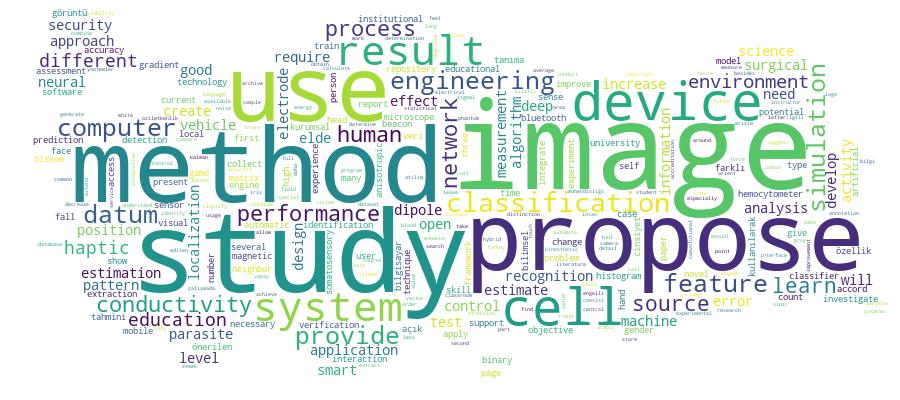
Competency Cloud

GCRIS Competency Cloud

Scholarly Output Search Results

Now showing 1 - 4 of 4
  • Conference Object
    Citation - WoS: 1
    Citation - Scopus: 3
    Gender Prediction by Using Local Binary Pattern and K Nearest Neighbor and Discriminant Analysis Classifications;
    (Institute of Electrical and Electronics Engineers Inc., 2016) Camalan,S.; Sengul,G.
    In this study, gender prediction is investigated for the face images. To extract the features of the images, Local Binary Pattern (LBP) is used with its different parameters. To classify the images male or female, K-Nearest Neighbors (KNN) and Discriminant Analysis (DA) methods are used. Their performances according to the LBP parameters are compared. Also classification methods' parameters are changed and the comparison results are shown. These methods are applied on FERET database with 530 female and 731 male images. To have better performance, the face parts of the images are cropped then feature extraction and classification methods applied on the face part of the images. © 2016 IEEE.
  • Article
    Citation - Scopus: 12
    Classification of parasite egg cells using gray level cooccurence matrix and kNN
    (Scientific Publishers of India, 2016) Şengül,G.
    Parasite eggs are around 20 to 80 μm dimensions, and they can be seen under microscopes only and their detection requires visual analyses of microscopic images, which requires human expertise and long analysis time. Besides visual analysis is very error prone to human procedures. In order to automatize this process, a number of studies are proposed in the literature. But there is still a gap between the preferred performance and the reported ones and it is necessary to increase the performance of the automatic parasite egg classification approaches. In this study a learning based statistical pattern recognition approach for parasite egg classification is proposed that will both decrease the time required for the manual classification by an expert and increase the performance of the previously suggested automated parasite egg classification approaches. The proposed method uses Gray-Level Co-occurrence Matrix as the feature extractor, which is a texture based statistical method that can differentiate the parasite egg cells based on their textures, and the k-Nearest Neighbourhood (kNN) classifier for the classification. The proposed method is tested on 14 parasite egg types commonly seen in humans. The results show that proposed method can classify the parasite egg cells with a performance rate of 99%. © 2016, Scientific Publishers of India. All rights reserved.
  • Article
    Citation - WoS: 6
    Citation - Scopus: 12
    Classification of Parasite Egg Cells Using Gray Level Cooccurence Matrix and Knn
    (Scientific Publishers india, 2016) Sengul, Gokhan
    Parasite eggs are around 20 to 80 mu m dimensions, and they can be seen under microscopes only and their detection requires visual analyses of microscopic images, which requires human expertise and long analysis time. Besides visual analysis is very error prone to human procedures. In order to automatize this process, a number of studies are proposed in the literature. But there is still a gap between the preferred performance and the reported ones and it is necessary to increase the performance of the automatic parasite egg classification approaches. In this study a learning based statistical pattern recognition approach for parasite egg classification is proposed that will both decrease the time required for the manual classification by an expert and increase the performance of the previously suggested automated parasite egg classification approaches. The proposed method uses Gray-Level Co-occurrence Matrix as the feature extractor, which is a texture based statistical method that can differentiate the parasite egg cells based on their textures, and the k-Nearest Neighbourhood (kNN) classifier for the classification. The proposed method is tested on 14 parasite egg types commonly seen in humans. The results show that proposed method can classify the parasite egg cells with a performance rate of 99%.
  • Conference Object
    Citation - WoS: 1
    Gender Prediction by Using Local Binary Pattern and K Nearest Neighbor and Discriminant Analysis Classifications
    (Ieee, 2016) Camalan, Seda; Çamalan, Seda; Sengul, Gokhan; Şengül, Gökhan; Çamalan, Seda; Şengül, Gökhan; Information Systems Engineering; Computer Engineering; Information Systems Engineering; Computer Engineering
    In this study, gender prediction is investigated for the face images. To extract the features of the images, Local Binary Pattern (LBP) is used with its different parameters. To classify the images male or female, K-Nearest Neighbors (KNN) and Discriminant Analysis (DA) methods are used. Their performances according to the LBP parameters are compared. Also classification methods' parameters are changed and the comparison results are shown. These methods are applied on FERET database with 530 female and 731 male images. To have better performance, the face parts of the images are cropped then feature extraction and classification methods applied on the face part of the images.