Billur, Eren

Loading...
Profile Picture
Name Variants
Billur, E.
Eren, Billur
E., Billur
E.,Billur
B.,Eren
B., Eren
Billur, Eren
Billur,E.
Job Title
Doktor Öğretim Üyesi
Email Address
eren.billur@atilim.edu.tr
Main Affiliation
Automotive Engineering
Status
Former Staff
Website
ORCID ID
Scopus Author ID
Turkish CoHE Profile ID
Google Scholar ID
WoS Researcher ID

Sustainable Development Goals

3

GOOD HEALTH AND WELL-BEING
GOOD HEALTH AND WELL-BEING Logo

2

Research Products

7

AFFORDABLE AND CLEAN ENERGY
AFFORDABLE AND CLEAN ENERGY Logo

1

Research Products

9

INDUSTRY, INNOVATION AND INFRASTRUCTURE
INDUSTRY, INNOVATION AND INFRASTRUCTURE Logo

1

Research Products
This researcher does not have a Scopus ID.
This researcher does not have a WoS ID.
Scholarly Output

9

Articles

4

Views / Downloads

29/75

Supervised MSc Theses

1

Supervised PhD Theses

0

WoS Citation Count

40

Scopus Citation Count

43

WoS h-index

3

Scopus h-index

3

Patents

0

Projects

0

WoS Citations per Publication

4.44

Scopus Citations per Publication

4.78

Open Access Source

3

Supervised Theses

1

Google Analytics Visitor Traffic

JournalCount
28th International Conference on Metallurgy and Materials (METAL) -- MAY 22-24, 2019 -- Brno, CZECH REPUBLIC1
5th International Conference on Hot Sheet Metal Forming of High-Performance Steel (CHS2 2015) -- MAY 31-JUN 03, 2015 -- Toronto, CANADA1
Hittite Journal of Science and Engineering1
International Conference on the Technology of Plasticity (ICTP) -- SEP 17-22, 2017 -- Cambridge, ENGLAND1
International Journal of Hydrogen Energy1
Current Page: 1 / 2

Scopus Quartile Distribution

Competency Cloud

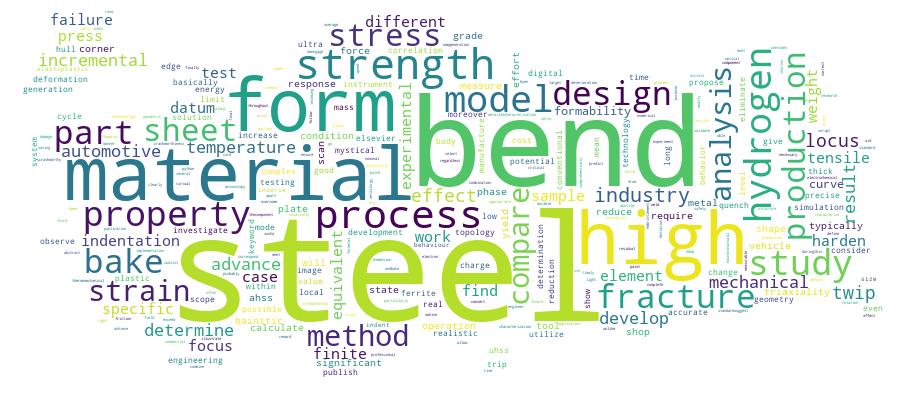
GCRIS Competency Cloud

Scholarly Output Search Results

Now showing 1 - 2 of 2
  • Article
    Citation - WoS: 2
    Citation - Scopus: 3
    Development of New Vehicle Safety Structures by Using Third Generation Steels
    (Sae int, 2022) Erzincanlioglu, Samet; Aydiner, Tamer; Aras, Firat; Celik, Hafize; Billur, Eren; Karabulut, Semih; Gumus, Iskender Onder
    Research and development efforts in the automotive industry have been long focused on crashworthy, durable vehicles with the lowest mass possible as higher mass requires more energy and, thus, causes more CO2 emissions. One way of approaching these objectives is to reduce the total vehicle weight by using higher strength-to-weight ratio materials, such as Advanced High-Strength Steels (AHSS). Typically, as the steel gets stronger, its formability is reduced. The steel industry has been long developing (so-called) third-generation (Gen3) AHSS for the automotive industry. These grades offer higher formability compared to first-generation (Gent) and cost less compared to the second-generation (Gen2) AHSS. Transformation Induced Plasticity (TRIP)-aided Bainitic Ferrite (TBF) and Quenching and Partitioning (Q&P) steel families are considered to be the Gen3 AHSS. These grades can be cold-formed to more complex shapes, compared with the Geni Dual Phase (DP) and TRIP steels at equivalent strength levels. In this article, new single-piece A- and B-pillar reinforcements were designed using a Gen3 AHSS, TBF980. Spot-welding operations were eliminated due to part consolidation with the more formable steel. These parts will be the first structural automotive parts which were manufactured with cold-forming technology using TBF steels with a sstrength level close to 1 GPa or even more. Weight and cost reductions were realized by the new design while improving the crash performance.
  • Article
    Mechanical Properties of Trip Aided Bainitic Ferrite (tbf) Steels in Production and Service Conditions
    (2018) Billur, Eren; Karabulut, Semih; Yılmaz, İmren Öztürk; Erzincanoğlu, Samet; Çelik, Hafize; Altınok, Evren; Başer, Tanya
    In the automotive industry, one of the most common methods to reduce the weight of the body components is to downgage the sheets using higher strength steels. In the design phase, engineers typically use the material properties of the incoming material, suchas the yield strength and the elongation. For forming analyses, however, more detailedcharacterization is required (flow curves, anisotropy, forming limit curves, etc.). Once thecomponents are formed in the press shop, the yield strength increases due to work (strain)hardening. The parts are then welded in the body shop, and the body-in-white goes to thepaint shop where it is baked to cure the paint. Most steels’ yield strength changes duringthis paint bake cycle, which determines its final properties in service. Bake hardening (andin some cases, bake softening) is measured by Bake Hardening Index (BHI) as defined byEN 10325-2006. The standard dictates relatively low pre-strain (2%) and baking temperature (170°C). In real production conditions however, higher strains are achieved andbaking temperatures may exceed 170°C to shorten the baking time. In this study, a newgeneration Advanced High Strength Steel (AHSS) grade TBF 1050 was characterized formetal forming purposes and its bake hardening response was studied both as the standardsuggests and as the real production cycle dictates.