
Nasöz, Duygu Lale
Loading...
Profile URL
Name Variants
D. L. Nasöz D.,Nasöz N.,Duygu Lale Nasöz, Duygu Lale D.L.Nasoz D.L.Nasöz D. L. Nasoz Nasoz,D.L. Duygu Lale, Nasoz Nasöz,D.L. Nasoz, Duygu Lale Duygu Lale, Nasöz D., Nasoz N., Duygu Lale
Job Title
Doktor Öğretim Üyesi
Email Address
duygu.tuna@atilim.edu.tr
Main Affiliation
Electrical-Electronics Engineering
Status
Website
ORCID ID
Scopus Author ID
Turkish CoHE Profile ID
Google Scholar ID
WoS Researcher ID
No research topics data found.
Sustainable Development Goals
 1
1NO POVERTY
0
Research Products
 2
2ZERO HUNGER
0
Research Products
 3
3GOOD HEALTH AND WELL-BEING
0
Research Products
 4
4QUALITY EDUCATION
0
Research Products
 5
5GENDER EQUALITY
0
Research Products
 6
6CLEAN WATER AND SANITATION
0
Research Products
 7
7AFFORDABLE AND CLEAN ENERGY
1
Research Products
 8
8DECENT WORK AND ECONOMIC GROWTH
0
Research Products
 9
9INDUSTRY, INNOVATION AND INFRASTRUCTURE
0
Research Products
 10
10REDUCED INEQUALITIES
0
Research Products
 11
11SUSTAINABLE CITIES AND COMMUNITIES
0
Research Products
 12
12RESPONSIBLE CONSUMPTION AND PRODUCTION
0
Research Products
 13
13CLIMATE ACTION
0
Research Products
 14
14LIFE BELOW WATER
0
Research Products
 15
15LIFE ON LAND
0
Research Products
 16
16PEACE, JUSTICE AND STRONG INSTITUTIONS
0
Research Products
 17
17PARTNERSHIPS FOR THE GOALS
0
Research Products

Documents
1
Citations
1
h-index
1

This researcher does not have a WoS ID.
No records found in other affiliations.

Scholarly Output
2
Articles
1
Views / Downloads
5/0
Supervised MSc Theses
0
Supervised PhD Theses
1
WoS Citation Count
1
Scopus Citation Count
1
Patents
0
Projects
0
WoS Citations per Publication
0.50
Scopus Citations per Publication
0.50
Open Access Source
0
Supervised Theses
1
| Journal | Count |
|---|---|
| Journal of Physical Chemistry C | 1 |
Current Page: 1 / 1
Scopus Quartile Distribution
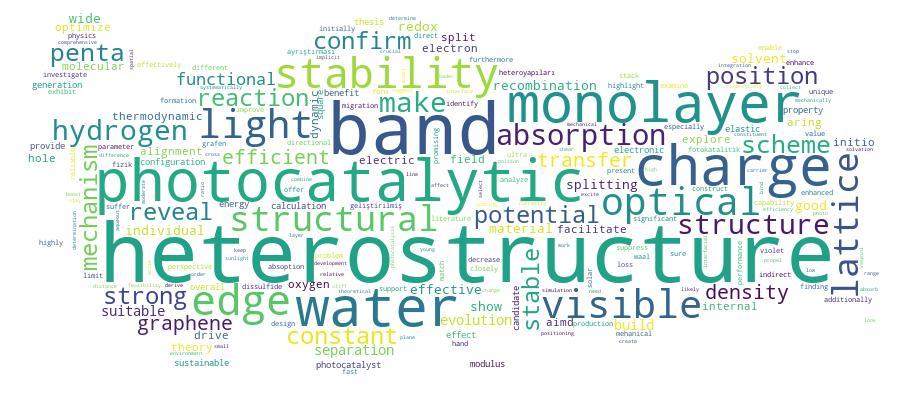
Competency Cloud
Scholarly Output Search Results
Now showing 1 - 2 of 2
Article Citation - WoS: 1Citation - Scopus: 1Penta-Graphene/SnS2 Heterostructures with Z-Scheme Charge Transfer for Efficient Photocatalytic Water Splitting(Amer Chemical Soc, 2025-09-09) Nasoz, Duygu Lale; Surucu, Ozge; Wang, Xiaotian; Surucu, Gokhan; Sarac, Yasemin; Gencer, AysenurThe present study explores the photocatalytic potential of penta-graphene (PG) and SnS2 monolayers, along with their heterostructures (PG/SnS2), using Density Functional Theory (DFT). Structural analysis confirms that the PG/SnS2 heterostructure exhibits enhanced stability, efficient charge separation, and suitable band alignment. Optimized lattice parameters (3.66 & Aring; for PG and 3.88 & Aring; for SnS2) closely matched literature values, while ab initio molecular dynamics (AIMD) confirmed thermodynamic stability at 300 K. The heterostructure's band gap of 2.75 eV (HSE method) supports visible light absorption, and the band edge positions enable hydrogen and oxygen evolution reactions across pH 0 to 6. Optical analysis reveals significant visible-light absorption with an optical band gap of 1.43 eV. Additionally, this study identifies a Z-scheme charge transfer mechanism in the PG/SnS2 heterostructure, facilitated by an internal built-in electric field that drives directional charge migration, effectively enhancing electron-hole separation and suppressing recombination losses. This Z-scheme mechanism optimizes redox reactions, making PG/SnS2 a highly efficient photocatalyst for solar-driven hydrogen production. Furthermore, the effect of water solvent is investigated, and it reveals that this heterostructure is stable under water solvent, having suitable band edges for the photocatalytic water splitting. These findings highlight the PG/SnS2 heterostructure as a promising candidate for sustainable hydrogen generation, offering a new perspective for the design of next-generation 2D photocatalytic materials.Doctoral Thesis Geliştirilmiş fotokatalitik su ayrıştırması için penta-grafen sns2 heteroyapıları(2025) Nasöz, Duygu Lale; Oymak, Yasemin Saraç; Gencer, AyşenurIn this thesis, we have examined the photocatalytic capabilities of penta-graphene (PG), tin dissulfide (SnS2) monolayers, and their van der Waals (vdW) heterostructure (PG/SnS2) through Density Functional Theory (DFT) calculations. The structural, electronic, and optical properties of the individual monolayers were initially analyzed to form reliable heterostructure formation. The PG monolayer has a unique square lattice structure with lattice constants of 3.66 Å. It has a mehanical stability and a wide indirect band gap of 3.40 eV (HSE method), which make sure that the positions of the band edge are suitable for water splitting especially hydrogen and oxygen evolution reactions. But it is limited to the ultra violet (UV) absorption and this makes it less effective for the photocatalytic water splitting. On the other hand, the SnS2 monolayer has a square lattice structure with lattice constant 3.88 Å and a direct band gap of 2.51 eV (HSE method). Also it has a strong visible light absoption but it suffers from fast charge recombination which decreases its overall photocatalytic performance. The PG/SnS2 heterostructure was built and improved to get around these problems. After the individual investigation of the structural, electronic and optical properties of the PG and the SnS2 monolayers, their 4 different heterostructures (A1, A2, A3, A4 stacking configurations) were constructed systematically in order to explore the interfacial effects and functional benefits arising from integration by changing the relative positioning of the SnS2 monolayer on the PG monolayer. A1 was selected for the further investigations because it has the lowest binding energy (-0.03 eV), which shows highest structural stability and smallest d-spacing (3.27 Å) , which is the distance between two layers as well. After determination of the most stable configuration (A1), mechanical stability calculations of the PG/SnS2 heterostructure have been done and elastic constants which are C11, C12, and C66 have been determined. From these elastic constants, the in-plane Young modulus (Y2D ), Shear modulus (G2D), and Poisson ratio (ν) are derived as 314.52 N/m, 169.30 N/m, and -0.07, respectively. These results suggest that the PG/SnS2 heterostructure is mechanically stronger and stiffer than its individual constituents. Ab-initio molecular dynamics (AIMD) simulations confirmed the thermodynamic stability of the heterostructure at 300 K. The PG/SnS2 heterostructure has a moderate band gap of 2.75 eV (HSE method), which makes it good at absorbing visible light. The band edge positions also cross the redox potentials needed for H2 and O2 evolution reactions over a wide pH range (0–6), which makes photocatalytic feasibility more likely. Optical analysis shows that the absorption edge is wider and that the effective optical band gap is 1.43 eV, which confirms that the material can collect a lot of visible light. Charge density difference and Bader charge analyses reveal a Z-scheme charge transfer mechanism, propelled by an internal built-in electric field at the interface, which facilitates the spatial separation of photo-excited carriers. This mechanism not only keeps strong redox potentials but also stops electron–hole recombination, which boosts the overall efficiency of photocatalysis. The VASPSOL implicit solvation model was also used to look at how the aqueous solvent environment affects the PG/SnS₂ heterostructure. The results showed that the structure stays stable and the band gap and the band edge positions line up correctly even when it is in water. These comprehensive results show that PG provides good structural stability and good band edge alignment, while SnS2 provides strong absorption of visible light. When these two materials are combined into a PG/SnS2 heterostructure, they work together to create a structure that has both of these benefits. So, the heterostructure is a very effective and stable photocatalyst for making hydrogen from sunlight. Within this thesis, theoretical investigations of the PG/SnS₂ heterostructure have revealed that this structure is a potential candidate for photocatalytic water splitting, which is crucial for sustainable energy development.