Cihaner, Atilla

Loading...
Profile Picture
Name Variants
C.,Atilla
A., Cihaner
C., Atilla
Cihaner A.
A.,Cihaner
Cihaner, Atilla
Cihaner,A.
Atilla Cihaner
Atilla, Cihaner
Cihaner,Atilla
Cihaner, A.
Cihaner, A
Job Title
Profesör Doktor
Email Address
atilla.cihaner@atilim.edu.tr
Main Affiliation
Chemical Engineering
Status
Website
Scopus Author ID
Turkish CoHE Profile ID
Google Scholar ID
WoS Researcher ID

Sustainable Development Goals

NO POVERTY1
NO POVERTY
0
Research Products
ZERO HUNGER2
ZERO HUNGER
0
Research Products
GOOD HEALTH AND WELL-BEING3
GOOD HEALTH AND WELL-BEING
1
Research Products
QUALITY EDUCATION4
QUALITY EDUCATION
0
Research Products
GENDER EQUALITY5
GENDER EQUALITY
0
Research Products
CLEAN WATER AND SANITATION6
CLEAN WATER AND SANITATION
1
Research Products
AFFORDABLE AND CLEAN ENERGY7
AFFORDABLE AND CLEAN ENERGY
3
Research Products
DECENT WORK AND ECONOMIC GROWTH8
DECENT WORK AND ECONOMIC GROWTH
0
Research Products
INDUSTRY, INNOVATION AND INFRASTRUCTURE9
INDUSTRY, INNOVATION AND INFRASTRUCTURE
0
Research Products
REDUCED INEQUALITIES10
REDUCED INEQUALITIES
0
Research Products
SUSTAINABLE CITIES AND COMMUNITIES11
SUSTAINABLE CITIES AND COMMUNITIES
0
Research Products
RESPONSIBLE CONSUMPTION AND PRODUCTION12
RESPONSIBLE CONSUMPTION AND PRODUCTION
0
Research Products
CLIMATE ACTION13
CLIMATE ACTION
0
Research Products
LIFE BELOW WATER14
LIFE BELOW WATER
0
Research Products
LIFE ON LAND15
LIFE ON LAND
0
Research Products
PEACE, JUSTICE AND STRONG INSTITUTIONS16
PEACE, JUSTICE AND STRONG INSTITUTIONS
0
Research Products
PARTNERSHIPS FOR THE GOALS17
PARTNERSHIPS FOR THE GOALS
0
Research Products
Documents

101

Citations

2366

h-index

28

Documents

103

Citations

2258

Scholarly Output

121

Articles

108

Views / Downloads

61/0

Supervised MSc Theses

12

Supervised PhD Theses

0

WoS Citation Count

2257

Scopus Citation Count

2347

Patents

0

Projects

13

WoS Citations per Publication

18.65

Scopus Citations per Publication

19.40

Open Access Source

6

Supervised Theses

12

JournalCount
Electrochimica Acta15
Journal of Electroanalytical Chemistry13
Turkish Journal of Chemistry6
Dyes and Pigments6
Organic Electronics6
Current Page: 1 / 8

Scopus Quartile Distribution

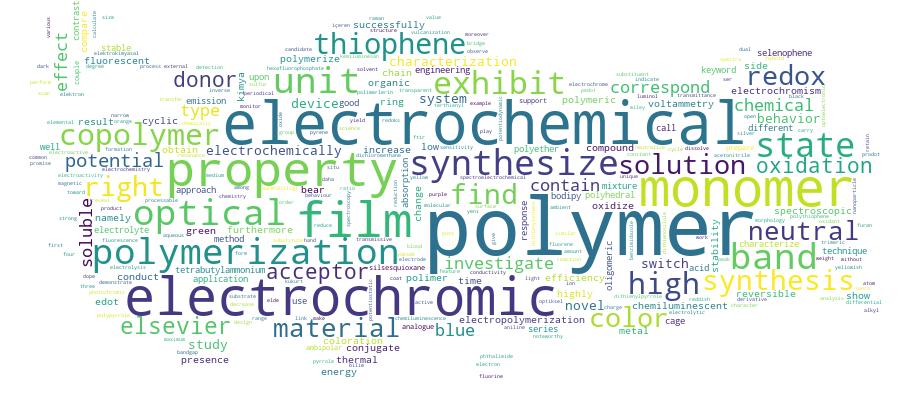
Competency Cloud

GCRIS Competency Cloud

Scholarly Output Search Results

Now showing 1 - 6 of 6
  • Article
    Citation - WoS: 45
    Citation - Scopus: 47
    An Electroactive Polymeric Material and Its Voltammetric Response Towards Alkali Metal Cations in Neat Water
    (Pergamon-elsevier Science Ltd, 2008) Algi, Fatih; Cihaner, Atilla
    The syntheses and characterization of a unique system based on thiophene, pyrrole and benzo-15-crown-5 (SNS-Crown) and its corresponding polymer (PSNS-Crown) are reported. Furthermore, selective, clear and reversible voltammetric responses of the conjugated polymer (PSNS-Crown) film towards the alkali series Li+, Na+ and K+ in both neat water and organic media (ethanol) are described. (c) 2008 Elsevier Ltd. All rights reserved.
  • Article
    Citation - WoS: 96
    Citation - Scopus: 99
    A Processable Rainbow Mimic Fluorescent Polymer and Its Unprecedented Coloration Efficiency in Electrochromic Device
    (Pergamon-elsevier Science Ltd, 2008) Cihaner, Atilla; Algi, Fatih
    A processable rainbow mimic fluorescent polymer (PSNSF) based on 1-(9H-fluoren-2-yl)-2,5-di(thiophen-2-yl)-1H-pyrrole (SNSF) was synthesized via electrochemical polymerization in a mixture of ethanol and CH2Cl2 solution containing 0.1 M LiClO4. Characterization was carried out using cyclic voltammetry, UV-vis and F-FAR spectroscopic techniques. Also, an electrochromic device based on PSNSF was studied, which exhibits high coloration efficiency (CE), high redox stability (retaining 98.6% of its optical activity after 4000th switch) and very low response time (less than 0.5 s). (c) 2007 Elsevier Ltd. All rights reserved.
  • Article
    Citation - WoS: 2
    Synthesis of n-polyethereal Polypyrroles and Their Application for the Preconcentration of Rare Earth Ions
    (John Wiley & Sons inc, 2008) Koksel, Bahar; Cihaner, Atilla; Kaya, Murat; Volkan, Muervet; Onal, Ahmet M.
    Conducting polymers containing polyether pseudocages (PI, PII, PIII) have been synthesized via chemical oxidation of 1,5-bis(1,1-pyrrole)-3-oxabutane (MI), 1,8-bis(I,I-pyrrole)-3,6-dioxahexane (MII), and 1,11-bis(1,1-pyrrole)-3,6,9-trioxaundecane (MIII) using anhydrous FeCl3 in CHCl3. Because as obtained polymer resins did not give any response toward any cations, they were reduced (undoped) using chemical reducing agents. Tetrabutylammonium hydroxide was found to be more effective in undoping to obtain more reproducible and reusable polymer resins. The undoped polymer resins were tried in the extraction of rare earth metal ions from the aqueous medium. Among them, only PIII resin removes La(III), Eu(III) and Yb(III) and can be employed for the preconcentration of these metal ions. For batch extraction of La(III), Eu(III) and Yb(III) at neutral pH values, percent recoveries of 98.0 +/- 1.0, 90.7 +/- 1.4, 87.3 +/- 4.0, respectively, has been obtained. The sorption capacity is found as 1.3 mg of La(III) per gram of PIII resin. The PIII resin could be reused at least five times without significant change in its sorption capacity. (c) 2008 Wiley Periodicals, Inc.
  • Article
    Citation - WoS: 11
    Citation - Scopus: 14
    Electrochemical Synthesis of New Conducting Copolymers Containing Pseudo-Polyether Cages With Pyrrole
    (Elsevier Science Sa, 2007) Cihaner, Atilla
    Conducting copolymers have been synthesized via electrochemical oxidation of pyrrole (Py) in the presence of monomer 1, 11 -bis(1,1-pyrrole)-3,6,9-trioxaundecane (I) in an electrolytic solution containing 0.1 M tetrabutylammonium hexafluorophosphate (TBAPF(6)) dissolved in acetonitrile. It is observed that reversible redox behavior of poly(I-co-Py)s shifts to more positive potentials with the increasing amount of I in the comonomer mixture, indicating formation of a copolymer. It is also found that increasing the ratio of I in the comonomer mixture decreases the conductivity of the obtained polymer films. The dark electrical conductivity measurements in the temperature range of 300-100 K revealed the extrinsic type of conduction with activation energy values being in the range of 82.3-16.9 meV. (c) 2007 Elsevier B.V. All rights reserved.
  • Article
    Citation - WoS: 65
    Citation - Scopus: 67
    An Electrochromic and Fluorescent Polymer Based on 1-(1
    (Elsevier Science Sa, 2008) Cihaner, Atilla; Algi, Fatih
    A novel polymer was synthesized by electrochemical polymerization of 1-(1-naphthyl)-2,5-di-2-thienyl-1H-pyrrole (SNS-1-NAPH). The corresponding polymer (PSNS-1-NAPH) was characterized by cyclic voltammetry, FT-IR and UV-vis spectroscopy. The polymer has a very well-defined and reversible redox process in both organic and aqueous solutions. Furthermore, it shows stable electrochromic behavior; yellow in the neutral state, green in the intermediate state and violet in the oxidized state. PSNS-1-NAPH is soluble in common solvents. Although SNS-1-NAPH is almost nonfluorescent, its polymer is a yellow and/or green light emitter. (c) 2007 Elsevier B.V. All rights reserved.
  • Article
    Citation - WoS: 2
    Citation - Scopus: 3
    Impedance Spectroscopy of N-Substituted Oligo-Oxyethylene Polypyrrole Films
    (John Wiley & Sons inc, 2008) Cihaner, Atilla; Onal, Ahmet M.
    The electrochemical properties of neutral (dedoped) and oxidized (doped) poly(1,11-bis(1,1-pyrrole)-3,6,9-trioxaundecane) (poly-I) film electrodes were investigated using cyclic voltammetry and electrochemical impedance spectroscopy (EIS) techniques. Poly-I was deposited on glassy carbon electrode (GCE) from acetonitrile solution containing 5.0 x 10(-3) M 1,11-bis(1,1-pyrrole)-3,6,9-trioxaundecane (I) and 0.1 M LiClO4 supporting electrolyte. Doped poly-I exhibits a single semicircle in its complex-capacitance plots, indicating a single dominant ion transport process, together with high capacitance values. These features make this polymer film a candidate for an energy storage material. Also, poly-I can be a candidate as a sensory material for the detection of Ag+ based on impedance parameters. (C) 2008 Wiley Periodicals, Inc.