
Cihaner, Atilla
Loading...
Profile URL
Name Variants
C.,Atilla
A., Cihaner
C., Atilla
Cihaner A.
A.,Cihaner
Cihaner, Atilla
Cihaner,A.
Atilla Cihaner
Atilla, Cihaner
Cihaner,Atilla
Cihaner, A.
Cihaner, A
A., Cihaner
C., Atilla
Cihaner A.
A.,Cihaner
Cihaner, Atilla
Cihaner,A.
Atilla Cihaner
Atilla, Cihaner
Cihaner,Atilla
Cihaner, A.
Cihaner, A
Job Title
Profesör Doktor
Email Address
atilla.cihaner@atilim.edu.tr
Main Affiliation
Chemical Engineering
Status
Website
ORCID ID
Scopus Author ID
Turkish CoHE Profile ID
Google Scholar ID
WoS Researcher ID
Sustainable Development Goals
 1
1NO POVERTY
0
Research Products
 2
2ZERO HUNGER
0
Research Products
 3
3GOOD HEALTH AND WELL-BEING
1
Research Products
 4
4QUALITY EDUCATION
0
Research Products
 5
5GENDER EQUALITY
0
Research Products
 6
6CLEAN WATER AND SANITATION
1
Research Products
 7
7AFFORDABLE AND CLEAN ENERGY
3
Research Products
 8
8DECENT WORK AND ECONOMIC GROWTH
0
Research Products
 9
9INDUSTRY, INNOVATION AND INFRASTRUCTURE
0
Research Products
 10
10REDUCED INEQUALITIES
0
Research Products
 11
11SUSTAINABLE CITIES AND COMMUNITIES
0
Research Products
 12
12RESPONSIBLE CONSUMPTION AND PRODUCTION
0
Research Products
 13
13CLIMATE ACTION
0
Research Products
 14
14LIFE BELOW WATER
0
Research Products
 15
15LIFE ON LAND
0
Research Products
 16
16PEACE, JUSTICE AND STRONG INSTITUTIONS
0
Research Products
 17
17PARTNERSHIPS FOR THE GOALS
0
Research Products

Documents
101
Citations
2366
h-index
28

Documents
103
Citations
2258

Scholarly Output
121
Articles
108
Views / Downloads
558/1849
Supervised MSc Theses
12
Supervised PhD Theses
0
WoS Citation Count
2257
Scopus Citation Count
2347
Patents
0
Projects
13
WoS Citations per Publication
18.65
Scopus Citations per Publication
19.40
Open Access Source
6
Supervised Theses
12
| Journal | Count |
|---|---|
| Electrochimica Acta | 15 |
| Journal of Electroanalytical Chemistry | 13 |
| Turkish Journal of Chemistry | 6 |
| Dyes and Pigments | 6 |
| Organic Electronics | 6 |
Current Page: 1 / 8
Scopus Quartile Distribution
Competency Cloud
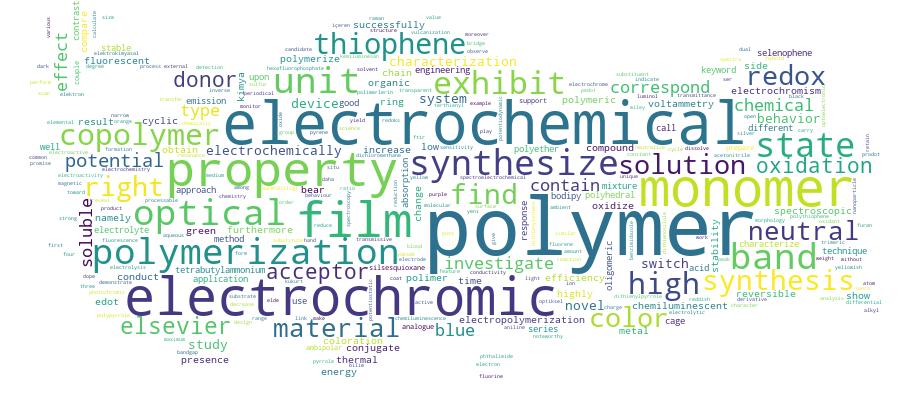
23 results
Scholarly Output Search Results
Now showing 1 - 10 of 23
Article Citation - WoS: 7Citation - Scopus: 6Side Chain Effect on the Electrochemical and Optical Properties of Thieno[3,4-c]pyrrole-4,6-dione Based Donor-Acceptor Donor Type Monomers and Polymers(Royal Soc Chemistry, 2023) Cakal, Deniz; Arabaci, Elif Demir; Yildirim, Erol; Cihaner, Atilla; Onal, Ahmet M.; Demir Arabacı, ElifIn organic pi-conjugated materials, side chains play great roles that impact far beyond solubility. In this work, we mainly focused on the synthesis of new donor-acceptor-donor (D-A-D) type conjugated monomers and their corresponding polymers appending thieno[3,4-c]pyrrole-4,6-dione (TPD) acceptor with a new side chain, fluorene (Fl), to investigate the side chain effect. In this context, to reveal the precise effect of the side chains on the optical and electrochemical properties of the monomers and polymers synthesized in this work, four series of D-A-D monomers, each containing a TPD core unit with a different side chain, are compared and discussed in relation to each other. Notably, it was discovered that the TPD acceptor unit can be modified with any functional group other than common alkyl chains to impart new functionalities by maintaining their superior optoelectronic properties. New types of side chains can be used to tune the physical characteristics, such as solubility, absorption, emission, and molecular packing. In this work, Fl-appended monomers as a new class of D-A-D type pi-conjugated molecules containing 3,4-ethylenedioxythiophene (EDOT (E)) and 3,4-propylenedioxythiophene (ProDOT (P)) donor units were studied and it was found that 1,3-bis(2,3-dihydrothieno[3,4-b][1,4]dioxin-5-yl)-5-(9H-fluoren-2-yl)-4H-thieno[3,4-c]pyrrole-4,6(5H)-dione (E(Fl)) and 1,3-bis(3,3-didecyl-3,4-dihydro-2H-thieno[3,4-b][1,4]dioxepin-6-yl)-5-(9H-fluoren-2-yl)-4H-thieno[3,4-c]pyrrole-4,6(5H)-dione (P(Fl)) exhibited reasonable quantum yields and their corresponding polymers revealed ambipolar character with slightly lower band gap as compared to the previous analogues containing other side chains. Observed experimental results were elucidated by first principle calculations. In this paper, we discussed that using side chain engineering is an effective strategy for improving next-generation organic pi-conjugated materials with the desired properties.Article Synthesis and Characterization of a Luminol Based Chemiluminescent Trimeric System(Springer/plenum Publishers, 2023) Kesimal, Busra; Balci, Burcu; Cakal, Deniz; Onal, Ahmet M.; Cihaner, AtillaA luminol based chemiluminescent trimeric system, namely 2,3-dihydro-5,8-di(thiophen-2-yl)phthalazine-1,4-dione (T2B-Lum), bearing thiophene rings as donor units and 2,3-dihydrophthalazine-1,4-dione as an acceptor unit was synthesized in two steps via donor-acceptor-donor approach using two different methods. It was found that T2B-Lum emits chemiluminescent light when exposed to H2O2 in a basic medium, and the presence of substituents and the type of aromatic ring bearing chemiluminescent active group have a direct effect on the compound's sensitivity. Among the members of a large family of metal ions, fluorescent and chemiluminescent T2B-Lum exhibited high sensitivity to Cu2+ and Fe3+ ions. Except for other metal cations (silver(I), cadmium(II), cobalt(II), iron(III), lithium(I), magnesium(II), manganese(II), nickel(II), zinc(II)), it has been observed that T2B-Lum is mostly sensitive to copper(II) ions with a detection limit value of 2.2 x 10(- 3) M. On the other hand, T2B-Lum was also found to exhibit a high sensitivity to extremely dilute aqueous solutions (e.g., 1:50.000 dilution) of blood samples, making it a promising candidate for use in forensic applications.Article Citation - WoS: 30Citation - Scopus: 32Effect of Fluorine Substituted Benzothiadiazole on Electro-Optical Properties of Donor-Acceptor Type Monomers and Their Polymers(Elsevier Sci Ltd, 2020) Cakal, Deniz; Ercan, Yunus Emre; Onal, Ahmet M.; Cihaner, AtillaA series of trimeric monomers bearing thiophene donor units and fluorinated analogues of benzothiadiazole acceptor units was synthesized via donor-acceptor-donor approach and polymerized electrochemically in order to investigate the effect of fluorine atom on electro-optical properties of both monomers and their corresponding polymers. All monomers exhibited solvatochromic and fluorescent properties. The introduction of fluorine atom into the conjugated backbone increased the oxidation potentials. Upon moving from nonfluorinated to fully fluorinated analogues, the oxidation potential shifts anodically from 1.30 V to 1.7 V. As in the case of monomers, the fluorine atom substitution also resulted in a decrease in the HOMO energy level of the corresponding polymers, leading to an increase in the electrochemical band gap energy (1.71-1.97 eV). This result can be attributed to deviations from planarity and also to decrease in the effective conjugation length. The polymeric film also exhibited electrochromic properties under various external potentials. Switching time and coloration efficiency values decreased with increasing number of fluorine atom substitution.Article Citation - WoS: 21Citation - Scopus: 21Synthesis and Electro-Optical Properties of New Conjugated Hybrid Polymers Based on Furan and Fluorene Units(Pergamon-elsevier Science Ltd, 2013) Gunes, Arzu; Cihaner, Atilla; Onal, Ahmet M.A novel series of hybrid monomers containing furan and fluorene units, namely 2-(2-(furan-2-yl)-9H-fluoren-7-yl)furan (FFF), 2,7-di(furan-2-yl)-9H-fluoren-9-one (FOF) and 2-(2-(furan-2-yl)-9,9-dihexyl-9H-fluoren-7-yl)furan (FHF), was synthesized and their electrochemical polymerization was achieved via potential cycling. Optical and electrochemical properties of the polymers, poly(2-(2-(furan-2-yl)9H-fluoren-7-yl)furan (PFFF), poly(2,7-di(furan-2-yl)-9H-fluoren-9-one) (PFOF) and poly(2-(2-(furan2-yl)-9,9-dihexyl-9H-fluoren-7-yl)furan) (PFHF), were investigated and it was found that polymer films exhibited quasi-reversible redox behavior (E-p(ox) =0.92V for PFFF, E-p(ox) = 1.08V for PFOF and E-p(ox) = 0.99V for PFHF) accompanied with a reversible electrochromic behavior, yellow to dark blue for PFFF, orange to green for PFOF and orange to green for PFHF. Their band gap values (E-g) were found to be 2.49, 2.32 and 2.61 eV for PFFF, PFOF and PFHF, respectively. (C) 2012 Elsevier Ltd. All rights reserved.Article Citation - WoS: 7Citation - Scopus: 7Electrochemical and optical properties of dicyclohexylmethyl substituted poly(3,4-propylenedioxythiophene) analogue(Wiley, 2018) Cakal, Deniz; Cihaner, Atilla; Onal, Ahmet M.An analogue of disubstituted 3,4-propylenedioxythiophenes, namely 3,3-bis(cyclohexylmethyl)-3,4-dihydro-2H-thieno[3,4-b][1,4]dioxepin (ProDOT-CycHex(2)), was synthesized and its electrochemical polymerization was carried out successfully in an electrolyte solution of 0.1 M tetrabutylammonium hexafluorophosphate dissolved in a mixture of acetonitrile and dichloromethane (3/1: v/v). The corresponding polymer called PProDOT-CycHex(2) has a reduced band gap of 1.85 eV and an electrochromic property: blue/violet when neutralized and highly transparent when oxidized. Also, PProDOT-CycHex(2) film exhibited faster response time (0.7 s) and higher coloration efficiency (769 cm(2)/C) during oxidation when compared to its benzyl substituted analogue. (c) 2018 Wiley Periodicals, Inc. J. Appl. Polym. Sci. 2018, 135, 46214.Article Citation - WoS: 2Citation - Scopus: 3Effect of Phthalimide and Thieno[3,4-C]pyrrole Acceptors on P-Conjugated Donor-Acceptor Monomers: Experimental and Theoretical Investigations of Photophysical and Electrochemical Properties(Pergamon-elsevier Science Ltd, 2023) Cakal, Deniz; Arabaci, Elif Demir; Yildirim, Erol; Cihaner, Atilla; Onal, Ahmet M.; Demir Arabacı, ElifIn this study, two novel donor-acceptor-donor monomers were synthesized by coupling a phthalimide (PI) acceptor unit with thiophene (T) and ethylenedioxythiophene (EDOT (E)) donor units. These two novel PI-based monomers, namely 2-(2-ethylhexyl)-4,7-di(thiophen-2-yl)isoindoline-1,3-dione (T-PI) and 4,7-bis(2,3-dihydrothieno[3,4-b] [1,4]dioxin-5-yl)-2-(2-ethylhexyl)isoindoline-1,3-dione (E-PI), were fully characterized via UV-vis and fluorescence spectroscopy as well as electrochemical methods, and the results were directly compared with those of previously synthesized thieno[3,4-c]pyrrole-4,6-dione (TPD)-based analogues to report the results for four classes of monomers. In this regard, the ef-fects of different donor groups and structural modifications in the acceptor unit as changed from PI to TPD have been investigated to reveal the precise effect of the donor and acceptor on the optical and electrochemical properties of the monomers. All monomers exhibits an intramolecular charge transfer band in the low energy region due to strong donor and acceptor interactions. The oxidation and reduction potentials of the monomers are found to vary depending on the strengths of both donor and acceptor units. PI-based monomers show more positive oxidation and less negative reduction potentials than TPD-based analogues. Similarly, thiophene-based analogues reveal the same trend in their oxidation and reduction potentials as compared to EDOT-based analogues. Lastly, PI-based monomers could not undergo polymerization via electrochemical method, unlike TPD-based monomers, since the dihedral angle arising between donor and PI acceptor disturbs molecular planarity significantly, as demonstrated by first principle calculations.(C) 2023 Elsevier Ltd. All rights reserved.Article Citation - WoS: 52Citation - Scopus: 59Furan and benzochalcogenodiazole based multichromic polymers via a donor-acceptor approach(Royal Soc Chemistry, 2013) Icli-Ozkut, Merve; Ipek, Halil; Karabay, Baris; Cihaner, Atilla; Onal, Ahmet M.Two new furan and benzochalcogenodiazole based monomers, namely 4,7-di(furan-2-yl) benzo[c][1,2,5]-selenadiazole (FSeF) and 4,7-di(furan-2-yl) benzo[c][1,2,5]thiadiazole (FSF), were designed and synthesized via a donor-acceptor-donor approach. The monomers were electrochemically polymerized via potentiodynamic or potentiostatic methods. The monomers and their polymers exhibited lower oxidation potentials (1.16 V and 1.06 V for monomers; 0.93 V and 0.80 V for polymers vs. Ag/AgCl) and red shifts of the whole dual-band absorption spectra upon moving from S to Se. Intramolecular charge transfer properties of the monomers and the polymers were demonstrated by using electroanalytical and optical methods. Also, the polymers PFSeF and PFSF were multicolored at different redox states and have low band gaps of 1.43 eV and 1.61 eV, respectively.Article Citation - WoS: 61Citation - Scopus: 72A Blue To Highly Transmissive Soluble Electrochromic Polymer Based on Poly(3,4-Propylenedioxyselenophene) With a High Stability and Coloration Efficiency(Royal Soc Chemistry, 2011) Ozkut, Merve Icli; Atak, Samed; Onal, Ahmet M.; Cihaner, AtillaThe optical and electrochemical properties of a regioregular and soluble alkylenedioxyselenophene-based electrochromic polymer, namely poly(3,3-didecyl-3,4-dihydro-2H-selenopheno[3,4-b][1,4] dioxepine (PProDOS-C-10), which is synthesized by electrochemical polymerization, are highlighted. It is noted that this unique polymer has a low band gap (1.58 eV) and is exceptionally stable under ambient atmospheric conditions. Polymer films retain 97% of their electroactivity after 40 000 cycles. The percentage transmittance of a PProDOS-C10 film was found to be 56.4% at 638 nm and 55.8% at 700 nm. Furthermore, this novel soluble PProDOS-C10 polymer shows an electrochromic behavior: a color change from pure blue to a highly transparent state in a low switching time (1.0 s) during oxidation, with high coloration efficiencies (328 cm 2 C-1 at 638 nm and 319 cm(2) C-1 at 700 nm) when compared to its thiophene analogue.Article Citation - WoS: 11Citation - Scopus: 11Electrochemical and Optical Properties of Substituted Phthalimide Based Monomers and Electrochemical Polymerization of 3,4-Ethylenedioxythiophene Oligomeric Silsesquioxane (poss) Analogue(Elsevier Sci Ltd, 2019) Cakal, Deniz; Ertan, Salih; Cihaner, Atilla; Onal, Ahmet M.A new series of donor-acceptor-donor type trimeric monomers bearing substituted phthalimide units as acceptor units and thiophene and 3,4-ethylenedioxythiophene (EDOT) as donor units was synthesized and characterized. The strength of acceptor units and intramolecular charge transfer between donor and acceptor units were investigated by using electrochemical and optical methods. The main advantage of phthalimide unit over other acceptor units is the ease of its functionalizability. Thus, utilizing this property, a phthalimide derivative (E2P-POSS) bearing polyhedral oligomeric silsesquioxane (POSS) cage was introduced successfully with EDOT and polymerized electrochemically. The corresponding electroactive polymer, PE2P-POSS, has a band gap of 1.72 eV and is an electrochromic polymer: gray when neutralized and eggplant purple when oxidized.Article Citation - WoS: 52Citation - Scopus: 57Members of Cmy Color Space: Cyan and Magenta Colored Polymers Based on Oxadiazole Acceptor Unit(Amer Chemical Soc, 2012) Ozkut, Merve Icli; Algi, Melek Pamuk; Oztas, Zahide; Algi, Fatih; Onal, Ahmet M.; Cihaner, AtillaIn this study, three novel oxadiazole-based polymers were synthesized and their electrochemical and optical properties were investigated. The polymers were found to have both p- and n-type doping properties accompanied by electrochromic response. Two polymer films exhibit cyan and magenta colors, which constitute two legs of CMY color spaces, in their neutral states and they are soluble in common-organic solvents. According to the color mixing theory, all colors in the visible spectrum including black color can be obtained by using these polymers with a yellow colored electrochromic polymer. Among these polymers, the polymer bearing propyledioxythiophene donor units has some superior properties like high stability (it retains 94% of its electroactivity after 2000 cycles), solubility, and high coloration efficiency (230 cm(2)/C), whereas as expected ethylenedioxythiophene containing one has the lowest band gap as 1.08 eV.

- «
- 1 (current)
- 2
- 3
- »