
Cihaner, Atilla
Loading...
Profile URL
Name Variants
C.,Atilla
A., Cihaner
C., Atilla
Cihaner A.
A.,Cihaner
Cihaner, Atilla
Cihaner,A.
Atilla Cihaner
Atilla, Cihaner
Cihaner,Atilla
Cihaner, A.
Cihaner, A
A., Cihaner
C., Atilla
Cihaner A.
A.,Cihaner
Cihaner, Atilla
Cihaner,A.
Atilla Cihaner
Atilla, Cihaner
Cihaner,Atilla
Cihaner, A.
Cihaner, A
Job Title
Profesör Doktor
Email Address
atilla.cihaner@atilim.edu.tr
Main Affiliation
Chemical Engineering
Status
Website
ORCID ID
Scopus Author ID
Turkish CoHE Profile ID
Google Scholar ID
WoS Researcher ID
Sustainable Development Goals
 1
1NO POVERTY
0
Research Products
 2
2ZERO HUNGER
0
Research Products
 3
3GOOD HEALTH AND WELL-BEING
1
Research Products
 4
4QUALITY EDUCATION
0
Research Products
 5
5GENDER EQUALITY
0
Research Products
 6
6CLEAN WATER AND SANITATION
1
Research Products
 7
7AFFORDABLE AND CLEAN ENERGY
3
Research Products
 8
8DECENT WORK AND ECONOMIC GROWTH
0
Research Products
 9
9INDUSTRY, INNOVATION AND INFRASTRUCTURE
0
Research Products
 10
10REDUCED INEQUALITIES
0
Research Products
 11
11SUSTAINABLE CITIES AND COMMUNITIES
0
Research Products
 12
12RESPONSIBLE CONSUMPTION AND PRODUCTION
0
Research Products
 13
13CLIMATE ACTION
0
Research Products
 14
14LIFE BELOW WATER
0
Research Products
 15
15LIFE ON LAND
0
Research Products
 16
16PEACE, JUSTICE AND STRONG INSTITUTIONS
0
Research Products
 17
17PARTNERSHIPS FOR THE GOALS
0
Research Products

Documents
101
Citations
2379
h-index
28

Documents
103
Citations
2265

Scholarly Output
121
Articles
108
Views / Downloads
122/151
Supervised MSc Theses
12
Supervised PhD Theses
0
WoS Citation Count
2265
Scopus Citation Count
2360
Patents
0
Projects
13
WoS Citations per Publication
18.72
Scopus Citations per Publication
19.50
Open Access Source
6
Supervised Theses
12
| Journal | Count |
|---|---|
| Electrochimica Acta | 15 |
| Journal of Electroanalytical Chemistry | 13 |
| Turkish Journal of Chemistry | 6 |
| Dyes and Pigments | 6 |
| Organic Electronics | 6 |
Current Page: 1 / 8
Scopus Quartile Distribution
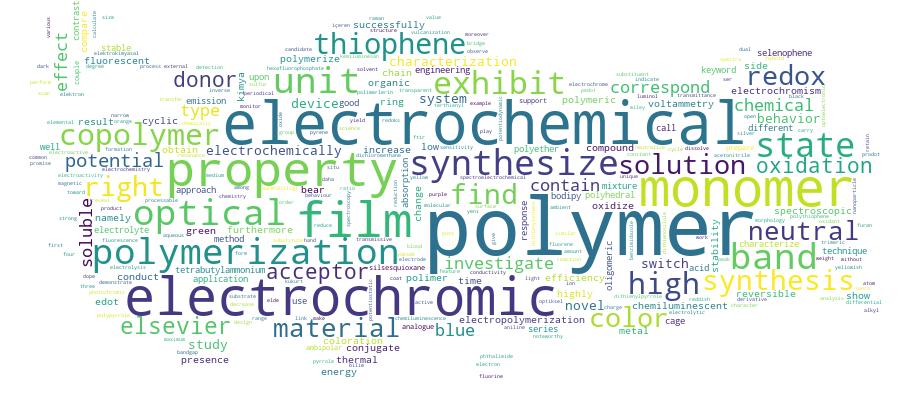
Competency Cloud
6 results
Scholarly Output Search Results
Now showing 1 - 6 of 6
Article Citation - WoS: 30Citation - Scopus: 31A New Low-Voltage Polymeric Electrochromic(Elsevier Sci Ltd, 2010) Pamuk, Melek; Tirkes, Seha; Cihaner, Atilla; Algi, FatihDesign, synthesis, and properties of a novel donor-acceptor-donor type low-voltage-driven green polymeric electrochrome, P1, which is based on 8-(2,3-dihydrothieno[3,4-b][1,4]dioxin-5-yl)-11-(2,3-dihydrothieno[3,4-b][l,4]dioxin-7-yl)acenaphtho[1,2-b]quinoxaline (1) are highlighted. It is noted that P1 has an ambipolar (n- and p-doping processes) character in 0.1 M tetrabutylammonium hexafluorophosphate/dichloromethame solution and switches to a transmissive blue state upon oxidation. Furthermore, this new polymeric electrochromic candidate exhibits high redox stability, high coloration efficiency and/or contrast ratio, high percent transmittance (%T) and low response time (1.0 s) with a band gap of 1.10 eV-1.25 eV. (C) 2009 Elsevier Ltd. All rights reserved.Article Citation - WoS: 25Citation - Scopus: 27A New Processable and Fluorescent Polydithienylpyrrole Electrochrome With Pyrene Appendages(Pergamon-elsevier Science Ltd, 2013) Tirkes, Seha; Mersini, Jetmire; Oztas, Zahide; Algi, Melek Pamuk; Algi, Fatih; Cihaner, AtillaA new hybrid compound, namely 1-(pyren-3-yl)-2,5-di(thiophen-2-yl)-1H-pyrrole (SNS-P), was polymerized via both chemical and electrochemical methods. Chemically obtained soluble polydithienylpyrrole (c-PSNS-P) bearing pyrene appendages is a homogeneous and uniform polymer with a number averaged molecular weight of 15,200 g/mol. The polymer exhibits both multi-electrochromic and fluorescent properties. Upon oxidation, the color of electrochemically obtained polymer (e-PSNS-P) changes from yellowish orange to greenish yellow and to green/blue and finally to blue. In addition, the polymer induces yellowish orange (564 nm) and bright orange emission (613 nm) in solution and solid states, respectively. (C) 2012 Elsevier Ltd. All rights reserved.Article Citation - WoS: 33Citation - Scopus: 34An ambipolar neutral state green polymeric electrochromic(Elsevier, 2009) Algi, Fatih; Cihaner, AtillaThe synthesis and properties of highly stable neutral state green polymeric electrochromic, P1, which is based on 5,8-bis(2,3-dihydrothieno[3,4-b][1,4]dioxin-5-yl)-2,3-di(1H-pyrrol-2-yl)quinoxaline were highlighted. P1 exhibits three well-defined absorption bands with a narrow band gap (1.17 eV). The n- and p-doping (ambipolar) processes suggest that P1 is one of the most promising neutral state green polymers and it can be used in supercapacitors as either cathode or anode electrode material. Apart from the stability and the robustness of the polymer film, P1 shows multi-electrochromic behavior; gray-purple in the reduced form and highly transmissive blue color in the oxidized state. (C) 2009 Elsevier B.V. All rights reserved.Article Citation - WoS: 13Citation - Scopus: 15Atomistic Engineering of Chemiluminogens: Synthesis, Properties and Polymerization of 2,3-Dihydro Scaffolds(Springer/plenum Publishers, 2017) Algi, Melek Pamuk; Tirkeş, Seha; Oztas, Zahide; Cihaner, Atilla; Tirkes, Seha; Cihaner, Atilla; Algi, Fatih; Tirkeş, Seha; Cihaner, Atilla; Chemical Engineering; Chemical EngineeringTwo chemiluminescent compounds containing 2,5-di(thien-2-yl)pyrrole and pyridazine units, namely 5,7-di(thiophen-2-yl)-2,3-dihydro-1H-pyrrolo[3,4-d]pyridazine-1,4(6H)-dione (5) and 6-phenyl-5,7-di(thiophen-2-yl)-2,3-dihydro-1H-pyrrolo[3,4-d]pyridazine-1,4(6H)-dione (6), were successfully synthesized and electrochemically polymerized. The compounds have chemiluminescent properties and glow in the presence of hydrogen peroxide in basic medium. The intensity of the glow can be increased dramatically by using Fe3+ ions, hemin (1.0 ppm) or blood samples (1.0 ppm) as catalyst. The compounds 5 and 6 have one well-defined irreversible oxidation peak at 1.08 V and 1.33 V vs Ag/AgCl, respectively. Electrochemical polymerization of both 5 and 6 were carried out successfully by repeating potential scanning in the presence of BF3. Et2O in an electrolyte solution of 0.1 M LiClO4 dissolved in acetonitrile. The electronic band gaps (E-g) of the polymers P5 and P6 were found to be 2.02 eV and 2.16 eV, respectively. On the other hand, the corresponding polymers are electroactive and exhibited electrochromic features.Article Citation - WoS: 94Citation - Scopus: 100A New Soluble Neutral State Black Electrochromic Copolymer Via a Donor-Acceptor Approach(Elsevier, 2010) Icli, Merve; Pamuk, Melek; Algi, Fatih; Onal, Ahmet M.; Cihaner, AtillaTwo donor-acceptor systems, 2-decyl-4,7-bis(3,3-didecyl-3,4-dihydro-2H-thieno[3,4-b][1,4]dioxepin-6-yl)-2H-benzo[d][1,2,3]triazole (1) and 4,7-bis(3,3-didecyl-3,4-dihydro-2H-thieno[3,4-b][1,4]dioxepin-6-yl)-2,1,3-benzoselenadiazole (2) are explored in order to attain a low bandgap black polymer electrochrome, which is highly difficult to attain due to the complexity of designing such materials. Electrochemical polymerization of 1 and 2 in 1:4 monomer feed ratio was performed in a mixture of acetonitrile and dichloromethane solution containing 0.1 M tetrabutylammonium hexafluorophosphate. It was found that electropolymerization provides a processable neutral state black copolymer, (P(1-co-2)), which absorbs virtually the whole visible spectrum (400-800 nm). (P(1-co-2)) is the first low bandgap (1.45 eV) electropolymerized material, which switches from black color (L = 14.3, a = 0.29, b = 0.35) in the neutral state to transmissive grey (L = 39.2, a = 0.29, b = 0.33) in the oxidized state with 15.3% of the transmittance change at 522 nm. Furthermore, it exhibits excellent operational and/or environmental stability under ambient conditions. (c) 2010 Elsevier B.V. All rights reserved.Article Citation - WoS: 23Citation - Scopus: 25A Neutral State Yellow To Navy Polymer Electrochrome With Pyrene Scaffold(Elsevier Science Bv, 2011) Icli-Ozkut, Merve; Cihaner, Atilla; Oztas, Zahide; Algi, Fatih; Cihaner, Atilla; Cihaner, Atilla; Içi-Özkut, Merve; Chemical Engineering; Chemical EngineeringA new pyrene based soluble polymer, namely poly(3,3-didecyl-6-(1-(3,3-didecyl-3,4-dihydro-2H-thieno[3,4-b][1,4] dioxepin-6-yl) pyren-6-yl)-3,4-dihydro-2H-thieno[3,4-b][1,4] dioxepine), P5, which is synthesized by both chemical and electrochemical methods, is highlighted. The polymer shows both electrochromic and fluorescent properties (the emission of yellow (545 nm) and yellowish green light (524 nm) in solid state and in THF solution, respectively). It is noteworthy that P5 has a specific optical band gap (2.2 eV) to reflect the yellow color in the neutral state. Furthermore, the optical and electrochemical features of the polymer were investigated. (C) 2011 Elsevier B. V. All rights reserved.
