Sıngh, Vımal

Loading...
Profile Picture
Name Variants
Singh, Vim
Singh,V.
V., Singh
S., Vimal
Vimal, Singh
V.,Sıngh
S.,Vimal
Sıngh, Vımal
V.,Singh
S.,Vımal
Singh, Vimal
Vımal, Sıngh
Sıngh,V.
Singh, V
Singh, V
Singh, V.
Job Title
Profesör Doktor
Email Address
Main Affiliation
Department of Mechatronics Engineering
Status
Former Staff
Website
ORCID ID
Scopus Author ID
Turkish CoHE Profile ID
Google Scholar ID
WoS Researcher ID

Sustainable Development Goals

SDG data is not available
This researcher does not have a Scopus ID.
This researcher does not have a WoS ID.
Scholarly Output

78

Articles

67

Views / Downloads

204/0

Supervised MSc Theses

0

Supervised PhD Theses

0

WoS Citation Count

1911

Scopus Citation Count

2172

WoS h-index

25

Scopus h-index

27

Patents

0

Projects

0

WoS Citations per Publication

24.50

Scopus Citations per Publication

27.85

Open Access Source

1

Supervised Theses

0

Google Analytics Visitor Traffic

JournalCount
Chaos, Solitons & Fractals16
IEEE Transactions on Circuits and Systems II: Express Briefs7
IEE Proceedings - Control Theory and Applications6
Automatica5
Digital Signal Processing5
Current Page: 1 / 6

Scopus Quartile Distribution

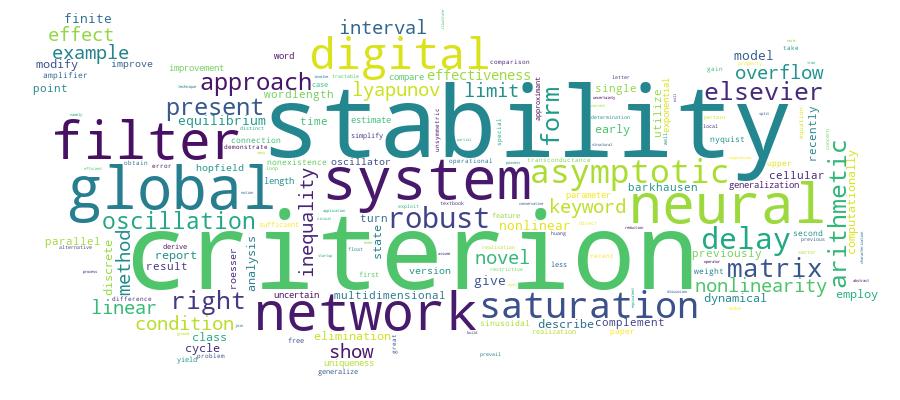
Competency Cloud

GCRIS Competency Cloud

Scholarly Output Search Results

Now showing 1 - 5 of 5
  • Letter
    Citation - WoS: 22
    Citation - Scopus: 24
    A Note on Determination of Oscillation Startup Condition
    (Springer, 2006) Singh, Vimal
    There prevails a widespread notion that, given a closed-loop system, oscillation will commence and build up therein if the magnitude of loop gain is greater than unity at the frequency at which the angle of loop gain is zero degree. Three novel examples in which this notion fails are presented.
  • Letter
    Citation - WoS: 3
    Citation - Scopus: 3
    Global Robust Stability of Interval Delayed Neural Networks: Modified Approach
    (Wiley, 2009) Singh, Vimal
    A criterion for the global robust stability of Hopfield-type delayed neural networks with the intervalized network parameters is presented. The criterion, which is derived by utilizing the idea of splitting the given interval into two intervals, is in the form of linear matrix inequality and, hence, computationally tractable. The criterion yields a less conservative condition compared with many recently reported criteria, as is demonstrated with an example. Copyright (C) 2008 John Wiley & Sons, Ltd.
  • Letter
    Citation - WoS: 29
    Citation - Scopus: 32
    Stability Analysis of 2-D Digital Filters With Saturation Arithmetic: an Lmi Approach
    (Ieee-inst Electrical Electronics Engineers inc, 2005) Kar, H; Singh, V
    An improved LMI-based criterion for the nonexistence of overflow oscillations in two-dimensional (2-D) digital filters described by the Roesser model employing saturation arithmetic is presented. The criterion makes use of the structural properties (as prevailing in the system under consideration) of the saturation nonlinearities in a greater detail than the usual sector restriction [0, 1].
  • Letter
    Citation - WoS: 58
    Citation - Scopus: 68
    Stability of 2-D Systems Described by the Fornasini-Marchesini First Model
    (Ieee-inst Electrical Electronics Engineers inc, 2003) Kar, H; Singh, V
    A sufficient condition for the stability of linear two-dimensional (2-D) systems described by the Fornasini-Marchesini (FM) first model is presented. The condition is compared with previously reported conditions.
  • Letter
    Citation - WoS: 23
    Citation - Scopus: 26
    Failure of Barkhausen Oscillation Building Up Criterion: Further Evidence
    (Springer, 2007) Singh, Vimal
    It has been suggested in many textbooks that, given a closed-loop system, oscillation will commence and build up therein if the magnitude of loop gain is greater than unity at the frequency at which the angle of loop gain is zero degree. A novel ideal op-amp based counterexample to this suggestion is presented. The Letter serves to substantiate the findings in a recent Letter. A discussion relating to the finite gain of op-amp is included.