
Mıshra, Alok
Loading...
Profile URL
Name Variants
Mishra, A.
Mishra, A
Mishra A.
Alok, Mishra
Mıshra, Alok
A., Mishra
Alok M.
M., Alok
M.,Alok
Mishra, Alok
Mishra,A.
A.,Mıshra
A.,Mishra
Alok, Mıshra
A., Mıshra
Mıshra,A.
Mishra, A
Mishra A.
Alok, Mishra
Mıshra, Alok
A., Mishra
Alok M.
M., Alok
M.,Alok
Mishra, Alok
Mishra,A.
A.,Mıshra
A.,Mishra
Alok, Mıshra
A., Mıshra
Mıshra,A.
Job Title
Profesor Doktor
Email Address
alok.mishra@atilim.edu.tr
Main Affiliation
Software Engineering
Status
Website
ORCID ID
Scopus Author ID
Turkish CoHE Profile ID
Google Scholar ID
WoS Researcher ID
Sustainable Development Goals
 1
1NO POVERTY
0
Research Products
 2
2ZERO HUNGER
1
Research Products
 3
3GOOD HEALTH AND WELL-BEING
9
Research Products
 4
4QUALITY EDUCATION
6
Research Products
 5
5GENDER EQUALITY
1
Research Products
 6
6CLEAN WATER AND SANITATION
1
Research Products
 7
7AFFORDABLE AND CLEAN ENERGY
0
Research Products
 8
8DECENT WORK AND ECONOMIC GROWTH
0
Research Products
 9
9INDUSTRY, INNOVATION AND INFRASTRUCTURE
8
Research Products
 10
10REDUCED INEQUALITIES
0
Research Products
 11
11SUSTAINABLE CITIES AND COMMUNITIES
4
Research Products
 12
12RESPONSIBLE CONSUMPTION AND PRODUCTION
4
Research Products
 13
13CLIMATE ACTION
4
Research Products
 14
14LIFE BELOW WATER
4
Research Products
 15
15LIFE ON LAND
0
Research Products
 16
16PEACE, JUSTICE AND STRONG INSTITUTIONS
10
Research Products
 17
17PARTNERSHIPS FOR THE GOALS
2
Research Products

Scopus data could not be loaded because of an error. Please refresh the page or try again later.

Documents
170
Citations
2558

Scholarly Output
197
Articles
103
Views / Downloads
161/259
Supervised MSc Theses
13
Supervised PhD Theses
8
WoS Citation Count
2079
Scopus Citation Count
3045
Patents
0
Projects
0
WoS Citations per Publication
10.55
Scopus Citations per Publication
15.46
Open Access Source
42
Supervised Theses
21
| Journal | Count |
|---|---|
| Sensors | 7 |
| TEM Journal | 7 |
| Computers in Human Behavior | 4 |
| Applied Sciences | 4 |
| Electronics Information and Planning | 4 |
Current Page: 1 / 22
Scopus Quartile Distribution
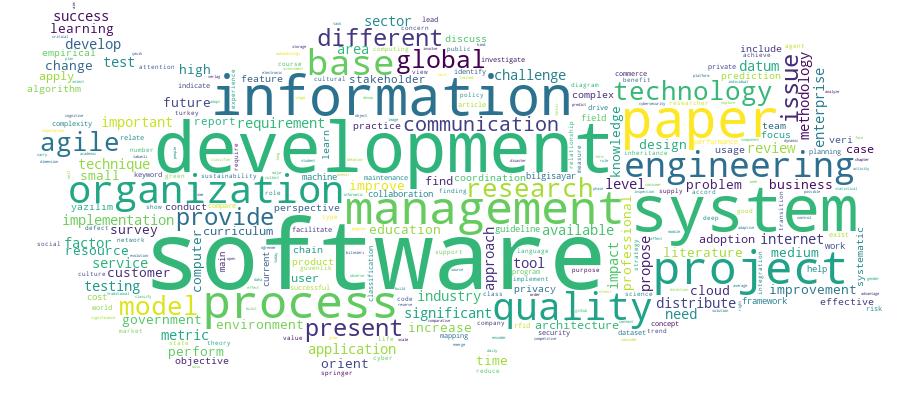
Competency Cloud
54 results
Scholarly Output Search Results
Now showing 1 - 10 of 54
Conference Object Citation - WoS: 6Cultural Issues in Distributed Software Development: a Review(Springer-verlag Berlin, 2014) Mishra, Alok; Mishra, DeeptiCultural impact is significant in global or distributed software development. Due to cultural differences, co-ordination and collaboration problems have been reported in case studies and this also leads to low quality deliverables and high turnover in software industry. This paper presents a literature review of distributed software development (DSD) or global software development (GSD) and cultural issues. The main focus is to highlight the current research, observations, as well as practice directions in these areas. Many studies have been performed in culture and global software development, still impact of culture in distributed software development in different dimensions received less attention among researchers.Conference Object Üniversite Yazilim Mühendisligi Programlari Müfredatinin Swebok Kilavuzu Kullanilarak Degerlendirme ve İyilestirilmesi: Türkiye'de Bir Vaka Çalismasi(CEUR-WS, 2015) Garousi,V.; Mishra,A.; Yazici,A.[No abstract available]Conference Object Citation - WoS: 9Successful Requirement Elicitation by Combining Requirement Engineering Techniques(Ieee, 2008) Mishra, Deepti; Mishra, Alok; Yazici, AliThe role of customers and other stakeholders is becoming increasingly significant during requirement engineering activities. Methods of eliciting requirements are now more co-operative. There are many techniques to obtain requirements from customers. Selecting the right techniques according to the characteristics of the project is very important. In some complex problems, combination of requirement engineering techniques should be applied for efficient and successful requirement engineering process. In this paper, we have presented the application of combination of requirement engineering techniques for a real life complex project (Supply Chain Management) with higher requirements volatility developed in a small scale software development organization, This will help in understanding requirements elicitation for such kind of complex software and facilitate in selecting the appropriate techniques towards getting the consistent and complete requirements.Conference Object Citation - WoS: 3Global Software Development and Quality Management: a Systematic Review(Springer-verlag Berlin, 2013) Mishra, Deepti; Mishra, Alok; Colomo-Palacios, Ricardo; Casado-Lumbreras, CristinaThis paper presents a systematic literature review of global software development (GSD) and quality management aspects. The main focus is to highlight the current research and practice direction in these areas. The results have been limited to peer-reviewed conference papers and journal articles, published between 2000 and 2011. The analysis reports that major studies have been performed in quality and process management, while verification and validation issues of GSD can only get limited attention among researchers. This indicates the need for future research (quantitative and qualitative) in these areas.Conference Object Scale Up Internet-Based Business Through Distributed Data Centers(Springer international Publishing Ag, 2015) Yu, Liguo; Mishra, Alok; Mishra, DeeptiDistributed data centers are becoming more and more important for internet-based companies. Without distributed data centers, it will be hard for internet companies to scale up their business. The traditional centralized data center suffers the drawback of bottle neck and single failure problem. Therefore, more and more internet companies are building distributed data centers, and more and more business are moved onto distributed Web services. This paper reviews the history of distributed Web services and studies their current status through examining the distributed data centers of several top Internet companies. Based on the study, we conclude that distributed services, including distributed data centers, are the key factors to scale up the business of a company, especially, an internet-based company.Conference Object Citation - WoS: 1Sustainable Software Engineering: a Move Towards Future(Ieee, 2017) Mishra, Alok[No Abstract Available]Conference Object Citation - WoS: 9Citation - Scopus: 57Successful Requirement Elicitation by Combining Requirement Engineering Techniques(IEEE, 2008) Mishra,D.; Mishra,A.; Yazici,A.The role of customers and other stakeholders is becoming increasingly significant during requirement engineering activities. Methods of eliciting requirements are now more co-operative. There are many techniques to obtain requirements from customers. Selecting the right techniques according to the characteristics of the project is very important. In some complex problems, combination of requirement engineering techniques should be applied for efficient and successful requirement engineering process. In this paper, we have presented the application of combination of requirement engineering techniques for a real life complex project (Supply Chain Management) with higher requirements volatility developed in a small scale software development organization.This will help in understanding requirements elicitation for such kind of complex software and facilitate in selecting the appropriate techniques towards getting the consistent and complete requirements. ©2008 IEEE.Conference Object Citation - Scopus: 1Crm System Implementation in a Multinational Enterprise(2009) Mishra,A.; Mishra,D.The concept of customer relationship management (CRM) resonates with managers in today's competitive economy. As more and more organizations realize the significance of becoming customer-centric in today's competitive era, they embrace CRM as a core business strategy. CRM an integration of information technology and relationship marketing provides the infrastructure that facilitates long-term relationship building with customers at an enterprise-wide level. Successful CRM implementation is a complex, expensive and rarely technical projects. This paper presents the successful implementation of CRM in a multinational organization. This study will facilitate in understanding transition, constraints and implementation of CRM in multinational enterprises. © Springer-Verlag 2009.Conference Object Informatics Engineering Education in Turkey and Expectations of Software Industry(Ieee, 2018) Yazici, Ali; Mishra, Alok; Karakaya, Ziya; Ustunkok, TolgaIn this study, using the OSYM data, the number of intakes in Informatics Engineering programs in Turkey, accreditation data and the medium of instruction of the program are summarized for the years 2016 and 2017. In addition, the software sector's expectations from the informatics engineering graduates are reassessed based on the academic studies. The developed knowledge-skill gap set was used to evaluate the situation in Turkish informatics engineering programs. Sector expectations are discussed in the context of 2017-2019 Turkey Software Sector Strategy and Action Plan prepared by the Ministry of Science, Industry and Technology of Turkey and some proposals are made for the academia. As a result, it was observed that the expectations of the software industry were similar in all studies. Additionally, the expectations were changed in the direction of developing technologies and this change should be reflected in the informatics engineering programs.Conference Object Citation - Scopus: 1Inventory System Transition Towards ERP(Institute of Electrical and Electronics Engineers Inc., 2019) Alansari,S.; Mishra,A.To do activities effectively and generate a value chain for organization competitiveness, it is required to run supply chain in best way by logistic services information system. Supply chains in the best way using logistic services information. Supply chain management has two purposes, first to deliver the product to the end users via multiple departments and, secondly, to deliver products to last customers because as it is beneficial to manage such product with coordination and monitoring everyday supply.To improve departments by equipping them with the best strategic information system, and to avoid all the associated risks its requires to have a specific system for inventory control. Therefore, the main goal of this paper is to illustrate the transition of the existing systems towards Enterprise Resource Planning (ERP). The study also proposes inception plans to develop the necessary software and search towards the best system by keeping in view many organizational constraints. To the end, a survey is carried out to measure the relationship between management models and organizational innovativeness in internal processes as part of the efforts towards adopting the new system planning. © 2019 IEEE.
