
Mıshra, Alok
Loading...
Profile URL
Name Variants
Mishra, A.
Mishra, A
Mishra A.
Alok, Mishra
Mıshra, Alok
A., Mishra
Alok M.
M., Alok
M.,Alok
Mishra, Alok
Mishra,A.
A.,Mıshra
A.,Mishra
Alok, Mıshra
A., Mıshra
Mıshra,A.
Mishra, A
Mishra A.
Alok, Mishra
Mıshra, Alok
A., Mishra
Alok M.
M., Alok
M.,Alok
Mishra, Alok
Mishra,A.
A.,Mıshra
A.,Mishra
Alok, Mıshra
A., Mıshra
Mıshra,A.
Job Title
Profesor Doktor
Email Address
alok.mishra@atilim.edu.tr
Main Affiliation
Software Engineering
Status
Website
ORCID ID
Scopus Author ID
Turkish CoHE Profile ID
Google Scholar ID
WoS Researcher ID
Sustainable Development Goals
 1
1NO POVERTY
0
Research Products
 2
2ZERO HUNGER
1
Research Products
 3
3GOOD HEALTH AND WELL-BEING
9
Research Products
 4
4QUALITY EDUCATION
6
Research Products
 5
5GENDER EQUALITY
1
Research Products
 6
6CLEAN WATER AND SANITATION
1
Research Products
 7
7AFFORDABLE AND CLEAN ENERGY
0
Research Products
 8
8DECENT WORK AND ECONOMIC GROWTH
0
Research Products
 9
9INDUSTRY, INNOVATION AND INFRASTRUCTURE
8
Research Products
 10
10REDUCED INEQUALITIES
0
Research Products
 11
11SUSTAINABLE CITIES AND COMMUNITIES
4
Research Products
 12
12RESPONSIBLE CONSUMPTION AND PRODUCTION
4
Research Products
 13
13CLIMATE ACTION
4
Research Products
 14
14LIFE BELOW WATER
4
Research Products
 15
15LIFE ON LAND
0
Research Products
 16
16PEACE, JUSTICE AND STRONG INSTITUTIONS
10
Research Products
 17
17PARTNERSHIPS FOR THE GOALS
2
Research Products

This researcher does not have a Scopus ID.

Documents
165
Citations
2516

Scholarly Output
197
Articles
103
Views / Downloads
696/2397
Supervised MSc Theses
13
Supervised PhD Theses
8
WoS Citation Count
2022
Scopus Citation Count
3009
Patents
0
Projects
0
WoS Citations per Publication
10.26
Scopus Citations per Publication
15.27
Open Access Source
42
Supervised Theses
21
| Journal | Count |
|---|---|
| Sensors | 7 |
| TEM Journal | 7 |
| Computers in Human Behavior | 4 |
| Applied Sciences | 4 |
| Electronics Information and Planning | 4 |
Current Page: 1 / 22
Scopus Quartile Distribution
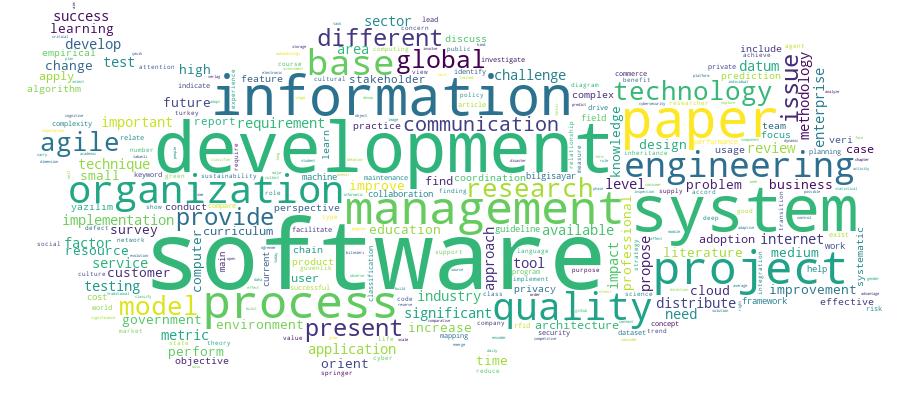
Competency Cloud
8 results
Scholarly Output Search Results
Now showing 1 - 8 of 8
Article Citation - Scopus: 15Software Quality Assurance Models in Small and Medium Organisations: a Comparison(Inderscience Publishers, 2006) Mishra,A.; Mishra,D.Presently, the majority of software development including outsourcing is carried out by small- and medium-sized software development organisations all over the world. These organisations are not capable of bearing the cost of implementing available software quality models like CMM, SPICE, ISO, etc. Therefore, there is a need to address this problem. In this paper, we have tried to compare the main characteristics, benefits, and limitations of the models for small and medium software development organisations. We believe that this effort will contribute towards the development of a standardised quality improvement model for small- and medium-sized software development organisations. Copyright © 2006 Inderscience Enterprises Ltd.Conference Object Citation - WoS: 3Global Software Development and Quality Management: a Systematic Review(Springer-verlag Berlin, 2013) Mishra, Deepti; Mishra, Alok; Colomo-Palacios, Ricardo; Casado-Lumbreras, CristinaThis paper presents a systematic literature review of global software development (GSD) and quality management aspects. The main focus is to highlight the current research and practice direction in these areas. The results have been limited to peer-reviewed conference papers and journal articles, published between 2000 and 2011. The analysis reports that major studies have been performed in quality and process management, while verification and validation issues of GSD can only get limited attention among researchers. This indicates the need for future research (quantitative and qualitative) in these areas.Conference Object Citation - WoS: 1Citation - Scopus: 3A Software Development Process Model for Cloud by Combining Traditional Approaches(Springer international Publishing Ag, 2015) Hacaloglu, Tuna; Eren, P. Erhan; Mishra, Deepti; Mishra, AlokEven though cloud computing is a technological paradigm that has been adopted more and more in various domains, there are few studies investigating the software development lifecycle in cloud computing applications and there is still not a comprehensive software development process model developed for cloud computing yet. Due to the nature of cloud computing that is completely different from the traditional software development, there is a need of suggesting process models to perform the software development systematically to create high quality software. In this study, we propose a new conceptual Software Development Life Cycle Model for Cloud Software Development that incorporates characteristics of different process models for traditional software development. The proposed model takes traditional model's specific characteristics into account and also considers cloud's specific nature i.e. advantages and challenges as well.Conference Object Citation - Scopus: 14Software Process Improvement Methodologies for Small and Medium Enterprises(Springer-Verlag Berlin, 2008) Mishra,D.; Mishra,A.Today, the software industry is one of the most rapidly growing sectors and small software development companies play an important role in economy. Many such organizations have been interested in Software Process Improvement (SPI). It has been observed that the successful implementation of SPI methodologies is generally not possible within the context of small and medium-sized software enterprises (SMEs) because they are not capable of bearing the cost of implementing these software process improvement programs. Further the proper implementation of software engineering techniques is difficult task for SMEs as they often operate on limited resources and with strict time constraints. There are number of methodologies to address these issues. In this paper, various SPI methodologies for SMEs are discussed and compared. This will lead towards maturity of software process improvement in SMEs and also facilitates in development of automation tools for SPIs in future. © 2008 Springer-Verlag Berlin Heidelberg.Review Information System Process Improvement: a Managerial Perspective(2003) Mishra,A.System process improvement is a continuous strategy in organizations for reducing overall cost, shortening cycle times, and improve quality and user satisfaction. For software organizations to remain competitive and survive in the global market place, it is now inevitable. All organizations are trying to achieve more value from their technology investments. There are various models like Capability Maturity Model (CMM), ISO, etc., available to measure it. However management role is vital for effective process improvement implementation strategy. This paper briefly presents an assessment of all the factors which if taken care by the management effectively can ensure success in information system process improvement.Article Citation - WoS: 4Citation - Scopus: 3A Legal Business Information System: Implementation Process Context(Budapest Tech, 2011) Mishra, Alok; Mishra, Deepti; Computer Engineering; Software EngineeringInformation Technology (IT) is fast becoming useful in implementing time, case, manpower and cost management strategies within judicial services. The legal system environment has adopted IT not just to save costs and time but also to give organizations a competitive edge and to ensure security as well. The Legal Business Information System is a fully operational and integrated system for a legal department. The mission of the department is to provide innovative and quality services in insolvency and trustee matters. Very few legal business information system implementations are documented in literature. Therefore this paper will facilitate understanding of system implementation in this sector.Conference Object Citation - Scopus: 4Global Software Development and Quality Management: a Systematic Review(Springer-Verlag Berlin, 2013) Mishra,D.; Mishra,A.; Colomo-Palacios,R.; Casado-Lumbreras,C.This paper presents a systematic literature review of global software development (GSD) and quality management aspects. The main focus is to highlight the current research and practice direction in these areas. The results have been limited to peer-reviewed conference papers and journal articles, published between 2000 and 2011. The analysis reports that major studies have been performed in quality and process management, while verification and validation issues of GSD can only get limited attention among researchers. This indicates the need for future research (quantitative and qualitative) in these areas. © 2013 Springer-Verlag.Conference Object Software Process Improvement Methodologies for Small and Medium Enterprises(2008) Mishra,D.; Mishra,A.Today, the software industry is one of the most rapidly growing sectors and small software development companies play an important role in economy. Many such organizations have been interested in Software Process Improvement (SPI). It has been observed that the successful implementation of SPI methodologies is generally not possible within the context of small and medium-sized software enterprises (SMEs) because they are not capable of bearing the cost of implementing these software process improvement programs. Further the proper implementation of software engineering techniques is difficult task for SMEs as they often operate on limited resources and with strict time constraints. There are number of methodologies to address these issues. In this paper, various SPI methodologies for SMEs are discussed and compared. This will lead towards maturity of software process improvement in SMEs and also facilitates in development of automation tools for SPIs in future. © 2008 Springer-Verlag Berlin Heidelberg.
