
Mıshra, Alok
Loading...
Profile URL
Name Variants
Mishra, A.
Mishra, A
Mishra A.
Alok, Mishra
Mıshra, Alok
A., Mishra
Alok M.
M., Alok
M.,Alok
Mishra, Alok
Mishra,A.
A.,Mıshra
A.,Mishra
Alok, Mıshra
A., Mıshra
Mıshra,A.
Mishra, A
Mishra A.
Alok, Mishra
Mıshra, Alok
A., Mishra
Alok M.
M., Alok
M.,Alok
Mishra, Alok
Mishra,A.
A.,Mıshra
A.,Mishra
Alok, Mıshra
A., Mıshra
Mıshra,A.
Job Title
Profesor Doktor
Email Address
alok.mishra@atilim.edu.tr
Main Affiliation
Software Engineering
Status
Website
ORCID ID
Scopus Author ID
Turkish CoHE Profile ID
Google Scholar ID
WoS Researcher ID
Sustainable Development Goals
 1
1NO POVERTY
0
Research Products
 2
2ZERO HUNGER
1
Research Products
 3
3GOOD HEALTH AND WELL-BEING
9
Research Products
 4
4QUALITY EDUCATION
6
Research Products
 5
5GENDER EQUALITY
1
Research Products
 6
6CLEAN WATER AND SANITATION
1
Research Products
 7
7AFFORDABLE AND CLEAN ENERGY
0
Research Products
 8
8DECENT WORK AND ECONOMIC GROWTH
0
Research Products
 9
9INDUSTRY, INNOVATION AND INFRASTRUCTURE
8
Research Products
 10
10REDUCED INEQUALITIES
0
Research Products
 11
11SUSTAINABLE CITIES AND COMMUNITIES
4
Research Products
 12
12RESPONSIBLE CONSUMPTION AND PRODUCTION
4
Research Products
 13
13CLIMATE ACTION
4
Research Products
 14
14LIFE BELOW WATER
4
Research Products
 15
15LIFE ON LAND
0
Research Products
 16
16PEACE, JUSTICE AND STRONG INSTITUTIONS
10
Research Products
 17
17PARTNERSHIPS FOR THE GOALS
2
Research Products

This researcher does not have a Scopus ID.

Documents
170
Citations
2551

Scholarly Output
197
Articles
103
Views / Downloads
726/2439
Supervised MSc Theses
13
Supervised PhD Theses
8
WoS Citation Count
2074
Scopus Citation Count
3043
Patents
0
Projects
0
WoS Citations per Publication
10.53
Scopus Citations per Publication
15.45
Open Access Source
42
Supervised Theses
21
| Journal | Count |
|---|---|
| Sensors | 7 |
| TEM Journal | 7 |
| Computers in Human Behavior | 4 |
| Applied Sciences | 4 |
| Electronics Information and Planning | 4 |
Current Page: 1 / 22
Scopus Quartile Distribution
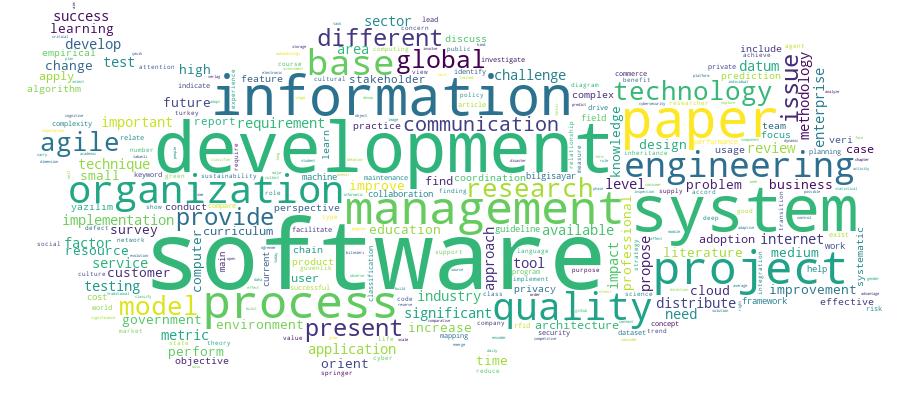
Competency Cloud
105 results
Scholarly Output Search Results
Now showing 1 - 10 of 105
Conference Object Citation - WoS: 6Software Architecture in Distributed Software Development: a Review(Springer-verlag Berlin, 2013) Mishra, Alok; Mishra, DeeptiThis paper presents a literature review of distributed software development (DSD) or global software development (GSD) and software architecture. The main focus is to highlight the current researches, observations, as well as practice directions in these areas. The results have been limited to peer-reviewed conference papers and journal articles, and analysis reports that major studies have been performed in software architecture and global software development, while the empirical studies of interfacing distributed/global software development and software architecture has only received very little attention among researchers up to now. This indicates the need for future research in these areas.Conference Object Software Quality Management Improvement Through Mentoring: an Exploratory Study From Gsd Projects(Springer-verlag Berlin, 2011) Colomo-Palacios, Ricardo; Soto-Acosta, Pedro; Mishra, Alok; Garcia-Crespo, AngelSoftware Quality Management (SQM) is a set of processes and procedures designed to assure the quality of software artifacts along with their development process. In an environment in which software development is evolving to a globalization, SQM is seen as one of its challenges. Global Software Development is a way to develop software across nations, continents, cultures and time zones. The aim of this paper is to detect if mentoring, one of the lead personnel development tools, can improve SQM of projects developed under GSD. The results obtained in the study reveal that the influence of mentoring on SQM is just temperate.Conference Object Citation - WoS: 12An Architectural Model for System of Information Systems(Springer int Publishing Ag, 2015) Majd, Saleh; Marie-Helene, Abel; Mishra, AlokOne of the most important aspects when designing and constructing an Information System is its architecture. This also applies to complex systems such as System of Information Systems (SoIS). Thus, we aim to propose an architectural model of System of Information Systems (SoIS). Though Architecture-based approaches have been promoted as a means of controlling the complexity of systems construction and evolution, what we really look for in this paper is an architectural model to aggregate services from already constructed systems. Nevertheless, it would be a good practice to compare the presented architecture of SoIS to other architecture-based approaches such as Service Oriented Architecture (SOA). Also, it is beneficial to examine how we can use the well-established standards of SOA for the designing of SoIS. In this paper we present an architectural model for System of Information Systems, and highlight the standards of Service Oriented Architecture that might help us in this task.Conference Object Informatics Engineering Education in Turkey and Expectations of Software Industry;(Institute of Electrical and Electronics Engineers Inc., 2018) Yazici,A.; Mishra,A.; Karakaya,Z.; Ustunkok,T.In this study, using the ÖSYM data, the number of intakes in Informatics Engineering programs in Turkey, accreditation data and the medium of instruction of the program are summarized for the years 2016 and 2017. In addition, the software sector's expectations from the informatics engineering graduates are reassessed based on the academic studies. The developed knowledge-skill gap set was used to evaluate the situation in Turkish informatics engineering programs. Sector expectations are discussed in the context of 2017-2019 Turkey Software Sector Strategy and Action Plan prepared by the Ministry of Science, Industry and Technology of Turkey and some proposals are made for the academia. As a result, it was observed that the expectations of the software industry were similar in all studies. Additionally, the expectations were changed in the direction of developing technologies and this change should be reflected in the informatics engineering programs. © 2018 IEEE.Article Citation - WoS: 44Citation - Scopus: 61Impact of Physical Ambiance on Communication, Collaboration and Coordination in Agile Software Development: an Empirical Evaluation(Elsevier, 2012) Mishra, Deepti; Mishra, Alok; Ostrovska, SofiyaContext: Communication, collaboration and coordination are key enablers of software development and even more so in agile methods. The physical environment of the workspace plays a significant role in effective communication, collaboration, and coordination among people while developing software. Objective: In this paper, we have studied and further evaluated empirically the effect of different constituents of physical environment on communication, coordination, and collaboration, respectively. The study aims to provide a guideline for prospective agile software developers. Method: A survey was conducted among software developers at a software development organization. To collect data, a survey was carried out along with observations, and interviews. Results: It has been found that half cubicles are 'very effective' for the frequency of communication. Further, half cubicles were discovered 'effective' but not 'very effective' for the quality/effectiveness of communication. It is found that half-height cubicles and status boards are 'very effective' for the coordination among team members according to the survey. Communal/discussion space is found to be 'effective' but not 'very effective' for coordination among team members. Our analysis also reveals that half-height glass barriers are 'very effective' during the individuals problem-solving activities while working together as a team. Infact, such a physically open environment appears to improve communication, coordination, and collaboration. Conclusion: According to this study, an open working environment with only half-height glass barriers and communal space plays a major role in communication among team members. The presence of status boards significantly help in reducing unnecessary communication by providing the required information to individuals and therefore, in turn reduce distractions a team member may confront in their absence. As communication plays a significant role in improving coordination and collaboration, it is not surprising to find the effect of open working environment and status boards in improving coordination and collaboration. An open working environment increases the awareness among software developers e.g. who is doing what, what is on the agenda, what is taking place, etc. That in turn, improves coordination among them. A communal/discussion space helps in collaboration immensely. (C) 2012 Elsevier B.V. All rights reserved.Conference Object Scale Up Internet-Based Business Through Distributed Data Centers(Springer international Publishing Ag, 2015) Yu, Liguo; Mishra, Alok; Mishra, DeeptiDistributed data centers are becoming more and more important for internet-based companies. Without distributed data centers, it will be hard for internet companies to scale up their business. The traditional centralized data center suffers the drawback of bottle neck and single failure problem. Therefore, more and more internet companies are building distributed data centers, and more and more business are moved onto distributed Web services. This paper reviews the history of distributed Web services and studies their current status through examining the distributed data centers of several top Internet companies. Based on the study, we conclude that distributed services, including distributed data centers, are the key factors to scale up the business of a company, especially, an internet-based company.Article Citation - WoS: 3White Box Test Tools: a Comparative View(Union Scientists Bulgaria, 2019) Atesogullari, Dilara; Mishra, AlokThere are multiple software testing techniques in the literature. These are white, black and gray box test techniques. Each of these has different tasks and purposes. Technical selection is decisive for these tasks and objectives. In this paper, information about white box technique and approaches are described. In addition, multiple test instruments that are currently in use are examined and a comparative view is provided. As a result of this comparison, a tabular chart is presented with an information set. This information set is intended to be valuable for software testing professionals and researchers to appreciate many tools at a glance.Conference Object Citation - WoS: 1Sustainable Software Engineering: a Move Towards Future(Ieee, 2017) Mishra, Alok[No Abstract Available]Article Citation - WoS: 18Citation - Scopus: 21Research Trends in Management Issues of Global Software Development: Evaluating the Past To Envision the Future(Taylor & Francis inc, 2011) Mishra, Deepti; Mishra, AlokThis paper presents research trends in management issues (project management, process management, knowledge management, requirements management, configuration management, risk management, quality management) of distributed/global information system development. The main objective is to highlight the current research and practice direction in these areas. The results are based on peer-reviewed conference papers/journal articles, published between 2000 and early 2011. The analysis revealed that most research has been done in project management, process management, knowledge management and requirements management areas while configuration, risk, and quality management issues could get only limited attention in global/distributed information system development. This indicates the need for future research (quantitative and qualitative) in these areas.Master Thesis Farklı işletmelerin ortak siber güvenlik politikalarının karşılaştırmalı araştırması(2017) Abduladheem, Maha Sameer; Mıshra, AlokSanal güvenlik, sadece tüm ölçeklerdeki işletmeler için değil aynı zamanda milli güvenlik için de temel sorunu ve üst düzey önceliği temsil eder. Günümüzde, birçok işletme, sanal çevrelerini ve bilgi ve iletişim teknolojilerini korumak için sanal güvenliğe büyük ölçüde yatırım yapmaktadır. Bu sebeple, birçok işletme, bir hasar gerçekleşmeden ve işletmenin iş alanında negatif bi etki oluşmadan önce herhangi bir saldırıya karşı savunma ve güvenlik çözümlerinden biri olarak güvenlik politikalarını uygulamaktadır. Bu çalışmada, farklı işletmelerin dikkate değer ve yaygın sanal güvenlik politikaları incelenmiş ve tartışılmıştır.Bu işletmelerin içerdiği alanlar sağlık sektörü, finans sektörü, eğitim sektörü, havacılık sektörü ve e-ticarettir. Bu çalışmanın amacı, tüm şirket ve işletmelerde güçlü ve kapsamlı sanal güvenlik kurmaktır. Bu çalışmanın sonucu, tüm işletme ve organizasyonlara kurulması gereken on adet önemli ve yaygın güvenlik politikası olduğunu göstermektedir. Bunlar; gizlilik politikası, veri koruma politikası, veri saklama politikası, bilgi güvenliği politikası, eposta güvenliği politikası, fiziksel güvenlik politikası, website güvenliği politikası, bulut güvenliği politikası, ağ güvenliği politikası ve erişim denetimi politikasıdır. Ek olarak, bu çalışmanın sonuçları, bazı sanal güvenlik politikalarının işletmeden işletmeye daha önemli ve kritik olduğunu göstermektedir. Bu güvenlik politikalarının önceliklerindeki farklılıklar, işletmelerin kontrolü altındaki bilginin türüne ve bu işletmelerin bu güvenlik politikalarına olan güvenlik ihtiyaçlarının türüne bağlıdır
