Mıshra, Alok

Loading...
Profile Picture
Name Variants
Mishra, A.
Mishra, A
Mishra A.
Alok, Mishra
Mıshra, Alok
A., Mishra
Alok M.
M., Alok
M.,Alok
Mishra, Alok
Mishra,A.
A.,Mıshra
A.,Mishra
Alok, Mıshra
A., Mıshra
Mıshra,A.
Job Title
Profesor Doktor
Email Address
alok.mishra@atilim.edu.tr
Main Affiliation
Software Engineering
Status
Website
Scopus Author ID
Turkish CoHE Profile ID
Google Scholar ID
WoS Researcher ID

Sustainable Development Goals

NO POVERTY1
NO POVERTY
0
Research Products
ZERO HUNGER2
ZERO HUNGER
1
Research Products
GOOD HEALTH AND WELL-BEING3
GOOD HEALTH AND WELL-BEING
9
Research Products
QUALITY EDUCATION4
QUALITY EDUCATION
6
Research Products
GENDER EQUALITY5
GENDER EQUALITY
1
Research Products
CLEAN WATER AND SANITATION6
CLEAN WATER AND SANITATION
1
Research Products
AFFORDABLE AND CLEAN ENERGY7
AFFORDABLE AND CLEAN ENERGY
0
Research Products
DECENT WORK AND ECONOMIC GROWTH8
DECENT WORK AND ECONOMIC GROWTH
0
Research Products
INDUSTRY, INNOVATION AND INFRASTRUCTURE9
INDUSTRY, INNOVATION AND INFRASTRUCTURE
8
Research Products
REDUCED INEQUALITIES10
REDUCED INEQUALITIES
0
Research Products
SUSTAINABLE CITIES AND COMMUNITIES11
SUSTAINABLE CITIES AND COMMUNITIES
4
Research Products
RESPONSIBLE CONSUMPTION AND PRODUCTION12
RESPONSIBLE CONSUMPTION AND PRODUCTION
4
Research Products
CLIMATE ACTION13
CLIMATE ACTION
4
Research Products
LIFE BELOW WATER14
LIFE BELOW WATER
4
Research Products
LIFE ON LAND15
LIFE ON LAND
0
Research Products
PEACE, JUSTICE AND STRONG INSTITUTIONS16
PEACE, JUSTICE AND STRONG INSTITUTIONS
10
Research Products
PARTNERSHIPS FOR THE GOALS17
PARTNERSHIPS FOR THE GOALS
2
Research Products
This researcher does not have a Scopus ID.
Documents

170

Citations

2551

Scholarly Output

197

Articles

103

Views / Downloads

726/2439

Supervised MSc Theses

13

Supervised PhD Theses

8

WoS Citation Count

2074

Scopus Citation Count

3043

Patents

0

Projects

0

WoS Citations per Publication

10.53

Scopus Citations per Publication

15.45

Open Access Source

42

Supervised Theses

21

JournalCount
Sensors7
TEM Journal7
Computers in Human Behavior4
Applied Sciences4
Electronics Information and Planning4
Current Page: 1 / 22

Scopus Quartile Distribution

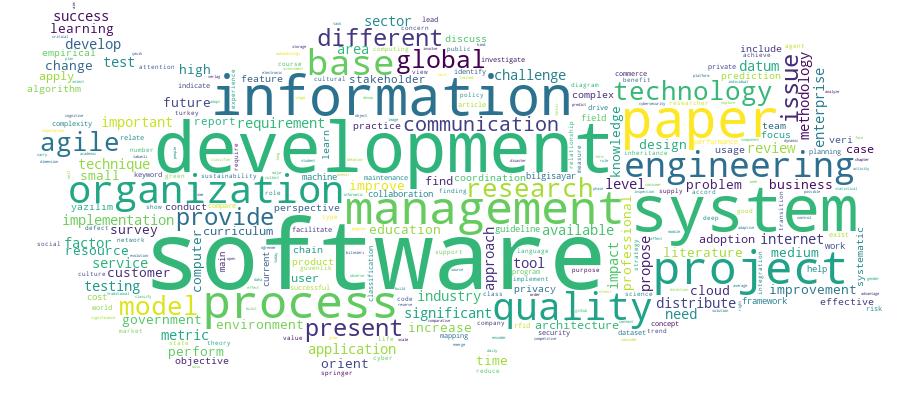
Competency Cloud

GCRIS Competency Cloud

Scholarly Output Search Results

Now showing 1 - 2 of 2
  • Conference Object
    Citation - WoS: 1
    Citation - Scopus: 2
    Use Cases and Object Modelling Using Argouml
    (Springer-Verlag Berlin, 2011) Complak,W.; Wojciechowski,A.; Mishra,A.; Mishra,D.
    The key factor in the process of good quality software development is using proper techniques for requirements elicitation, representation and modelling providing foundations to build a logical model of the projected system. One of the most popular functional requirements description methods is use cases and scenarios approach introduced by Jacobson in 1993. Use case diagrams and analysis of functionality necessary for future users of the system allows precise definition of object model of target software system. However there are few fully functional free CASE tools supporting system designer at this software development stage. The article describes process of creating guidelines and formal requirements for design of a software system supporting storage and analysis of data concerning regulatory duties of Polish Telecom (Polish name: Telekomunikacja Polska) in the range of RIO framework agreement regarding collocation with the free UML modelling ArgoUML tool. © 2011 Springer-Verlag.
  • Conference Object
    Informatics Engineering Education in Turkey and Expectations of Software Industry;
    (Institute of Electrical and Electronics Engineers Inc., 2018) Yazici,A.; Mishra,A.; Karakaya,Z.; Ustunkok,T.
    In this study, using the ÖSYM data, the number of intakes in Informatics Engineering programs in Turkey, accreditation data and the medium of instruction of the program are summarized for the years 2016 and 2017. In addition, the software sector's expectations from the informatics engineering graduates are reassessed based on the academic studies. The developed knowledge-skill gap set was used to evaluate the situation in Turkish informatics engineering programs. Sector expectations are discussed in the context of 2017-2019 Turkey Software Sector Strategy and Action Plan prepared by the Ministry of Science, Industry and Technology of Turkey and some proposals are made for the academia. As a result, it was observed that the expectations of the software industry were similar in all studies. Additionally, the expectations were changed in the direction of developing technologies and this change should be reflected in the informatics engineering programs. © 2018 IEEE.