
Mıshra, Alok
Loading...
Profile URL
Name Variants
Mishra, A.
Mishra, A
Mishra A.
Alok, Mishra
Mıshra, Alok
A., Mishra
Alok M.
M., Alok
M.,Alok
Mishra, Alok
Mishra,A.
A.,Mıshra
A.,Mishra
Alok, Mıshra
A., Mıshra
Mıshra,A.
Mishra, A
Mishra A.
Alok, Mishra
Mıshra, Alok
A., Mishra
Alok M.
M., Alok
M.,Alok
Mishra, Alok
Mishra,A.
A.,Mıshra
A.,Mishra
Alok, Mıshra
A., Mıshra
Mıshra,A.
Job Title
Profesor Doktor
Email Address
alok.mishra@atilim.edu.tr
Main Affiliation
Software Engineering
Status
Website
ORCID ID
Scopus Author ID
Turkish CoHE Profile ID
Google Scholar ID
WoS Researcher ID
Sustainable Development Goals
 1
1NO POVERTY
0
Research Products
 2
2ZERO HUNGER
1
Research Products
 3
3GOOD HEALTH AND WELL-BEING
9
Research Products
 4
4QUALITY EDUCATION
6
Research Products
 5
5GENDER EQUALITY
1
Research Products
 6
6CLEAN WATER AND SANITATION
1
Research Products
 7
7AFFORDABLE AND CLEAN ENERGY
0
Research Products
 8
8DECENT WORK AND ECONOMIC GROWTH
0
Research Products
 9
9INDUSTRY, INNOVATION AND INFRASTRUCTURE
8
Research Products
 10
10REDUCED INEQUALITIES
0
Research Products
 11
11SUSTAINABLE CITIES AND COMMUNITIES
4
Research Products
 12
12RESPONSIBLE CONSUMPTION AND PRODUCTION
4
Research Products
 13
13CLIMATE ACTION
4
Research Products
 14
14LIFE BELOW WATER
4
Research Products
 15
15LIFE ON LAND
0
Research Products
 16
16PEACE, JUSTICE AND STRONG INSTITUTIONS
10
Research Products
 17
17PARTNERSHIPS FOR THE GOALS
2
Research Products

This researcher does not have a Scopus ID.

Documents
170
Citations
2551

Scholarly Output
197
Articles
103
Views / Downloads
726/2439
Supervised MSc Theses
13
Supervised PhD Theses
8
WoS Citation Count
2074
Scopus Citation Count
3043
Patents
0
Projects
0
WoS Citations per Publication
10.53
Scopus Citations per Publication
15.45
Open Access Source
42
Supervised Theses
21
| Journal | Count |
|---|---|
| Sensors | 7 |
| TEM Journal | 7 |
| Computers in Human Behavior | 4 |
| Applied Sciences | 4 |
| Electronics Information and Planning | 4 |
Current Page: 1 / 22
Scopus Quartile Distribution
Competency Cloud
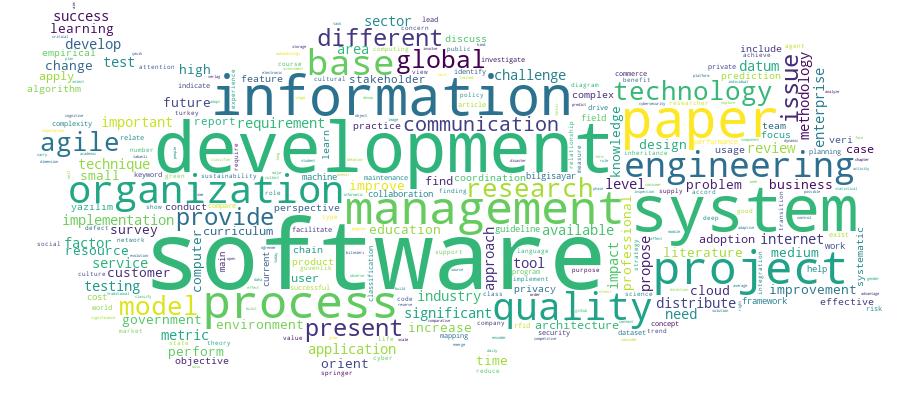
53 results
Scholarly Output Search Results
Now showing 1 - 10 of 53
Article Citation - WoS: 11Citation - Scopus: 14Sustainability Inclusion in Informatics Curriculum Development(Mdpi, 2020) Mishra, Deepti; Mishra, Alok(1) Background: Presently, sustainability is a crucial issue for human beings due to many disasters owing to climate change. Information Technology (IT) is now part of everyday life in society due to the proliferation of gadgets such as mobile phones, apps, computers, information systems, web-based systems, etc. (2) Methods: The analysis is based on recent ACM/IEEE curriculum guidelines for IT, a rigorous literature review as well as various viewpoints and their relevance for sustainability-oriented curriculum development; it also includes an assessment of key competencies in sustainability for proposed units in the IT curriculum. (3) Results: Sustainability is a critical subject for prospective IT professionals. Therefore, it is imperative to motivate and raise awareness among students and the faculty community regarding sustainability through its inclusion in the Informatics curriculum. This paper focuses on how sustainability can be included in various courses of the Informatics curriculum. It also considers recent ACM/IEEE curriculum guidelines for IT professionals, which assert that IT students should explore IT strategies required for developing a culture of green and sustainable IT. (4) Conclusions: This paper provides guidelines for IT curriculum development by incorporating sustainable elements in courses, so that future IT professionals can learn and practice sustainability in order to develop a sustainable society.Article Citation - WoS: 18Citation - Scopus: 21Research Trends in Management Issues of Global Software Development: Evaluating the Past To Envision the Future(Taylor & Francis inc, 2011) Mishra, Deepti; Mishra, AlokThis paper presents research trends in management issues (project management, process management, knowledge management, requirements management, configuration management, risk management, quality management) of distributed/global information system development. The main objective is to highlight the current research and practice direction in these areas. The results are based on peer-reviewed conference papers/journal articles, published between 2000 and early 2011. The analysis revealed that most research has been done in project management, process management, knowledge management and requirements management areas while configuration, risk, and quality management issues could get only limited attention in global/distributed information system development. This indicates the need for future research (quantitative and qualitative) in these areas.Conference Object Citation - WoS: 2Object-Oriented Inheritance Metrics: Cognitive Complexity Perspective(Springer-verlag Berlin, 2009) Mishra, Deepti; Mishra, AlokIdentifying high cognitive complexity modules can lead to a better quality software system and can help during maintenance also. It has been found that inheritance has an impact on cognitive complexity of a software system. In this paper, two inheritance metrics based on cognitive complexity, one at class level CCI (Class Complexity due to Inheritance) and another at program level ACI (Average Complexity of a program due to Inheritance), have been proposed for object-oriented software systems. These metrics are also compared with other well known object-oriented inheritance metrics.Conference Object Citation - WoS: 6Software Architecture in Distributed Software Development: a Review(Springer-verlag Berlin, 2013) Mishra, Alok; Mishra, DeeptiThis paper presents a literature review of distributed software development (DSD) or global software development (GSD) and software architecture. The main focus is to highlight the current researches, observations, as well as practice directions in these areas. The results have been limited to peer-reviewed conference papers and journal articles, and analysis reports that major studies have been performed in software architecture and global software development, while the empirical studies of interfacing distributed/global software development and software architecture has only received very little attention among researchers up to now. This indicates the need for future research in these areas.Article Citation - WoS: 3Citation - Scopus: 7Erp System Implementation in Fmcg Sector(Univ Osijek, Tech Fac, 2010) Mishra, Alok; Mishra, Deepti; Computer Engineering; Software EngineeringToday's businesses have become extremely complex. Enterprise Resource Planning (ERP) systems can help enterprises to reduce operating costs, generate more accurate forecasts of demand, accelerate production cycles and enhance customer service. This paper reports challenges, opportunities and outcome of ERP implementation in a top Fast Moving Consumer Goods (FMCG) house in South-East Asia with diversified interests in varied businesses. This study will facilitate the understanding of the transition, constraints and implementation of ERP in this sector and also provide guidelines from lessons learned in this regard to researchers and practising managers.Article Citation - WoS: 180Citation - Scopus: 238Theory of Reasoned Action Application for Green Information Technology Acceptance(Pergamon-elsevier Science Ltd, 2014) Mishra, Deepti; Akman, Ibrahim; Mishra, AlokThe increase in the use of Information Technology (IT) in recent decades has contributed to additional power consumption as well as a potential overuse of scarce resources. Also, IT is quickly surpassing air transportation in terms of its carbon footprint. For these reasons, increased environmental awareness has increased interest in Green Information Technology (GIT) among IT practitioners. Therefore, the aim of this paper is to investigate behavior for the adoption of GIT applying the conceptual model, referred to as the 'Theory of Reasoned Action' (TEA). For this purpose, a survey was conducted among IT professionals from major public and private sector establishments. Findings indicated that behavioral intention influences actual behavior positively. IT professionals with positive intentions towards GIT issues are actually practicing GIT in their work. Results also indicated that external factors such as person related beliefs, sector of respondents' establishment, and level of awareness have significant impact on attitude towards adoption of GIT. (C) 2014 Elsevier Ltd. All rights reserved.Article Citation - WoS: 9Citation - Scopus: 11Industry Oriented Advanced Software Engineering Education Curriculum(Fac Teacher Education, 2012) Mishra, Alok; Mishra, Deepti; Computer Engineering; Software EngineeringSoftware engineering is the fastest-evolving engineering discipline and most of the tasks of software development organizations are diverse in nature. Various studies have shown that there is a wide gap between software industry needs and education for prospective software engineers. It is the responsibility of Software engineering education to prepare SE professionals by providing them with the skills to meet the expectations of the software industry. SE curriculum should correspond to the industry needs, and only then can Universities produce highly skilled professionals, who can meet the needs of software industry. During the last decade, software engineering education (SEE) has been emerging as an independent and mature discipline. Accordingly, various studies are being conducted to provide guidelines for SEE curriculum design. This paper summarizes the need for software industry related courses and discusses the significance of industry oriented software engineering education to meet the educational objectives of all stakeholders. The software industry oriented curriculum for undergraduate and graduate levels is discussed. An industry oriented graduate level (master's level) software engineering course which includes foundational and applied courses to provide effective training for future software engineers is also proposed. This will lead to an increase in their employment prospects in the industrial and allied sectors.Conference Object Citation - WoS: 6Cultural Issues in Distributed Software Development: a Review(Springer-verlag Berlin, 2014) Mishra, Alok; Mishra, DeeptiCultural impact is significant in global or distributed software development. Due to cultural differences, co-ordination and collaboration problems have been reported in case studies and this also leads to low quality deliverables and high turnover in software industry. This paper presents a literature review of distributed software development (DSD) or global software development (GSD) and cultural issues. The main focus is to highlight the current research, observations, as well as practice directions in these areas. Many studies have been performed in culture and global software development, still impact of culture in distributed software development in different dimensions received less attention among researchers.Article Citation - WoS: 5Sustainable Software Engineering Education Curricula Development(Union Scientists Bulgaria, 2020) Mishra, Alok; Mıshra, Alok; Mishra, Deepti; Mıshra, Deepti; Mıshra, Alok; Mıshra, Deepti; Computer Engineering; Software Engineering; Computer Engineering; Software EngineeringClimate change risk and environmental degradation are the most critical issues of our society. Our technology influenced daily life style involves many software and apps which are used by large society and their use is increasing than ever before. Sustainability is a significant topic for future professionals and more so for Information Technology (IT) professionals and software engineers due to its impact on the society. It is significant to motivate and raise concern among students and faculty members regarding sustainability by including it into Software Engineering curriculum.Article Citation - WoS: 5Citation - Scopus: 5Managing Requirements in Market-Driven Software Project: Agile Methods View(Univ Osijek, Tech Fac, 2010) Mishra, Deepti; Mishra, Alok; Computer Engineering; Software EngineeringTime-to-market and insufficient initial requirements are two significant challenges that make managing requirements for market-driven software projects different from custom-made software projects. These challenges can be resolved by using agile software development methodologies for market-driven software development as agile methods put emphasis on a dynamic approach for requirement engineering which works closely with an iterative release cycle. In this study, dynamic requirement engineering approach of Agile methods was used for the successful implementation of market-driven complex software project.
