Sönmez, Çağla

Loading...
Profile Picture
Name Variants
Sonmez,Cagla
Sönmez, Çağla
Sönmez Ç.
Ç.,Sönmez
Çağla Sönmez
Altun C.
Ç., Sönmez
Sonmez,C.
Sonmez, Cagla
S., Çağla
S.,Çağla
Çağla, Sönmez
C., Sonmez
C.,Sonmez
Sonmez C.
Sönmez,Ç.
S.,Cagla
S., Cagla
Cagla, Sonmez
Sonmez,Ç.
Job Title
Profesör Doktor
Email Address
cagla.sonmez@atilim.edu.tr
Main Affiliation
Basic Sciences
Status
Scopus Author ID
Turkish CoHE Profile ID
Google Scholar ID
WoS Researcher ID

Sustainable Development Goals

NO POVERTY1
NO POVERTY
0
Research Products
ZERO HUNGER2
ZERO HUNGER
1
Research Products
GOOD HEALTH AND WELL-BEING3
GOOD HEALTH AND WELL-BEING
2
Research Products
QUALITY EDUCATION4
QUALITY EDUCATION
0
Research Products
GENDER EQUALITY5
GENDER EQUALITY
0
Research Products
CLEAN WATER AND SANITATION6
CLEAN WATER AND SANITATION
0
Research Products
AFFORDABLE AND CLEAN ENERGY7
AFFORDABLE AND CLEAN ENERGY
0
Research Products
DECENT WORK AND ECONOMIC GROWTH8
DECENT WORK AND ECONOMIC GROWTH
0
Research Products
INDUSTRY, INNOVATION AND INFRASTRUCTURE9
INDUSTRY, INNOVATION AND INFRASTRUCTURE
0
Research Products
REDUCED INEQUALITIES10
REDUCED INEQUALITIES
0
Research Products
SUSTAINABLE CITIES AND COMMUNITIES11
SUSTAINABLE CITIES AND COMMUNITIES
0
Research Products
RESPONSIBLE CONSUMPTION AND PRODUCTION12
RESPONSIBLE CONSUMPTION AND PRODUCTION
0
Research Products
CLIMATE ACTION13
CLIMATE ACTION
1
Research Products
LIFE BELOW WATER14
LIFE BELOW WATER
0
Research Products
LIFE ON LAND15
LIFE ON LAND
0
Research Products
PEACE, JUSTICE AND STRONG INSTITUTIONS16
PEACE, JUSTICE AND STRONG INSTITUTIONS
0
Research Products
PARTNERSHIPS FOR THE GOALS17
PARTNERSHIPS FOR THE GOALS
0
Research Products
Documents

13

Citations

492

h-index

7

Documents

13

Citations

462

Scholarly Output

3

Articles

2

Views / Downloads

12/0

Supervised MSc Theses

0

Supervised PhD Theses

0

WoS Citation Count

4

Scopus Citation Count

6

Patents

0

Projects

0

WoS Citations per Publication

1.33

Scopus Citations per Publication

2.00

Open Access Source

2

Supervised Theses

0

JournalCount
Scientific Reports2
Journal of Agronomy and Crop Science1
Current Page: 1 / 1

Scopus Quartile Distribution

Competency Cloud

GCRIS Competency Cloud

Scholarly Output Search Results

Now showing 1 - 1 of 1
  • Article
    Citation - WoS: 4
    Citation - Scopus: 6
    Antioxidant Activity of Micractinium Sp. (Chlorophyta) Extracts Against H2O2 Induced Oxidative Stress in Human Breast Adenocarcinoma Cells
    (Nature Portfolio, 2024) Bulut, Onur; Kose, Iskin Engin; Sonmez, Cagla; Oktem, Huseyin Avni
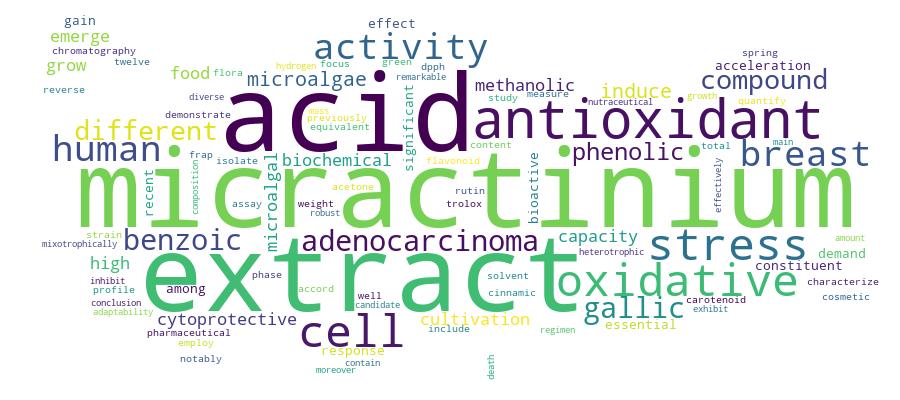
    In response to the growing demand for high-value bioactive compounds, microalgae cultivation has gained a significant acceleration in recent years. Among these compounds, antioxidants have emerged as essential constituents in the food, pharmaceutical, and cosmetics industries. This study focuses on Micractinium sp. ME05, a green microalgal strain previously isolated from hot springs flora in our laboratory. Micractinium sp. cells were extracted using six different solvents, and their antioxidant capacity, as well as total phenolic, flavonoid, and carotenoid contents were evaluated. The methanolic extracts demonstrated the highest antioxidant capacity, measuring 7.72 and 93.80 mu mol trolox equivalents g-1 dry weight (DW) according to the DPPH and FRAP assays, respectively. To further characterize the biochemical profile, reverse phase high-performance chromatography (RP-HPLC) was employed to quantify twelve different phenolics, including rutin, gallic acid, benzoic acid, cinnamic acid, and beta-carotene, in the microalgal extracts. Notably, the acetone extracts of Micractinium sp. grown mixotrophically contained a high amount of gallic acid (469.21 +/- 159.74 mu g g-1 DW), while 4-hydroxy benzoic acid (403.93 +/- 20.98 mu g g-1 DW) was the main phenolic compound in the methanolic extracts under heterotrophic cultivation. Moreover, extracts from Micractinium sp. exhibited remarkable cytoprotective activity by effectively inhibiting hydrogen peroxide-induced oxidative stress and cell death in human breast adenocarcinoma (MCF-7) cells. In conclusion, with its diverse biochemical composition and adaptability to different growth regimens, Micractinium sp. emerges as a robust candidate for mass cultivation in nutraceutical and food applications.