
Ertan, Salih
Loading...
Profile URL
Name Variants
Ertan, Salih
Ertan,Salih
S., Ertan
Ertan,S.
E.,Salih
Salih Ertan
Salih, Ertan
E., Salih
S.,Ertan
Ertan,Salih
S., Ertan
Ertan,S.
E.,Salih
Salih Ertan
Salih, Ertan
E., Salih
S.,Ertan
Job Title
Doktor Öğretim Üyesi
Email Address
salih.ertan@tilim.edu.tr
Main Affiliation
Chemical Engineering
Status
Website
ORCID ID
Scopus Author ID
Turkish CoHE Profile ID
Google Scholar ID
WoS Researcher ID
Sustainable Development Goals
 1
1NO POVERTY
0
Research Products
 2
2ZERO HUNGER
0
Research Products
 3
3GOOD HEALTH AND WELL-BEING
1
Research Products
 4
4QUALITY EDUCATION
0
Research Products
 5
5GENDER EQUALITY
0
Research Products
 6
6CLEAN WATER AND SANITATION
0
Research Products
 7
7AFFORDABLE AND CLEAN ENERGY
0
Research Products
 8
8DECENT WORK AND ECONOMIC GROWTH
0
Research Products
 9
9INDUSTRY, INNOVATION AND INFRASTRUCTURE
0
Research Products
 10
10REDUCED INEQUALITIES
0
Research Products
 11
11SUSTAINABLE CITIES AND COMMUNITIES
0
Research Products
 12
12RESPONSIBLE CONSUMPTION AND PRODUCTION
0
Research Products
 13
13CLIMATE ACTION
0
Research Products
 14
14LIFE BELOW WATER
0
Research Products
 15
15LIFE ON LAND
0
Research Products
 16
16PEACE, JUSTICE AND STRONG INSTITUTIONS
0
Research Products
 17
17PARTNERSHIPS FOR THE GOALS
0
Research Products

Documents
9
Citations
162
h-index
7

Documents
10
Citations
169

Scholarly Output
10
Articles
9
Views / Downloads
68/142
Supervised MSc Theses
1
Supervised PhD Theses
0
WoS Citation Count
121
Scopus Citation Count
124
Patents
0
Projects
0
WoS Citations per Publication
12.10
Scopus Citations per Publication
12.40
Open Access Source
0
Supervised Theses
1
| Journal | Count |
|---|---|
| Dyes and Pigments | 3 |
| Electrochimica Acta | 2 |
| Journal of Polymer Science Part A: Polymer Chemistry | 1 |
| Macromolecules | 1 |
| Materials Today Communications | 1 |
Current Page: 1 / 2
Scopus Quartile Distribution
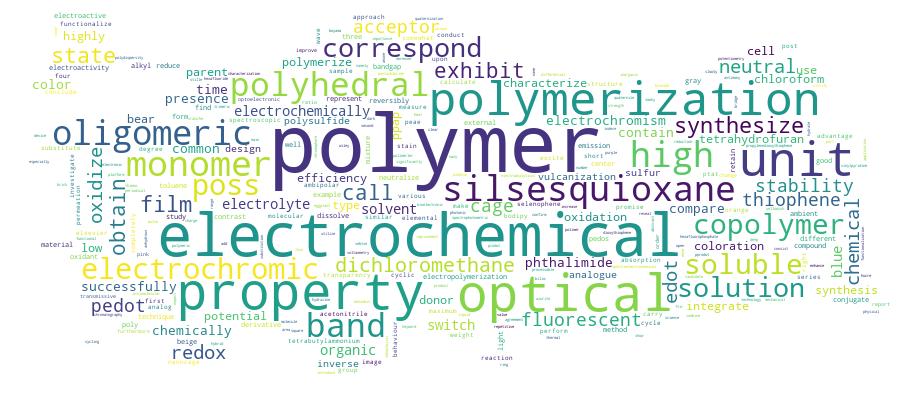
Competency Cloud
4 results
Scholarly Output Search Results
Now showing 1 - 4 of 4
Article Citation - WoS: 11Citation - Scopus: 11Electrochemical and Optical Properties of Substituted Phthalimide Based Monomers and Electrochemical Polymerization of 3,4-Ethylenedioxythiophene Oligomeric Silsesquioxane (poss) Analogue(Elsevier Sci Ltd, 2019) Cakal, Deniz; Ertan, Salih; Cihaner, Atilla; Onal, Ahmet M.A new series of donor-acceptor-donor type trimeric monomers bearing substituted phthalimide units as acceptor units and thiophene and 3,4-ethylenedioxythiophene (EDOT) as donor units was synthesized and characterized. The strength of acceptor units and intramolecular charge transfer between donor and acceptor units were investigated by using electrochemical and optical methods. The main advantage of phthalimide unit over other acceptor units is the ease of its functionalizability. Thus, utilizing this property, a phthalimide derivative (E2P-POSS) bearing polyhedral oligomeric silsesquioxane (POSS) cage was introduced successfully with EDOT and polymerized electrochemically. The corresponding electroactive polymer, PE2P-POSS, has a band gap of 1.72 eV and is an electrochromic polymer: gray when neutralized and eggplant purple when oxidized.Article Citation - WoS: 8Citation - Scopus: 8Improvement of Optical Properties and Redox Stability of Poly(3,4-Ethylenedioxythiophene)(Elsevier Sci Ltd, 2018) Ertan, Salih; Cihaner, AtillaIn order to improve the optical properties and redox stability of poly(3,4-ethylenedioxythiophene) (PEDOT) without changing its electrochemical and electrochromic behaviour, it was supported with alkyl-substituted polyhedral oligomeric silsesquioxane (POSS) cage. The corresponding copolymers were obtained electrochemically via potentiostatic or potentiodynamic methods and compared to the parent homopolymers. Electrochemical polymerization of EDOT and POSS containing EDOT called EDOT-POSS in various monomer feed ratios was performed in an electrolyte solution of 0.1 M TBAPF(6) dissolved in a mixture of dichloromethane and acetonitrile (1/3: v/v). Just as PEDOT, the copolymers represented the similar band gap (1.61 eV), redox and electrochromic behaviors. On the other hand, when compared to the parent PEDOT, the presence of POSS cages in the copolymer backbone improved the redox stability and optical properties of PEDOT such as higher percent transmittance change (65% at 621 nm), higher transparency at oxidized state, lower switching time (similar to 1.0 s) and higher coloration efficiency (463 cm(2)/C for 95% switching) as well as higher electrochemical stability (86% of its electroactivity retains after 1750 cycles under ambient conditions).Article Citation - WoS: 24Citation - Scopus: 23Synthesis and Electrochemical Polymerization of D-A Type Monomers With Thieno [3,4-c] Pyrrole-4,6 Acceptor Unit(Elsevier Sci Ltd, 2018) Cakal, Deniz; Ertan, Salih; Cihaner, Atilla; Onal, Ahmet M.In this study, three new donor-acceptor-donor type monomers bearing 1,3-dibromo-5-(2-ethylhexyl)-4H-thieno [3,4-c]pyrrole- 4,6(5H)-dione (A) as an acceptor unit and thiophene, 3,4-ethylenedioxythiophene (EDOT) and 3,3-didecy1-3,4-dihydro-2H-thieno[3,4-b][1,4]dioxepine (didecyl-ProDOT) as donor units were synthesized via Stille cross-coupling reaction and their electrochemical polymerization by repetitive cycling was reported. The electrochemical and optical properties of the monomers ((5-(2-ethyl-liexyl)-1,3-di(thienyl-2-yl)-4H-thienolr-3,4-cl pyrrole-4,6(5H)-dione (TAT), 1,3-bis(2,3-dihydrothieno[3,4-1)] (1,4]dioicin-5-yl)-5-(2-ethylhexyl)-4H-thieno(3,4-c) pyrrole-4,6-(5H)-dione (EAE) and 1,3-bis(3,3-didecyl-3,4-dihydro-2H-thieno[3,4-1)111,41-dioxepin-6-yl)-5-(2-ethylhexyl)-4H-thieno[3,4-apyrrole-4,6(5H)-dione (PAP)) and their corresponding polymers called PTAT, PEAE and PPAP were investigated and it was found that EDOT units containing monomer and polymer (EAE and PEAE) have lower oxidation potentials and lower band gap value as compared to didecyl-ProDOT and thiophene units containing monomers and polymers (PAP, TAT and PPAP, PTAT). Spectroelectrochemical investigations conducted on electrochemically obtained polymer films revealed that polymer films exhibited electrochromic behaviors: brick red to gray for PTAT, blue/violet to highly sky blue for PEAE and blue to highly light blue for PPAP in their neutral and oxidized states, respectively. Moreover, PAP was also polymerized chemically using FeC13 as an oxidizing agent. Both chemically and electrochemically obtained PPAP were found to be soluble in some organic solvents and their dichloromethane solutions can be reversibly oxidized and reduced using antimony pentachloride and hydrazine hydrate solutions, respectively.Article Citation - WoS: 3Citation - Scopus: 2Polyhedral Oligomeric Silsesquioxane Cage Integrated Soluble and Fluorescent Poly(3,4-Propylenedioxythiophene) Dye(Elsevier Sci Ltd, 2021) Ertan, Salih; Kaya, Murat; Cihaner, AtillaA new analog of poly (3,4-propylenedioxythiophene) conjugated polymers called PProDOT-POSS, where polyhedral oligomeric silsesquioxane (POSS) nanocage with alkyl substitutions was integrated on the bridge of 3,4-propylenedioxythiophene unit and its structure was confirmed by spectroscopic techniques, was reported. The polymers were synthesized via both chemical and electrochemical polymerization techniques. While chemical polymerization was carried out in the presence of anhydrous FeCl3 as an oxidant, a solution of 0.1 M tetrabutylammonium hexafluoride electrolyte dissolved in a mixture of dichloromethane and acetonitrile (1/3: v/v) was used as an electrolyte solution for electrochemical polymerization. Electro-optical properties of the corresponding polymers were characterized by using electroanalytical techniques such as cyclic voltammetry and square wave potentiometry, and spectrophotometric methods like ultraviolet-visible and fluorescent spectrophotometry. Corresponding polymers obtained both electrochemically and chemically are soluble completely in common organic solvents such as chloroform, toluene, dichloromethane, tetrahydrofuran, etc. Polymer samples both in film and solution forms can be doped/dedoped reversibly by using a chemical oxidant or an external potential. The optical bandgap of the neutral polymer film with a maximum absorption band at 555 nm was calculated as 1.95 eV. Polymers have fluorescent property and excited polymers represented a red/orange light with an emission band centered at 605 nm in toluene. Also, PProDOT-POSS polymers have electrochromic properties under external potentials and they have an optical contrast of 55% at 555 nm between their neutral and oxidized states. Upon oxidation, they showed high transparency and they can switch between redox states in a short time (switching time = similar to 1.0 s) as well as high coloration efficiency (502 cm(2)/C for 95% switching). It can be concluded that POSS based PProDOT polymers can be good candidates for optoelectronic and bioelectronics applications. Short Abstract for Paper Submission: A new analog of poly (3,4-propylenedioxythiophene) conjugated polymers called PProDOT-POSS, was reported with the integrated of alkyl-substituted polyhedral oligomeric silsesquioxane nanocage structure. The polymers were synthesized via both chemical and electrochemical polymerization techniques. Corresponding polymers obtained both electrochemically and chemically are soluble completely in common organic solvents such as chloroform, toluene, dichloromethane, tetrahydrofuran, etc. Polymer samples both in film and solution forms can be doped/dedoped reversibly by using a chemical oxidant or an external potential. The optical bandgap of the neutral polymer film with a maximum absorption band at 555 nm was calculated as 1.95 eV. Polymers have fluorescent property and excited polymers represented a red/orange light with an emission band centered at 605 nm in toluene.
