
Akış, Tolga
Loading...
Profile URL
Name Variants
Akis T.
Akis,Tolga
Tolga, Akış
Akış,T.
Akis,T.
T., Akış
Akis, Tolga
Akış, Tolga
Tolga Akış
T., Akis
T.,Akış
Akış T.
T.,Akis
Akiş T.
A.,Tolga
A., Tolga
Tolga, Akis
Akis, T
Akis,Tolga
Tolga, Akış
Akış,T.
Akis,T.
T., Akış
Akis, Tolga
Akış, Tolga
Tolga Akış
T., Akis
T.,Akış
Akış T.
T.,Akis
Akiş T.
A.,Tolga
A., Tolga
Tolga, Akis
Akis, T
Job Title
Profesör Doktor
Email Address
tolga.akis@atilim.edu.tr
Main Affiliation
Civil Engineering
Status
Website
ORCID ID
Scopus Author ID
Turkish CoHE Profile ID
Google Scholar ID
WoS Researcher ID
Sustainable Development Goals
 1
1NO POVERTY
0
Research Products
 2
2ZERO HUNGER
0
Research Products
 3
3GOOD HEALTH AND WELL-BEING
1
Research Products
 4
4QUALITY EDUCATION
0
Research Products
 5
5GENDER EQUALITY
0
Research Products
 6
6CLEAN WATER AND SANITATION
0
Research Products
 7
7AFFORDABLE AND CLEAN ENERGY
0
Research Products
 8
8DECENT WORK AND ECONOMIC GROWTH
0
Research Products
 9
9INDUSTRY, INNOVATION AND INFRASTRUCTURE
0
Research Products
 10
10REDUCED INEQUALITIES
0
Research Products
 11
11SUSTAINABLE CITIES AND COMMUNITIES
6
Research Products
 12
12RESPONSIBLE CONSUMPTION AND PRODUCTION
2
Research Products
 13
13CLIMATE ACTION
0
Research Products
 14
14LIFE BELOW WATER
0
Research Products
 15
15LIFE ON LAND
0
Research Products
 16
16PEACE, JUSTICE AND STRONG INSTITUTIONS
0
Research Products
 17
17PARTNERSHIPS FOR THE GOALS
0
Research Products

Documents
28
Citations
508
h-index
13

Documents
27
Citations
539

Scholarly Output
53
Articles
34
Views / Downloads
9/0
Supervised MSc Theses
16
Supervised PhD Theses
0
WoS Citation Count
539
Scopus Citation Count
651
Patents
0
Projects
0
WoS Citations per Publication
10.17
Scopus Citations per Publication
12.28
Open Access Source
10
Supervised Theses
16
| Journal | Count |
|---|---|
| Iranian Journal of Science and Technology, Transactions of Mechanical Engineering | 3 |
| Acta Mechanica | 2 |
| Journal of the Croatian Association of Civil Engineers | 2 |
| Journal of the Faculty of Engineering and Architecture of Gazi University | 2 |
| Mechanics Based Design of Structures and Machines | 2 |
Current Page: 1 / 6
Scopus Quartile Distribution
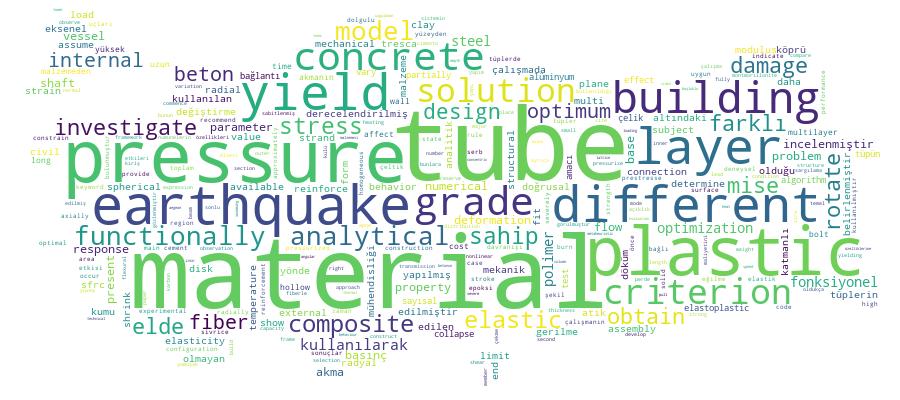
Competency Cloud
33 results
Scholarly Output Search Results
Now showing 1 - 10 of 33
Article Citation - WoS: 3On the Yielding of Two-Layer Composite Spherical Pressure Vessels(Gazi Univ, 2017) Akis, TolgaThe yielding of two-layer composite spherical pressure vessels under either internal or external pressure is investigated analytically in the framework of small deformations and von Mises yield criterion. It is shown for both pressure cases that depending on the material properties and sphere dimensions, different modes of plasticization may take place. Unlike the deformation behavior of a single layer spherical pressure vessel, yielding may commence at the inner layer or at the outer layer or simultaneously at both layers of the assembly.Article Citation - WoS: 33Citation - Scopus: 36Exact Solution of Rotating Fgm Shaft Problem in the Elastoplastic State of Stress(Springer, 2007) Akis, Tolga; Eraslan, Ahmet N.Plane strain analytical solutions to estimate purely elastic, partially plastic and fully plastic deformation behavior of rotating functionally graded (FGM) hollow shafts are presented. The modulus of elasticity of the shaft material is assumed to vary nonlinearly in the radial direction. Tresca's yield criterion and its associated flow rule are used to formulate three different plastic regions for an ideal plastic material. By considerina different material compositions as well as a wide range of bore radii, it is demonstrated in this article that both the elastic and the elastoplastic responses of a rotating FGM hollow shaft are affected significantly by the material nonhomogeneity.Article Citation - WoS: 20Citation - Scopus: 20The Stress Response of Partially Plastic Rotating Fgm Hollow Shafts: Analytical Treatment for Axially Constrained Ends(Taylor & Francis inc, 2006) Eraslan, Ahmet N.; Akis, Tolgaanalytical solutions to estimating the elastoplastic response of rotating functionally graded (FGM) hollow shafts with fixed ends are presented. The modulus of elasticity, as well as the uniaxial yield limit of the shaft material, are assumed to vary nonlinearly in the radial direction. The plastic model is based on Tresca's yield criterion, its associated flow rule, and ideal plastic material behaviour. Elastic, partially plastic, fully plastic, and residual stress states are investigated. It is shown that the elastoplastic stress response of a rotating FGM hollow shaft is affected significantly by the nonhomogeneity of the material. Unlike the case of a homogeneous hollow shaft, plastic deformation may commence at the inner surface, at the outer surface, or simultaneously at both surfaces. Accordingly, each case requires different mathematical treatment to arrive at its partially plastic solution. It is also shown that, by taking a numerical limit, the complete FGM solution presented herein converge to the solution of a homogeneous rotating shaft.Article Citation - WoS: 22Citation - Scopus: 27The Stress Response and Onset of Yield of Rotating Fgm Hollow Shafts(Springer Wien, 2006) Akis, T.; Eraslan, A. N.An analytical model is developed to study the stress response and the yielding of rotating functionally graded hollow shafts in the framework of generalized plane strain. The modulus of elasticity and the uniaxial yield limit of the shaft material are assumed to vary radially in nonlinear forms. It is shown that different modes of plasticization may take place. Analytical expressions for the critical values of the material parameters leading to different modes of plastic deformation and the corresponding elastic limit rotation speeds are derived by the use of Tresca's yield criterion.Article Citation - WoS: 11Citation - Scopus: 13Automated Selection of Optimal Material for Pressurized Multi-Layer Composite Tubes Based on an Evolutionary Approach(Springer London Ltd, 2018) Azad, Saeid Kazemzadeh; Akis, Tolga; Kazemzadeh Azad, SaeidDecision making on the configuration of material layers as well as thickness of each layer in composite assemblies has long been recognized as an optimization problem. Today, on the one hand, abundance of industrial alloys with different material properties and costs facilitates fabrication of more economical or light weight assemblies. On the other hand, in the design stage, availability of different alternative materials apparently increases the complexity of the design optimization problem and arises the need for efficient optimization techniques. In the present study, the well-known big bang-big crunch optimization algorithm is reformulated for optimum design of internally pressurized tightly fitted multi-layer composite tubes with axially constrained ends. An automated material selection and thickness optimization approach is employed for both weight and cost minimization of one-, two-, and three-layer tubes, and the obtained results are compared. The numerical results indicate the efficiency of the proposed approach in practical optimum design of multi-layer composite tubes under internal pressure and quantify the optimality of different composite assemblies compared to one-layer tubes.Article Citation - WoS: 2Citation - Scopus: 2Structural Design Optimization of Multi-Layer Spherical Pressure Vessels: a Metaheuristic Approach(Springer, 2019) Akis, Tolga; Azad, Saeid Kazemzadeh; Kazemzadeh Azad, SaeidThis study addresses the optimum design problem of multi-layer spherical pressure vessels based on von Mises yield criterion. In order to compute the structural responses under internal pressure, analytical solutions for one-, two-, and three-layer spherical pressure vessels are provided. A population-based metaheuristic algorithm is reformulated for optimum material selection as well as thickness optimization of multi-layer spherical pressure vessels. Furthermore, in order to enhance the computational efficiency of the optimization algorithm, upper bound strategy is also integrated with the algorithm for reducing the total number of structural response evaluations during the optimization iterations. The performance of the algorithm is investigated through weight and cost minimization of one-, two- and three-layer spherical pressure vessels and the results are presented in detail. The obtained numerical results, based on different internal pressures as well as vessel sizes, indicate the usefulness and efficiency of the employed methodology in optimum design of multi-layer spherical pressure vessels.Article Citation - WoS: 2Yielding of Radially Pressurized Functionally Graded Long Tubes Based on Von Mises Criterion(Gazi Univ, 2015) Akis, Tolga; Eren, OmurThe elastic behaviour of functionally graded long tubes with axially constrained ends subject to either internal or external pressure is investigated analytically. The modulus of elasticity and the yield limit of the tube material are assumed to vary radially in nonlinear forms. Making use of von Mises yield criterion, the effect of grading parameters on the yielding behavior of the tube is investigated and it is observed that for both pressure cases, the plastic flow may commence at the inner surface, at the outer surface or simultaneously at both surfaces depending on the functionally grading parameters.Article Dikkat mi Nabız Mı: Apne Sürelerinin Tahmin Edilmesinde Yukarıdan Aşağıya ve Aşağıdan Yukarıya Süreçlerin Bütünleştirilmesine Yönelik Bir Ön Çalışma(2023) Alkan, Neşe; Akış, TolgaSerbest dalış performansı gibi bazı aktivitelerde zamanın doğru algılanması hayati önem taşımaktadır. Saniyeler ile ifade edilebilecek görece uzun zaman aralıklarının doğru tahmininin altında yatan kesin mekanizmaların anlaşılması, psikolojide çözülmesi gereken konulardan biridir. Bu amaçla, mevcut çalışmada, prospektif bir paradigma kullanılarak, 25, 50 ve 75 saniyelik apne sürelerinin yordayıcıları incelenmiştir. Çalışmanın verileri, iki deneysel koşulda, on bir serbest dalış sporcusunun hedef apne tahminlerini havada ve suda (daldırılmış) yapmaları yolu ile elde edilmiştir. Katılımcıların kalp atış hızı değerleri, dikkat kontrol kapasiteleri ve duygu durumlarının üç farklı hedef apne tahminindeki doğruluğunun incelendiği bu çalışmada: zaman tahminini etkileyen tek faktörün kalp atış hızı olmadığı; dikkat kapasitesi ve olumlu duygudurumun lineer olmayan bir tarzda zaman tahmininin doğruluğuna etki ettiği; yordayıcı olarak kullanılan bu üç değişkenin, deney koşuluna ve hedef aralığın süresine göre farklı şekilde etkili olduğu ve son olarak, katılımcıların en doğru zaman tahmininin, bu çalışmada kullanılan en uzun zaman aralığı olan 75 saniye suda apne olduğu bulunmuştur.Article Citation - WoS: 23Citation - Scopus: 30On the Elastic-Plastic Deformation of a Rotating Disk Subjected To a Radial Temperature Gradient(Marcel dekker inc, 2003) Eraslan, AN; Akis, TElastic-plastic stress distribution in a nonisothermal rotating annular disk is analyzed by the use of Tresca and von Mises criteria. An energy equation that accounts for the convective heat transfer with a variable heat transfer coefficient is modeled. For a given angular velocity, the steady temperature distribution in the disk is obtained by the analytical solution of the energy equation. Tresca yield criterion and its associated flow rule are used to obtain the analytical stress distributions for a linearly hardening material. A computational model is developed to analyze elastic-plastic deformations of the disk using von Mises yield criterion and its flow rule. This model incorporates Swift's hardening law to simulate linear as well as nonlinear hardening material behavior. It is shown that the stress distribution in the disk is affected significantly by the presence of the temperature gradient.Article Citation - Scopus: 13Deformation Analysis of Elastic-Plastic Two Layer Tubes Subject To Pressure: an Analytical Approach(2004) Eraslan,A.N.; Akiş,T.Analytical solutions are obtained for axisymmetric elastic-plastic deformations in tightly fitted concentric tubes with fixed ends subjected to either internal or external pressure. Tresca's yield criterion and its associated flow rule are used to estimate the elastic-plastic response of the assembly. The closed form solutions for all elastic-plastic deformation stages are obtained by assuming linear hardening material behavior. Some numerical examples are handled using the mechanical properties of real engineering materials.
