Akbaş Uslu, Gülçin

Loading...
Profile Picture
Name Variants
Gulcin, Akbas Uslu
G.,Akbas Uslu
G., Akbaş Uslu
Akbas Uslu,G.
A., Gülçin
Akbaş Uslu, Gülçin
A.,Gulcin
A.U.Gülçin
Akbas Uslu, Gulcin
A.,Gülçin
G., Akbas Uslu
Gülçin, Akbaş Uslu
A. U. Gülçin
Akbaş Uslu,G.
G.,Akbaş Uslu
Gülçin Akbaş Uslu
A., Gulcin
Akbas Uslu,Gulcin
A. U. Gulcin
Akbaş,G.
Akbas, Gulcin
Akbaş, Gülçin
Job Title
Doktor Öğretim Üyesi
Email Address
gulcin.akbasuslu@atilim.edu.tr
Main Affiliation
Department of Psychology
Status
Website
Scopus Author ID
Turkish CoHE Profile ID
Google Scholar ID
WoS Researcher ID

Sustainable Development Goals

NO POVERTY1
NO POVERTY
0
Research Products
ZERO HUNGER2
ZERO HUNGER
0
Research Products
GOOD HEALTH AND WELL-BEING3
GOOD HEALTH AND WELL-BEING
0
Research Products
QUALITY EDUCATION4
QUALITY EDUCATION
0
Research Products
GENDER EQUALITY5
GENDER EQUALITY
4
Research Products
CLEAN WATER AND SANITATION6
CLEAN WATER AND SANITATION
0
Research Products
AFFORDABLE AND CLEAN ENERGY7
AFFORDABLE AND CLEAN ENERGY
0
Research Products
DECENT WORK AND ECONOMIC GROWTH8
DECENT WORK AND ECONOMIC GROWTH
0
Research Products
INDUSTRY, INNOVATION AND INFRASTRUCTURE9
INDUSTRY, INNOVATION AND INFRASTRUCTURE
0
Research Products
REDUCED INEQUALITIES10
REDUCED INEQUALITIES
2
Research Products
SUSTAINABLE CITIES AND COMMUNITIES11
SUSTAINABLE CITIES AND COMMUNITIES
0
Research Products
RESPONSIBLE CONSUMPTION AND PRODUCTION12
RESPONSIBLE CONSUMPTION AND PRODUCTION
0
Research Products
CLIMATE ACTION13
CLIMATE ACTION
0
Research Products
LIFE BELOW WATER14
LIFE BELOW WATER
0
Research Products
LIFE ON LAND15
LIFE ON LAND
0
Research Products
PEACE, JUSTICE AND STRONG INSTITUTIONS16
PEACE, JUSTICE AND STRONG INSTITUTIONS
2
Research Products
PARTNERSHIPS FOR THE GOALS17
PARTNERSHIPS FOR THE GOALS
3
Research Products
This researcher does not have a Scopus ID.
Documents

16

Citations

294

Scholarly Output

12

Articles

10

Views / Downloads

10/0

Supervised MSc Theses

0

Supervised PhD Theses

0

WoS Citation Count

100

Scopus Citation Count

110

Patents

0

Projects

0

WoS Citations per Publication

8.33

Scopus Citations per Publication

9.17

Open Access Source

7

Supervised Theses

0

JournalCount
Sex Roles2
Cyberfeminism and Gender Violence in Social Media1
Examining Complex Intergroup Relations: Through the Lens of Turkey1
İstanbul Gelişim Üniversitesi Sosyal Bilimler Dergisi1
Journal of Adult Development1
Current Page: 1 / 3

Scopus Quartile Distribution

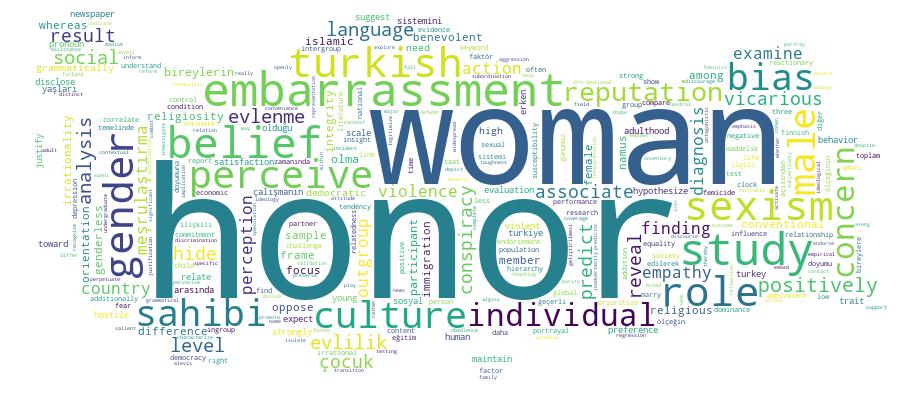
Competency Cloud

GCRIS Competency Cloud

Scholarly Output Search Results

Now showing 1 - 1 of 1
  • Article
    Citation - WoS: 68
    Citation - Scopus: 76
    Why Do Women Endorse Honor Beliefs? Ambivalent Sexism and Religiosity as Predictors
    (Springer/plenum Publishers, 2016) Glick, Peter; Sakalli-Ugurlu, Nuray; Akbas, Gulcin; Orta, Irem Metin; Ceylan, Suzan
    Cultures of honor, such as Turkey, prioritize defending individual and family reputations, but in gender-specific ways (Nisbett and Cohen 1996). Men maintain honor via reputations for toughness, aggression, control over women, and avenging insults. Women maintain honor through obedience to men, sexual modesty, and religious piety. Honor beliefs support women's subordination, justifying violence against them (Sev'er and Yurdakul, Violence against Women, 7, 964-998, 2001) and therefore should be challenged. Understanding honor beliefs' ideological correlates may inform such efforts. We hypothesized that benevolent sexism, a subjectively favorable system-justifying ideology, would more strongly, positively predict Turkish women's (versus men's) honor beliefs; whereas hostile sexism, which is openly antagonistic toward women, would more strongly, positively predict Turkish men's (versus women's) honor beliefs. Additionally, due to justifications for gender inequality embedded in Islamic religious teachings, we expected Islamic religiosity to positively predict honor beliefs for both genders. A convenience sample of Turkish undergraduates (313 women and 122 men) in Ankara completed the Ambivalent Sexism Inventory, Religious Orientation Scale, and Honor Endorsement Index. Regression analyses revealed that benevolent (but not hostile) sexism positively predicted women's honor beliefs, whereas hostile (but not benevolent) sexism positively predicted men's honor beliefs. Islamic religiosity positively predicted honor beliefs for both genders, but (unexpectedly) did so more strongly for men than women. We suggest that combating benevolent sexism and promoting feminist interpretations of Islamic religiosity may help to empower Turkish women to challenge honor beliefs.