Karakaya, Ziya

Loading...
Profile Picture
Name Variants
Karakaya, Z
K.,Ziya
Ziya, Karakaya
K., Ziya
Z., Karakaya
Karakaya,Z.
Karakaya, Ziya
Z.,Karakaya
Job Title
Doktor Öğretim Üyesi
Email Address
ziya.karakaya@atilim.edu.tr
Main Affiliation
Computer Engineering
Status
Former Staff
Website
ORCID ID
Scopus Author ID
Turkish CoHE Profile ID
Google Scholar ID
WoS Researcher ID

Sustainable Development Goals

NO POVERTY1
NO POVERTY
0
Research Products
ZERO HUNGER2
ZERO HUNGER
0
Research Products
GOOD HEALTH AND WELL-BEING3
GOOD HEALTH AND WELL-BEING
1
Research Products
QUALITY EDUCATION4
QUALITY EDUCATION
0
Research Products
GENDER EQUALITY5
GENDER EQUALITY
0
Research Products
CLEAN WATER AND SANITATION6
CLEAN WATER AND SANITATION
0
Research Products
AFFORDABLE AND CLEAN ENERGY7
AFFORDABLE AND CLEAN ENERGY
0
Research Products
DECENT WORK AND ECONOMIC GROWTH8
DECENT WORK AND ECONOMIC GROWTH
0
Research Products
INDUSTRY, INNOVATION AND INFRASTRUCTURE9
INDUSTRY, INNOVATION AND INFRASTRUCTURE
2
Research Products
REDUCED INEQUALITIES10
REDUCED INEQUALITIES
0
Research Products
SUSTAINABLE CITIES AND COMMUNITIES11
SUSTAINABLE CITIES AND COMMUNITIES
0
Research Products
RESPONSIBLE CONSUMPTION AND PRODUCTION12
RESPONSIBLE CONSUMPTION AND PRODUCTION
0
Research Products
CLIMATE ACTION13
CLIMATE ACTION
0
Research Products
LIFE BELOW WATER14
LIFE BELOW WATER
1
Research Products
LIFE ON LAND15
LIFE ON LAND
0
Research Products
PEACE, JUSTICE AND STRONG INSTITUTIONS16
PEACE, JUSTICE AND STRONG INSTITUTIONS
0
Research Products
PARTNERSHIPS FOR THE GOALS17
PARTNERSHIPS FOR THE GOALS
0
Research Products
This researcher does not have a Scopus ID.
This researcher does not have a WoS ID.
Scholarly Output

41

Articles

3

Views / Downloads

267/2090

Supervised MSc Theses

13

Supervised PhD Theses

2

WoS Citation Count

78

Scopus Citation Count

98

Patents

0

Projects

0

WoS Citations per Publication

1.90

Scopus Citations per Publication

2.39

Open Access Source

4

Supervised Theses

15

JournalCount
UBMK 2018 - 3rd International Conference on Computer Science and Engineering -- 3rd International Conference on Computer Science and Engineering, UBMK 2018 -- 20 September 2018 through 23 September 2018 -- Sarajevo -- 1435604
3rd International Conference on Computer Science and Engineering (UBMK) -- SEP 20-23, 2018 -- Sarajevo, BOSNIA & HERCEG3
2017 International Conference on Computer and Applications, ICCA 2017 -- 2017 International Conference on Computer and Applications, ICCA 2017 -- 6 September 2017 through 7 September 2017 -- Doha -- 1315022
Lecture Notes in Computer Science (including subseries Lecture Notes in Artificial Intelligence and Lecture Notes in Bioinformatics) -- 7th International Conference on Computational Science, ICCS 2007 -- 27 May 2007 through 30 May 2007 -- Beijing -- 708232
2017 International Conference on Computer Science and Engineering (UBMK) -- OCT 05-08, 2017 -- Antalya, TURKEY1
Current Page: 1 / 4

Scopus Quartile Distribution

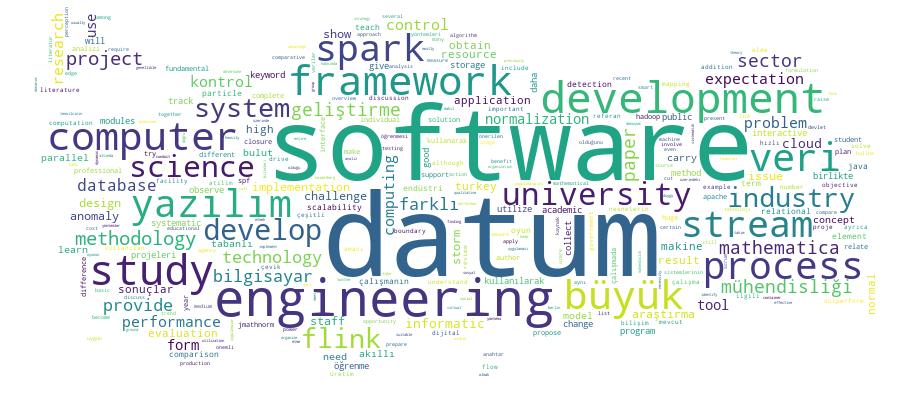
Competency Cloud

GCRIS Competency Cloud

Scholarly Output Search Results

Now showing 1 - 8 of 8
  • Conference Object
    Citation - Scopus: 2
    Big Data on Cloud for Government Agencies: Benefits, Challenges, and Solutions
    (Assoc Computing Machinery, 2018) Rashed, Alaa Hussain; Karakaya, Ziya; Yazici, Ali
    Big Data and Cloud computing are the most important technologies that give the opportunity for government agencies to gain a competitive advantage and improve their organizations. On one hand, Big Data implementation requires investing a significant amount of money in hardware, software, and workforce. On the other hand, Cloud Computing offers an unlimited, scalable and on-demand pool of resources which provide the ability to adopt Big Data technology without wasting on the financial resources of the organization and make the implementation of Big Data faster and easier. The aim of this study is to conduct a systematic literature review in order to collect data to identify the benefits and challenges of Big Data on Cloud for government agencies and to make a clear understanding of how combining Big Data and Cloud Computing help to overcome some of these challenges. The last objective of this study is to identify the solutions for related challenges of Big Data. Four research questions were designed to determine the information that is related to the objectives of this study. Data is collected using literature review method and the results are deduced from there.
  • Conference Object
    Citation - Scopus: 25
    A Comparison of Stream Processing Frameworks
    (Institute of Electrical and Electronics Engineers Inc., 2017) Karakaya,Z.; Yazici,A.; Alayyoub,M.
    This study compares the performance of Big Data Stream Processing frameworks including Apache Spark, Flink, and Storm. Also, it measures the resource usage and performance scalability of the frameworks against a varying number of cluster sizes. It has been observed that, Flink outperforms both Spark and Storm under equal constraints. However, Spark can be optimized to provide the higher throughput than Flink with the cost of higher latency. © 2017 IEEE.
  • Conference Object
    Citation - Scopus: 2
    Systematic Mapping for Big Data Stream Processing Frameworks
    (Institute of Electrical and Electronics Engineers Inc., 2016) Alayyoub,M.; Yazıcı, Ali; Yazici,A.; Karakaya,Z.; Karakaya, Ziya; Yazıcı, Ali; Karakaya, Ziya; Software Engineering; Computer Engineering; Software Engineering; Computer Engineering
    There has been lots of discussions about the choice of a stream processing framework (SPF) for Big Data. Each of the SPFs has different cutting edge technologies in their steps of processing the data in motion that gives them a better advantage over the others. Even though, the cutting edge technologies used in each stream processing framework might better them, it is still hard to say which framework bests the rest under different scenarios and conditions. In this study, we aim to show trends and differences about several SPFs for Big Data by using the Systematic Mapping (SM) approach. To achieve our objectives, we raise 6 research questions (RQs), in which 91 studies that conducted between 2010 and 2015 were evaluated. We present the trends by classifying the research on SPFs with respect to the proposed RQs which can help researchers to obtain an overview of the field. © 2016 IEEE.
  • Conference Object
    Citation - WoS: 3
    Software Engineering Issues in Big Data Application Development
    (Ieee, 2017) Karakaya, Ziya
    Big Data has become one of the most important concepts that is being studied in Computer/Software Engineering. The data produced in recent years have increased rapidly and exponentially, necessitating the solution of major problems such as the collection, processing and storage of huge volume of data. Big Data Frameworks are developed specifically to solve these problems that facilitates application developers by providing opportunities to collect, process, manage, monitor and analyze these data. A few examples of these frameworks are Hadoop, Spark, Storm, and Flink, which are developed by Software Engineers as open source projects. Although the challenges raised from coordination of IT resources such as huge amounts of computation power, storage area, memory, and network bandwidth in a distributed manner solved by these frameworks, there still remains many Software Engineering problems in application development phase, even if they based on these frameworks. High scalability, fault tolerance, flexibility, reliability and testability can be listed as the main issues need to be carefully considered in terms of Software Engineering. In this paper, we first clarify the terms Framework-Application, and then the overview information about Big Data and related frameworks are given before emphasizing the problems arising in terms of Software Engineering. Nevertheless, we tried to provide guidance to the people who would develop software for Big Data and tried to give the further research guidance.
  • Conference Object
    Citation - Scopus: 4
    Software engineering issues in big data application development
    (Institute of Electrical and Electronics Engineers Inc., 2017) Karakaya,Z.
    Big Data has become one of the most important concepts that is being studied in Computer/Software Engineering. The data produced in recent years have increased rapidly and exponentially, necessitating the solution of major problems such as the collection, processing and storage of huge volume of data. Big Data Frameworks are developed specifically to solve these problems that facilitates application developers by providing opportunities to collect, process, manage, monitor and analyze these data. A few examples of these frameworks are Hadoop, Spark, Storm, and Flink, which are developed by Software Engineers as open source projects. Although the challenges raised from coordination of IT resources such as huge amounts of computation power, storage area, memory, and network bandwidth in a distributed manner solved by these frameworks, there still remains many Software Engineering problems in application development phase, even if they based on these frameworks. High scalability, fault tolerance, flexibility, reliability and testability can be listed as the main issues need to be carefully considered in terms of Software Engineering. In this paper, we first clarify the terms Framework-Application, and then the overview information about Big Data and related frameworks are given before emphasizing the problems arising in terms of Software Engineering. Nevertheless, we tried to provide guidance to the people who would develop software for Big Data and tried to give the further research guidance. © 2017 IEEE.
  • Conference Object
    A Comparison of Stream Processing Frameworks
    (Institute of Electrical and Electronics Engineers Inc., 2017) Karakaya,Z.; Yazici,A.; Alayyoub,M.
    This study compares the performance of Big Data Stream Processing frameworks including Apache Spark, Flink, and Storm. Also, it measures the resource usage and performance scalability of the frameworks against a varying number of cluster sizes. It has been observed that, Flink outperforms both Spark and Storm under equal constraints. However, Spark can be optimized to provide the higher throughput than Flink with the cost of higher latency. © 2017 IEEE.
  • Conference Object
    Citation - WoS: 28
    A Comparison of Stream Processing Frameworks
    (Ieee, 2017) Karakaya, Ziya; Yazici, Ali; Alayyoub, Mohammed
    This study compares the performance of Big Data Stream Processing frameworks including Apache Spark, Flink, and Storm. Also, it measures the resource usage and performance scalability of the frameworks against a varying number of cluster sizes. It has been observed that, Flink outperforms both Spark and Storm under equal constraints. However, Spark can be optimized to provide the higher throughput than Flink with the cost of higher latency.
  • Conference Object
    Systematic Mapping for Big Data Stream Processing Frameworks
    (Ieee, 2016) Alayyoub, Mohammed; Yazici, Ali; Karakaya, Ziya
    There has been lots of discussions about the choice of a stream processing framework (SPF) for Big Data. Each of the SPFs has different cutting edge technologies in their steps of processing the data in motion that gives them a better advantage over the others. Even though, the cutting edge technologies used in each stream processing framework might better them, it is still hard to say which framework bests the rest under different scenarios and conditions. in this study, we aim to show trends and differences about several SPFs for Big Data by using the Systematic Mapping (SM) approach. To achieve our objectives, we raise 6 research questions (RQs), in which 91 studies that conducted between 2010 and 2015 were evaluated. We present the trends by classifying the research on SPFs with respect to the proposed RQs which can help researchers to obtain an overview of the field.