Yılmaz, Vadi Su

Loading...
Profile Picture
Name Variants
Y., Vadi Su
Yilmaz,V.S.
Vadi Su, Yılmaz
V. S. Yilmaz
Yılmaz,V.S.
Vadi Su, Yilmaz
V.S.Yilmaz
Yilmaz, Vadi Su
V.,Yilmaz
Y.,Vadi Su
Yilmaz V.
Yılmaz, Vadi Su
V., Yilmaz
V.,Yılmaz
V.S.Yılmaz
V. S. Yılmaz
Job Title
Araştırma Görevlisi
Email Address
vadi.yilmaz@atilim.edu.tr
Main Affiliation
Electrical-Electronics Engineering
Mechatronics Engineering
Status
Website
ORCID ID
Scopus Author ID
Turkish CoHE Profile ID
Google Scholar ID
WoS Researcher ID

Sustainable Development Goals

SDG data is not available
Documents

7

Citations

31

h-index

3

Documents

7

Citations

20

Scholarly Output

11

Articles

4

Views / Downloads

8/24

Supervised MSc Theses

1

Supervised PhD Theses

1

WoS Citation Count

20

Scopus Citation Count

31

Patents

0

Projects

0

WoS Citations per Publication

1.82

Scopus Citations per Publication

2.82

Open Access Source

3

Supervised Theses

2

JournalCount
10th International Conference on Electrical and Electronics Engineering (ELECO) -- NOV 30-DEC 02, 2017 -- Bursa, TURKEY1
2020 28th Signal Processing and Communications Applications Conference, SIU 2020 - Proceedings -- 28th Signal Processing and Communications Applications Conference, SIU 2020 -- 5 October 2020 through 7 October 2020 -- Gaziantep -- 1664131
24th IEEE International Conference on Electronics, Circuits and Systems (ICECS) -- DEC 05-08, 2017 -- Batumi, GEORGIA1
28th Signal Processing and Communications Applications Conference (SIU) -- OCT 05-07, 2020 -- ELECTR NETWORK1
Diagnostics1
Current Page: 1 / 2

Scopus Quartile Distribution

Competency Cloud

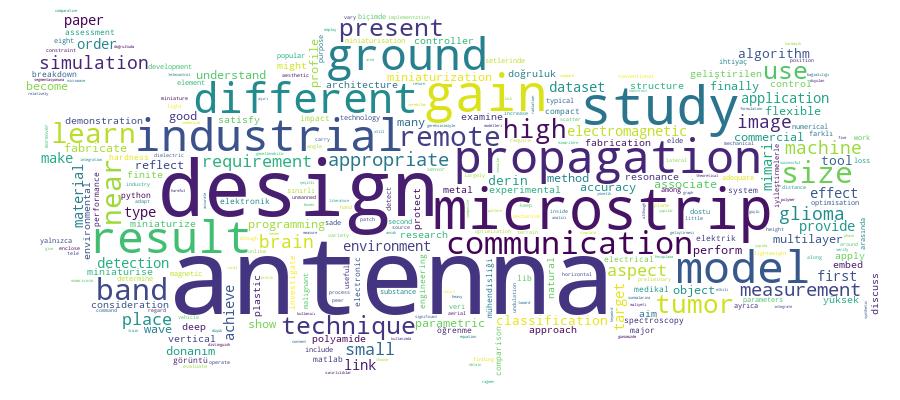
GCRIS Competency Cloud

Scholarly Output Search Results

Now showing 1 - 5 of 5
  • Article
    Citation - WoS: 3
    Citation - Scopus: 3
    Classification of Different Recycled Rubber-Epoxy Composite Based on Their Hardness Using Laser-Induced Breakdown Spectroscopy (libs) With Comparison Machine Learning Algorithms
    (Mdpi, 2023) Yilmaz, Vadi Su; Yılmaz, Vadi Su; Eseller, Kemal Efe; Aslan, Ozgur; Aslan, Özgür; Bayraktar, Emin; Eseller, Kemal Efe; Yılmaz, Vadi Su; Aslan, Özgür; Eseller, Kemal Efe; Electrical-Electronics Engineering; Department of Electrical & Electronics Engineering; Mechanical Engineering; Electrical-Electronics Engineering; Mechanical Engineering; Department of Electrical & Electronics Engineering
    This paper aims toward the successful detection of harmful materials in a substance by integrating machine learning (ML) into laser-induced breakdown spectroscopy (LIBS). LIBS is used to distinguish five different synthetic polymers where eight different heavy material contents are also detected by LIBS. Each material intensity-wavelength graph is obtained and the dataset is constructed for classification by a machine learning (ML) algorithm. Seven popular machine learning algorithms are applied to the dataset which include eight different substances with their wavelength-intensity value. Machine learning algorithms are used to train the dataset, results are discussed and which classification algorithm is appropriate for this dataset is determined.
  • Doctoral Thesis
    3B Medikal Görüntü İşleme İçin Derin Öğrenme Model Mimarisinin Geliştirmesi ve Analizi
    (2025) Yılmaz, Vadi Su; Doruk, Reşat Özgür; Tora, Hakan
    Günümüzde medikal görüntü segmentasyonuna yönelik geliştirilen derin öğrenme modelleri, yüksek doğruluk sunmalarına rağmen; aşırı hesaplama maliyeti, karmaşık yapılar ve donanım bağımlılığı nedeniyle pratik kullanımda çeşitli sınırlılıklar barın-dırmaktadır. Bu doğrultuda, kullanıcı dostu, düşük donanım gereksinimiyle çalışabi-len, sade ancak derin yapıda, sınırlı veri setlerinde de etkili sonuçlar verebilen, genellenebilir ve güçlü mimarilere duyulan ihtiyaç giderek artmaktadır. Bu tezde, herhangi bir fine-tuning veya dışsal optimizasyona ( pruning, quantization, attention vb.) ihtiyaç duymadan, yalnızca yapısal mimari iyileştirmelerle yüksek doğruluk elde eden donanım dostu bir 3B CNN modeli geliştirilmiştir. Model mimarisi kapsamlı biçimde ele alınmış; katman derinliği, filtre boyutu, kanal sayısı, aktivasyon ve normalizasyon sıralaması gibi birçok parametre sistematik olarak analiz edilmiştir. Farklı çekirdek boyutlarına sahip konvolüsyon filtreleri hem paralel yollarla aynı blok içinde, hem de ardışık katmanlar arasında dağıtılarak farklı mimari konfigürasyonlarla yapılandırılmıştır. Bu yapılarda tek ve çok katmanlı, simetrik ve asimetrik tasarımlar denenmiştir. Ayrıca model tasarımı sürecinde NAS (Neural Architecture Search) yöntemi uygulanmış; elde edilen mimari varyantlar performans açısından değerlendirilmiştir. Geliştirilen model, klasik U-Net'e kıyasla eğitim süresini 2.5 ila 10 kat arasında kısaltmış, FLOPs değerini yaklaşık yarı yarıya düşürmüş ve benzer Dice Benzerlik Katsayısı (DSC) ile segmentasyon doğruluğunu korumayı başarmıştır. Ayrıca yapılan analizlerde, FLOPs'un gerçek zamanlı performansı belirlemede tek başına yeterli bir ölçüt olmadığı ortaya konmuştur. Bu tez kapsamında yürütülen çalışmalar, yalnızca mimari düzeyde gerçekleştirilen iyileştirmelerle yüksek doğruluk ve donanım verimliliğine ulaşılabileceğini göstermekte; geliştirilen yapının sade fakat derin mimarisi-yle genellenebilirliği, sınırlı veri setlerinde başarımı ve hangi mimari parametrelerin modele belirgin katkı sağladığı detaylı biçimde ortaya konmuştur.
  • Article
    Citation - WoS: 4
    Citation - Scopus: 8
    Investigating the Impact of Two Major Programming Environments on the Accuracy of Deep Learning-Based Glioma Detection From Mri Images
    (Mdpi, 2023) Yilmaz, Vadi Su; Akdag, Metehan; Dalveren, Yaser; Doruk, Resat Ozgur; Kara, Ali; Soylu, Ahmet
    Brain tumors have been the subject of research for many years. Brain tumors are typically classified into two main groups: benign and malignant tumors. The most common tumor type among malignant brain tumors is known as glioma. In the diagnosis of glioma, different imaging technologies could be used. Among these techniques, MRI is the most preferred imaging technology due to its high-resolution image data. However, the detection of gliomas from a huge set of MRI data could be challenging for the practitioners. In order to solve this concern, many Deep Learning (DL) models based on Convolutional Neural Networks (CNNs) have been proposed to be used in detecting glioma. However, understanding which CNN architecture would work efficiently under various conditions including development environment or programming aspects as well as performance analysis has not been studied so far. In this research work, therefore, the purpose is to investigate the impact of two major programming environments (namely, MATLAB and Python) on the accuracy of CNN-based glioma detection from Magnetic Resonance Imaging (MRI) images. To this end, experiments on the Brain Tumor Segmentation (BraTS) dataset (2016 and 2017) consisting of multiparametric magnetic MRI images are performed by implementing two popular CNN architectures, the three-dimensional (3D) U-Net and the V-Net in the programming environments. From the results, it is concluded that the use of Python with Google Colaboratory (Colab) might be highly useful in the implementation of CNN-based models for glioma detection. Moreover, the 3D U-Net model is found to perform better, attaining a high accuracy on the dataset. The authors believe that the results achieved from this study would provide useful information to the research community in their appropriate implementation of DL approaches for brain tumor detection.
  • Conference Object
    Citation - Scopus: 2
    Miniaturized 2.4 Ghz Antenna Design for Uav Communication Link;
    (Institute of Electrical and Electronics Engineers Inc., 2020) Yilmaz,V.S.; Kara,A.; Aydin,E.
    In many communications applications, unlike conventional antennas, lightweight, flexible, small antennas that can adapt to mechanical and industrial constraints are required. In this study, the results of antenna design operating at 2.4 GHz are presented for use in Unmanned Aerial Vehicle (UAV) tele command links. In the parametric and optimization studies carried out on the antenna, it is aimed to increase the gain while keeping the size as small as possible. The requirements of the industry, such as light, aesthetics, miniature and high gain aspects of the antenna were targeted in the design process. Finally, an antenna of 55.2x88 mm size and 7dB gain was achieved using commercial electromagnetic design tools. The designed antenna become satisfying industrial requirements with these features. © 2020 IEEE.
  • Conference Object
    Miniaturized 2.4 Ghz Antenna Design for Uav Communication Link
    (Ieee, 2020) Yilmaz, Vadi Su; Kara, Ali; Aydin, Elif
    In many communications applications, unlike conventional antennas, lightweight, flexible, small antennas that can adapt to mechanical and industrial constraints are required. In this study, the results of antenna design operating at 2.4 GHz are presented for use in Unmanned Aerial Vehicle (UAV) tele command links. In the parametric and optimization studies carried out on the antenna, it is aimed to increase the gain while keeping the size as small as possible. The requirements of the industry, such as light, aesthetics, miniature and high gain aspects of the antenna were targeted in the design process. Finally, an antenna of 55.2x88 mm size and 7dB gain was achieved using commercial electromagnetic design tools. The designed antenna become satisfying industrial requirements with these features.