Saygılı, Hülya

Loading...
Profile Picture
Name Variants
H.,Saygili
S., Hulya
Saygılı, Hülya
Saygılı,H.
S.,Hulya
S., Hülya
Saygili, Hulya
Saygili,H.
Saygili, Huelya
Hülya, Saygili
H., Saygili
H.,Saygılı
Hülya, Saygılı
Saygili, Hülya
Sayglll H.
H., Saygılı
Hulya, Saygili
Saygili H.
S.,Hülya
Job Title
Doktor Öğretim Üyesi
Email Address
hulya.saygili@atilim.edu.tr
Main Affiliation
International Trade and Logistics
Status
Website
Scopus Author ID
Turkish CoHE Profile ID
Google Scholar ID
WoS Researcher ID

Sustainable Development Goals

2

ZERO HUNGER
ZERO HUNGER Logo

0

Research Products

14

LIFE BELOW WATER
LIFE BELOW WATER Logo

0

Research Products

17

PARTNERSHIPS FOR THE GOALS
PARTNERSHIPS FOR THE GOALS Logo

3

Research Products

5

GENDER EQUALITY
GENDER EQUALITY Logo

0

Research Products

16

PEACE, JUSTICE AND STRONG INSTITUTIONS
PEACE, JUSTICE AND STRONG INSTITUTIONS Logo

0

Research Products

8

DECENT WORK AND ECONOMIC GROWTH
DECENT WORK AND ECONOMIC GROWTH Logo

1

Research Products

4

QUALITY EDUCATION
QUALITY EDUCATION Logo

0

Research Products

6

CLEAN WATER AND SANITATION
CLEAN WATER AND SANITATION Logo

0

Research Products

7

AFFORDABLE AND CLEAN ENERGY
AFFORDABLE AND CLEAN ENERGY Logo

0

Research Products

10

REDUCED INEQUALITIES
REDUCED INEQUALITIES Logo

1

Research Products

11

SUSTAINABLE CITIES AND COMMUNITIES
SUSTAINABLE CITIES AND COMMUNITIES Logo

0

Research Products

9

INDUSTRY, INNOVATION AND INFRASTRUCTURE
INDUSTRY, INNOVATION AND INFRASTRUCTURE Logo

1

Research Products

1

NO POVERTY
NO POVERTY Logo

1

Research Products

3

GOOD HEALTH AND WELL-BEING
GOOD HEALTH AND WELL-BEING Logo

0

Research Products

12

RESPONSIBLE CONSUMPTION AND PRODUCTION
RESPONSIBLE CONSUMPTION AND PRODUCTION Logo

0

Research Products

13

CLIMATE ACTION
CLIMATE ACTION Logo

0

Research Products

15

LIFE ON LAND
LIFE ON LAND Logo

0

Research Products
This researcher does not have a Scopus ID.
Documents

21

Citations

69

Scholarly Output

7

Articles

5

Views / Downloads

5/0

Supervised MSc Theses

2

Supervised PhD Theses

0

WoS Citation Count

1

Scopus Citation Count

2

WoS h-index

1

Scopus h-index

1

Patents

0

Projects

0

WoS Citations per Publication

0.14

Scopus Citations per Publication

0.29

Open Access Source

1

Supervised Theses

2

Google Analytics Visitor Traffic

JournalCount
Applied Economics1
Business and Economics Research Journal1
Empirical Economics1
International Economics1
International Trade Journal1
Current Page: 1 / 1

Scopus Quartile Distribution

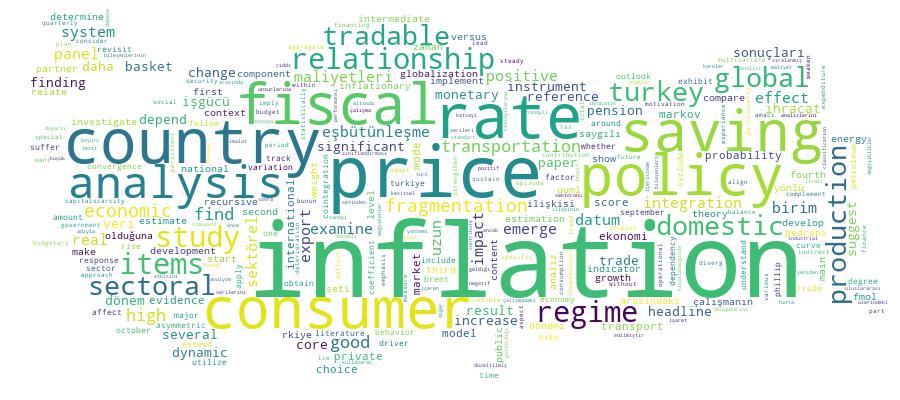
Competency Cloud

GCRIS Competency Cloud

Scholarly Output Search Results

Now showing 1 - 4 of 4
  • Article
    Citation - Scopus: 1
    Production Fragmentation and Transport Mode Choice in Eu-28 Exports
    (Routledge, 2024) Türkcan,K.; Saygılı,H.
    This study uses detailed data on exports from the European Union (EU-28) to non-EU countries to investigate the impact of global production fragmentation on the choice of transportation modes. The article finds a positive relationship between production fragmentation and air transportation. The study also finds that air transportation is more likely to be chosen for high-value products. Additionally, the positive effect of production fragmentation on the likelihood of using air transportation is more pronounced when goods are exported to medium-range markets, upper-middle-income countries, countries with better air transportation infrastructure, and time-sensitive products. © 2024 Taylor & Francis Group, LLC.
  • Article
    Oil Price Pass-Through on Sector-Level Prices: Evidence From Turkey
    (2023) Ekinci, Mehmet Fatih; Saygılı, Hülya
    As energy dependency is one of the main drivers of rising global inflation, understanding the sectoral outlook for the effects of oil prices on inflation is crucial. This paper investigates oil price pass-through to consumer prices in Turkey utilizing a Phillips Curve estimation approach. Extending the results in the literature, we estimate Brent crude petroleum price pass-through coefficients for the 2-digit sectoral components of the consumer price index. Then, we compare the sector-level pass-through rates to the ones obtained from the headline and core inflation. We also apply a recursive estimation modeling to track pass-through behavior over time for each inflation series. The paper has several conclusions. First, the long-run oil price pass-through to headline inflation is around 7%. Second, pass-through to the core and sectoral inflation rates exhibit a significant amount of variation from headline inflation. Results with core inflation rates depend on whether energy prices are included or excluded from the consumer basket. Third, the sectoral pass-through rate depends on the weight of the energy-related items in that sector. Our findings suggest that the transport sector has the highest degree of pass-through. Fourth, the rate of pass-through to all prices increases following the hikes in inflation rates in September 2018 and October 2021.
  • Article
    Citation - WoS: 1
    Citation - Scopus: 1
    How Do Real and Monetary Integrations Affect Inflation Dynamics?
    (Elsevier, 2023) Saygili, Hulya
    This paper examines the significance of real and monetary integrations for the inflationary dynamics of an emerging country, Turkey. The analysis accounts for 2-digit items of CPI inflation, which can be broadly categorized as tradable versus non-tradable and goods versus services. We find that a fall in the inflation gap between partner countries is mainly related to real integration whereas the co-movement of inflation is prominently driven by monetary policy co-movements. The product-type analysis shows that inflation gap in tradable items between trade partners shrinks and becomes more correlated with the (de)convergence and co-movement of real integration.
  • Article
    Tradable and Non-Tradable Inflation in Turkey: Asymmetric Responses To Global Factors
    (Physica-verlag Gmbh & Co, 2023) Saygili, Huelya; Turkvatan, Aysun
    We contribute to the debate on the linkage between inflation regimes and globalization in several respects. First, we analyze consumer goods and services classified with respect to their tradability and content of intermediate imports. Second, we use 4-digit commodity-based price index data and the official weights of items in the consumer basket in computations. Third, we explore which states of the reference indicators are more related to low, normal or high regimes of inflation. Regimes are determined using Markov regime-switching models. Probability score analysis compares the best matching of different regimes of inflation and reference indicators. Fourth, since we use commodity-based data we perform the analysis for an emerging country, Turkey, which has not only high trade openness and high global integration rate but also implements inflation targeting regime. Findings suggest that relevance of the reference indicators for predicting inflation depends on: the share of tradable items in the consumer basket, imported intermediate content of items in the consumer basket, the regime of inflation and invoicing currency.