
Garousi, Vahid
Loading...

Profile URL
Name Variants
Garousi-Yusifoglu, Vahid
G.,Vahid
G., Vahid
Garousi, Vahid
V.,Garousi
V., Garousi
Garousi,V.
Vahid, Garousi
Yusifoglu, Vahid Garousi
G.,Vahid
G., Vahid
Garousi, Vahid
V.,Garousi
V., Garousi
Garousi,V.
Vahid, Garousi
Yusifoglu, Vahid Garousi
Job Title
Doçent Doktor
Email Address
Main Affiliation
Software Engineering
Status
Former Staff
Website
ORCID ID
Scopus Author ID
Turkish CoHE Profile ID
Google Scholar ID
WoS Researcher ID
Sustainable Development Goals
SDG data is not available

This researcher does not have a Scopus ID.

This researcher does not have a WoS ID.

Scholarly Output
13
Articles
9
Views / Downloads
1/0
Supervised MSc Theses
0
Supervised PhD Theses
0
WoS Citation Count
613
Scopus Citation Count
790
WoS h-index
10
Scopus h-index
11
Patents
0
Projects
0
WoS Citations per Publication
47.15
Scopus Citations per Publication
60.77
Open Access Source
3
Supervised Theses
0
Google Analytics Visitor Traffic
| Journal | Count |
|---|---|
| Journal of Systems and Software | 4 |
| Information and Software Technology | 3 |
| ACM International Conference Proceeding Series -- 2014 International Conference on Software and Systems Process, ICSSP 2014 -- 26 May 2014 through 28 May 2014 -- Nanjing -- 105608 | 1 |
| CEUR Workshop Proceedings -- 9th Turkish National Software Engineering Symposium, UYMS 2015 -- 9 September 2015 through 11 September 2015 -- Izmir -- 117665 | 1 |
| 17th International Conference on Evaluation and Assessment in software Engineering -- APR 14-16, 2013 -- Porto de Galinhas, BRAZIL | 1 |
Current Page: 1 / 2
Scopus Quartile Distribution
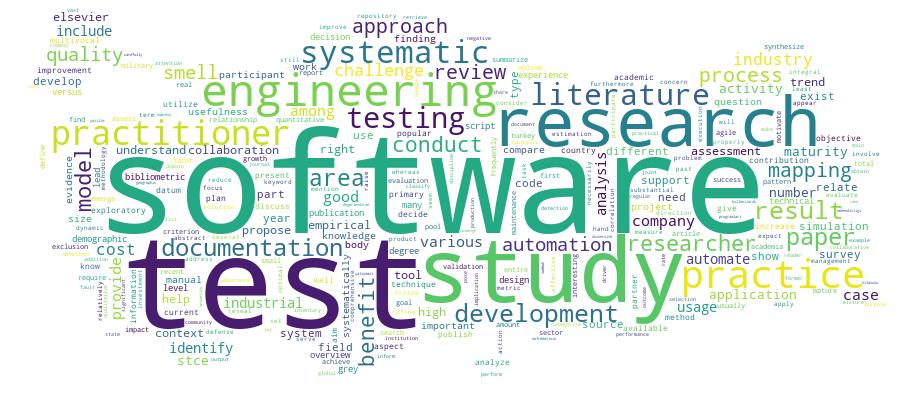
Competency Cloud
6 results
Scholarly Output Search Results
Now showing 1 - 6 of 6
Article Citation - WoS: 16What We Know About Software Test Maturity and Test Process Improvement(Ieee Computer Soc, 2018) Garousi, Vahid; Felderer, Michael; Hacaloglu, Tuna[No Abstract Available]Article Citation - WoS: 70Citation - Scopus: 86Cost, Benefits and Quality of Software Development Documentation: a Systematic Mapping(Elsevier Science inc, 2015) Zhi, Junji; Garousi-Yusifoglu, Vahid; Sun, Bo; Garousi, Golara; Shahnewaz, Shawn; Ruhe, GuentherContext: Software documentation is an integral part of any software development process. Researchers and practitioners have expressed concerns about costs, benefits and quality of software documentation in practice. On the one hand, there is a lack of a comprehensive model to evaluate the quality of documentation. On the other hand, researchers and practitioners need to assess whether documentation cost outweighs its benefit. Objectives: In this study, we aim to summarize the existing literature and provide an overview of the field of software documentation cost, benefit and quality. Method: We use the systematic-mapping methodology to map the existing body of knowledge related to software documentation cost, benefit and quality. To achieve our objectives, 11 Research Questions (RQ) are raised. The primary papers are carefully selected. After applying the inclusion and exclusion criteria, our study pool included a set of 69 papers from 1971 to 2011. A systematic map is developed and refined iteratively. Results: We present the results of a systematic mapping covering different research aspects related to software documentation cost, benefit and quality (RQ1-11). Key findings include: (1) validation research papers are dominating (27 papers), followed by solution proposals (21 papers). (2) Most papers (61 out of 69) do not mention the development life-cycle model explicitly. Agile development is only mentioned in 6 papers. (3) Most papers include only one "System under Study" (SUS) which is mostly academic prototype. The average number of participants in survey-based papers is 106, the highest one having approximately 1000 participants. (4) In terms of focus of papers, 50 papers focused on documentation quality, followed by 37 papers on benefit, and 12 papers on documentation cost. (5) The quality attributes of documentation that appear in most papers are, in order: completeness, consistency and accessibility. Additionally, improved meta-models for documentation cost, benefit and quality are also presented. Furthermore, we have created an online paper repository of the primary papers analyzed and mapped during this study. Conclusion: Our study results show that this research area is emerging but far from mature. Firstly, documentation cost aspect seems to have been neglected in the existing literature and there are no systematic methods or models to measure cost. Also, despite a substantial number of solutions proposed during the last 40 years, more and stronger empirical evidences are still needed to enhance our understanding of this area. In particular, what we expect includes (1) more validation or evaluation studies; (2) studies involving large-scale development projects, or from large number of study participants of various organizations; (3) more industry-academia collaborations; (4) more estimation models or methods to assess documentation quality, benefit and, especially, cost. (C) 2014 Elsevier Inc. All rights reserved.Article Citation - WoS: 21Citation - Scopus: 24A Bibliometric/Geographic Assessment of 40 Years of Software Engineering Research (1969-2009)(World Scientific Publ Co Pte Ltd, 2013) Garousi, Vahid; Ruhe, GuentherBibliometric rankings are quite common in the field of software engineering. For example, there are a series of ranking repeated every year which identify the top researchers and institutions at the international level in the field. There are also other studies to determine the most cited articles in software engineering journals, the most popular research topics in this area, or identify the top researchers and institutions in regional levels. However, there exists no existing bibliometric quantitative analysis of publications in the area of software engineering (SE), including relative and absolute growth in the number of all SE publications as well as an analysis among countries. This is the main goal and motivation of this article. Besides, this study intends to provide an overall quantitative trend of the software engineering papers, and compare that trend to research output in other areas of science. The bibliometric study reported in this paper is motivated by the fact that understanding the amount of geographical research contributions to the field of software engineering can help identify different countries' level of commitment to support research activities in this area over years. We analyze how the contribution levels of top-ranked countries have changed over the years and how SE compares to other disciplines of engineering and science. Among the most interesting findings of this study are: (1) Over 40 years, in total about 60% of the SE literature has been contributed by only 7% of all countries, (2) the SE research output of different countries does not necessarily correlate with their GDPs, (3) the share of contributions to the SE discipline by the American researchers has declined from 71.43% ( in 1980) to 14.90% ( in 2008), and ( 4) China is the country with the biggest share growth in the number of publications ( from 0.82% of the entire SE publications in 1991 to 13.82% in 2009).Article Citation - WoS: 116Citation - Scopus: 144Smells in Software Test Code: a Survey of Knowledge in Industry and Academia(Elsevier Science inc, 2018) Garousi, Vahid; Kucuk, BarisAs a type of anti-pattern, test smells are defined as poorly designed tests and their presence may negatively affect the quality of test suites and production code. Test smells are the subject of active discussions among practitioners and researchers, and various guidelines to handle smells are constantly offered for smell prevention, smell detection, and smell correction. Since there is a vast grey literature as well as a large body of research studies in this domain, it is not practical for practitioners and researchers to locate and synthesize such a large literature. Motivated by the above need and to find out what we, as the community, know about smells in test code, we conducted a 'multivocal' literature mapping (classification) on both the scientific literature and also practitioners' grey literature. By surveying all the sources on test smells in both industry (120 sources) and academia (46 sources), 166 sources in total, our review presents the largest catalogue of test smells, along with the summary of guidelines/techniques and the tools to deal with those smells. This article aims to benefit the readers (both practitioners and researchers) by serving as an "index" to the vast body of knowledge in this important area, and by helping them develop high-quality test scripts, and minimize occurrences of test smells and their negative consequences in large test automation projects. (C) 2017 Elsevier Inc. All rights reserved.Article Citation - WoS: 45Citation - Scopus: 54Software Test-Code Engineering: a Systematic Mapping(Elsevier, 2015) Yusifoglu, Vahid Garousi; Amannejad, Yasaman; Can, Aysu BetinContext: As a result of automated software testing, large amounts of software test code (script) are usually developed by software teams. Automated test scripts provide many benefits, such as repeatable, predictable, and efficient test executions. However, just like any software development activity, development of test scripts is tedious and error prone. We refer, in this study, to all activities that should be conducted during the entire lifecycle of test-code as Software Test-Code Engineering (STCE). Objective: As the STCE research area has matured and the number of related studies has increased, it is important to systematically categorize the current state-of-the-art and to provide an overview of the trends in this field. Such summarized and categorized results provide many benefits to the broader community. For example, they are valuable resources for new researchers (e.g., PhD students) aiming to conduct additional secondary studies. Method: In this work, we systematically classify the body of knowledge related to STCE through a systematic mapping (SM) study. As part of this study, we pose a set of research questions, define selection and exclusion criteria, and systematically develop and refine a systematic map. Results: Our study pool includes a set of 60 studies published in the area of STCE between 1999 and 2012. Our mapping data is available through an online publicly-accessible repository. We derive the trends for various aspects of STCE. Among our results are the following: (1) There is an acceptable mix of papers with respect to different contribution facets in the field of STCE and the top two leading facets are tool (68%) and method (65%). The studies that presented new processes, however, had a low rate (3%), which denotes the need for more process-related studies in this area. (2) Results of investigation about research facet of studies and comparing our result to other SM studies shows that, similar to other fields in software engineering, STCE is moving towards more rigorous validation approaches. (3) A good mixture of STCE activities has been presented in the primary studies. Among them, the two leading activities are quality assessment and co-maintenance of test-code with production code. The highest growth rate for co-maintenance activities in recent years shows the importance and challenges involved in this activity. (4) There are two main categories of quality assessment activity: detection of test smells and oracle assertion adequacy. (5) JUnit is the leading test framework which has been used in about 50% of the studies. (6) There is a good mixture of SUT types used in the studies: academic experimental systems (or simple code examples), real open-source and commercial systems. (7) Among 41 tools that are proposed for STCE, less than half of the tools (45%) were available for download. It is good to have this percentile of tools to be available, although not perfect, since the availability of tools can lead to higher impact on research community and industry. Conclusion: We discuss the emerging trends in STCE, and discuss the implications for researchers and practitioners in this area. The results of our systematic mapping can help researchers to obtain an overview of existing STCE approaches and spot areas in the field that require more attention from the research community. (C) 2014 Elsevier B.V. All rights reserved.Article Citation - WoS: 8Citation - Scopus: 15Cross-Factor Analysis of Software Engineering Practices Versus Practitioner Demographics: an Exploratory Study in Turkey(Elsevier Science inc, 2016) Garousi, Vahid; Coskuncay, Ahmet; Demirors, Onur; Yazici, AliContext: Understanding the types of software engineering practices and techniques used in the industry is important. There is a wide spectrum in terms of the types and maturity of software engineering practices conducted in each software team and company. Furthermore, it is important to understand the cross-factor relationship of software engineering practices and practitioner demographics including their companies and projects, e.g., is it the case that practitioners developing software for sectors such as military would utilize software size measurement approaches more, or use different software development methodologies, compared to practitioners developing software for other sectors?, and what kinds of practices are conducted by practitioners in small versus large companies? Objective: Our objective is to get an understanding into the cross-factor correlation of various software engineering practices versus practitioner demographics including their companies and projects (e.g., target industry, size and work experience). Such an understanding will enable us to identify patterns and pinpoint special issues which should be studied and addressed in the context of each specific demographic (e.g., small versus large companies). Thus, we decided to conduct an exploratory study in this area and collected real industrial data in the context of Turkey which has a vibrant software industry. Method: To achieve the above objective, we use the data from a recent Turkish-wide survey of software engineering practices which was systematically designed with 46 questions based on our past experience in the Canadian context and using the Software Engineering Body of Knowledge (SWEBOK). 202 practicing software engineers participated in the survey. We raise a set of 12 research questions about the cross-factor correlation of software engineering practices and practitioner demographics, and address them using statistical analysis. Results: The exploratory study results reveal important and interesting findings about cross-factor relationship of software engineering practices and practitioner demographics. Among some of the most interesting findings are the followings: (1) By analyzing the trends, we were first surprised to see that as a practitioner gets more years of work experience, against what one would expect, s/he experiences more challenges in Software Development Life-Cycle (SDLC) phases and SE tasks; (2) Almost 55% of participants measure software size; (3) Agile/lean development is used the least (16%) by the participants working in the companies serving the military and defense sector; (4) Usage of waterfall is low among participants employed by small sized companies whereas Agile/lean development is relatively popular among this class of participants; and (5) As company size increases, usage of spiral development slightly increases, whereas usage of extreme programming practices decreases. Conclusion: The results of this exploratory study will be useful to software engineering professionals and researchers both in Turkey and world-wide by revealing the cross-factor relationship of software engineering practices versus practitioner demographics. The study raises several new research directions, e.g., (1) Why are not many practitioners using any size nor project estimation metrics and how these fundamental engineering approaches could be utilized more frequently?, (2) What are the best practices, success stories and challenging experiences in using SE tools?, and (3) Why is Agile lean development is not popular in the military and defense sector and how these approaches could be utilized more frequently. (C) 2015 Elsevier Inc. All rights reserved.
