Garousi, Vahid

Loading...
Profile Picture
Name Variants
Garousi-Yusifoglu, Vahid
G.,Vahid
G., Vahid
Garousi, Vahid
V.,Garousi
V., Garousi
Garousi,V.
Vahid, Garousi
Yusifoglu, Vahid Garousi
Job Title
Doçent Doktor
Email Address
Main Affiliation
Software Engineering
Status
Former Staff
Website
ORCID ID
Scopus Author ID
Turkish CoHE Profile ID
Google Scholar ID
WoS Researcher ID

Sustainable Development Goals

SDG data is not available
This researcher does not have a Scopus ID.
This researcher does not have a WoS ID.
Scholarly Output

13

Articles

9

Views / Downloads

1/0

Supervised MSc Theses

0

Supervised PhD Theses

0

WoS Citation Count

611

Scopus Citation Count

788

WoS h-index

10

Scopus h-index

11

Patents

0

Projects

0

WoS Citations per Publication

47.00

Scopus Citations per Publication

60.62

Open Access Source

3

Supervised Theses

0

Google Analytics Visitor Traffic

JournalCount
Journal of Systems and Software4
Information and Software Technology3
ACM International Conference Proceeding Series -- 2014 International Conference on Software and Systems Process, ICSSP 2014 -- 26 May 2014 through 28 May 2014 -- Nanjing -- 1056081
CEUR Workshop Proceedings -- 9th Turkish National Software Engineering Symposium, UYMS 2015 -- 9 September 2015 through 11 September 2015 -- Izmir -- 1176651
17th International Conference on Evaluation and Assessment in software Engineering -- APR 14-16, 2013 -- Porto de Galinhas, BRAZIL1
Current Page: 1 / 2

Scopus Quartile Distribution

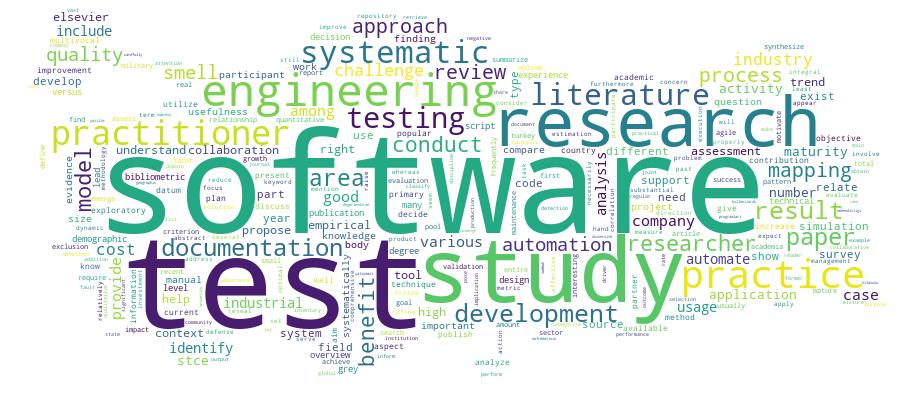
Competency Cloud

GCRIS Competency Cloud

Scholarly Output Search Results

Now showing 1 - 2 of 2
  • Article
    Citation - WoS: 70
    Citation - Scopus: 85
    Cost, Benefits and Quality of Software Development Documentation: a Systematic Mapping
    (Elsevier Science inc, 2015) Zhi, Junji; Garousi-Yusifoglu, Vahid; Sun, Bo; Garousi, Golara; Shahnewaz, Shawn; Ruhe, Guenther
    Context: Software documentation is an integral part of any software development process. Researchers and practitioners have expressed concerns about costs, benefits and quality of software documentation in practice. On the one hand, there is a lack of a comprehensive model to evaluate the quality of documentation. On the other hand, researchers and practitioners need to assess whether documentation cost outweighs its benefit. Objectives: In this study, we aim to summarize the existing literature and provide an overview of the field of software documentation cost, benefit and quality. Method: We use the systematic-mapping methodology to map the existing body of knowledge related to software documentation cost, benefit and quality. To achieve our objectives, 11 Research Questions (RQ) are raised. The primary papers are carefully selected. After applying the inclusion and exclusion criteria, our study pool included a set of 69 papers from 1971 to 2011. A systematic map is developed and refined iteratively. Results: We present the results of a systematic mapping covering different research aspects related to software documentation cost, benefit and quality (RQ1-11). Key findings include: (1) validation research papers are dominating (27 papers), followed by solution proposals (21 papers). (2) Most papers (61 out of 69) do not mention the development life-cycle model explicitly. Agile development is only mentioned in 6 papers. (3) Most papers include only one "System under Study" (SUS) which is mostly academic prototype. The average number of participants in survey-based papers is 106, the highest one having approximately 1000 participants. (4) In terms of focus of papers, 50 papers focused on documentation quality, followed by 37 papers on benefit, and 12 papers on documentation cost. (5) The quality attributes of documentation that appear in most papers are, in order: completeness, consistency and accessibility. Additionally, improved meta-models for documentation cost, benefit and quality are also presented. Furthermore, we have created an online paper repository of the primary papers analyzed and mapped during this study. Conclusion: Our study results show that this research area is emerging but far from mature. Firstly, documentation cost aspect seems to have been neglected in the existing literature and there are no systematic methods or models to measure cost. Also, despite a substantial number of solutions proposed during the last 40 years, more and stronger empirical evidences are still needed to enhance our understanding of this area. In particular, what we expect includes (1) more validation or evaluation studies; (2) studies involving large-scale development projects, or from large number of study participants of various organizations; (3) more industry-academia collaborations; (4) more estimation models or methods to assess documentation quality, benefit and, especially, cost. (C) 2014 Elsevier Inc. All rights reserved.
  • Conference Object
    Citation - WoS: 42
    Citation - Scopus: 56
    Usage and usefulness of technical software documentation: An industrial case study
    (Elsevier, 2015) Garousi, Golara; Garousi-Yusifoglu, Vahid; Ruhe, Guenther; Zhi, Junji; Moussavi, Mahmoud; Smith, Brian
    Context: Software documentation is an integral part of any software development process. However, software practitioners are often concerned about the value, degree of usage and usefulness of documentation during development and maintenance. Objective: Motivated by the needs of NovAtel Inc. (NovAtel), a world-leading company developing software systems in support of global navigation satellite systems, and based on the results of a former systematic mapping study, we aimed at better understanding of the usage and the usefulness of various technical documents during software development and maintenance. Method: We utilized the results of a former systematic mapping study and performed an industrial case study at NovAtel. From the joint definition of the analysis goals, the research method incorporates qualitative and quantitative analysis of 55 documents (design, test and process related) and 1630 of their revisions. In addition, we conducted a survey on the usage and usefulness of documents. A total of 25 staff members from the industrial partner, all having a medium to high level of experience, participated in the survey. Results: In the context of the case study, a number of findings were derived. They include that (1) technical documentation was consulted least frequently for maintenance purpose and most frequently as an information source for development, (2) source code was considered most frequently as the preferred information source during software maintenance, (3) there is no significant difference between the usage of various documentation types during both development and maintenance, and (4) initial hypotheses stating that up-to-date information, accuracy and preciseness have the highest impact on usefulness of technical documentation. Conclusions: It is concluded that the usage of documentation differs for various purposes and it depends on the type of the information needs as well as the tasks to be completed (e.g., development and maintenance). The results have been confirmed to be helpful for the company under study, and the firm is currently implementing some of the recommendations given. (C) 2014 Elsevier B.V. All rights reserved.