Keskinkılıç, Ender

Loading...
Profile Picture
Name Variants
Keskinkılıç, Ender
Ender, Keskinkilic
Keskinkilic, Ender
E., Keskinkilic
Ender, Keskinkılıç
Keskinkiliç E.
E.,Keskinkılıç
Keskinkılıç,E.
Keskinkilic E.
Keskinkilic, E.
E.,Keskinkilic
K., Ender
K.,Ender
E., Keskinkılıç
Keskinkilic,E.
Job Title
Profesor Doktor
Email Address
ender.keskinkilic@atilim.edu.tr
Main Affiliation
Metallurgical and Materials Engineering
Status
Website
ORCID ID
Scopus Author ID
Turkish CoHE Profile ID
Google Scholar ID
WoS Researcher ID

Sustainable Development Goals

NO POVERTY1
NO POVERTY
0
Research Products
ZERO HUNGER2
ZERO HUNGER
0
Research Products
GOOD HEALTH AND WELL-BEING3
GOOD HEALTH AND WELL-BEING
0
Research Products
QUALITY EDUCATION4
QUALITY EDUCATION
0
Research Products
GENDER EQUALITY5
GENDER EQUALITY
0
Research Products
CLEAN WATER AND SANITATION6
CLEAN WATER AND SANITATION
0
Research Products
AFFORDABLE AND CLEAN ENERGY7
AFFORDABLE AND CLEAN ENERGY
0
Research Products
DECENT WORK AND ECONOMIC GROWTH8
DECENT WORK AND ECONOMIC GROWTH
0
Research Products
INDUSTRY, INNOVATION AND INFRASTRUCTURE9
INDUSTRY, INNOVATION AND INFRASTRUCTURE
2
Research Products
REDUCED INEQUALITIES10
REDUCED INEQUALITIES
0
Research Products
SUSTAINABLE CITIES AND COMMUNITIES11
SUSTAINABLE CITIES AND COMMUNITIES
0
Research Products
RESPONSIBLE CONSUMPTION AND PRODUCTION12
RESPONSIBLE CONSUMPTION AND PRODUCTION
0
Research Products
CLIMATE ACTION13
CLIMATE ACTION
0
Research Products
LIFE BELOW WATER14
LIFE BELOW WATER
1
Research Products
LIFE ON LAND15
LIFE ON LAND
0
Research Products
PEACE, JUSTICE AND STRONG INSTITUTIONS16
PEACE, JUSTICE AND STRONG INSTITUTIONS
0
Research Products
PARTNERSHIPS FOR THE GOALS17
PARTNERSHIPS FOR THE GOALS
0
Research Products
Documents

31

Citations

158

h-index

5

Documents

24

Citations

127

Scholarly Output

30

Articles

13

Views / Downloads

99/0

Supervised MSc Theses

0

Supervised PhD Theses

0

WoS Citation Count

120

Scopus Citation Count

152

Patents

0

Projects

0

WoS Citations per Publication

4.00

Scopus Citations per Publication

5.07

Open Access Source

6

Supervised Theses

0

JournalCount
Journal of the Southern African Institute of Mining and Metallurgy4
Journal of Mining and Metallurgy, Section B: Metallurgy3
11th International Symposium on High-Temperature Metallurgical Processing -- FEB 23-27, 2020 -- San Diego, CA2
Minerals, Metals and Materials Series2
4th International Symposium on High-Temperature Metallurgical Processing held during the 142nd TMS Annual Meeting and Exhibition -- MAR 03-07, 2013 -- San Antonio, TX1
Current Page: 1 / 5

Scopus Quartile Distribution

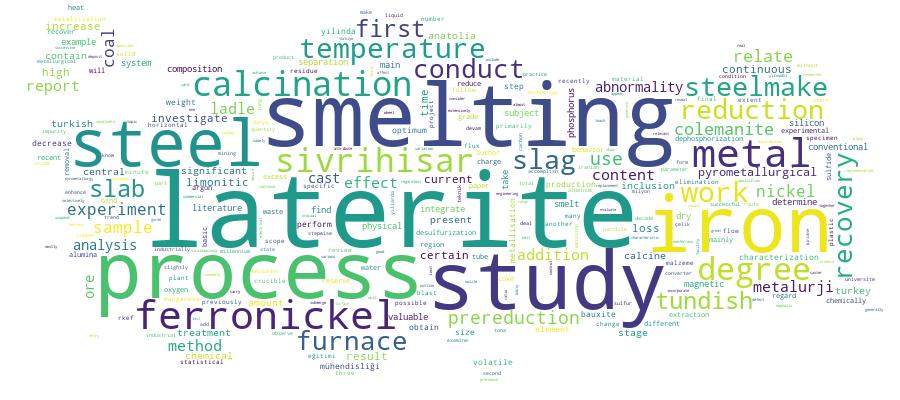
Competency Cloud

GCRIS Competency Cloud

Scholarly Output Search Results

Now showing 1 - 8 of 8
  • Conference Object
    Citation - WoS: 2
    Citation - Scopus: 2
    A Study on Recovery of Iron from Red Mud by Solid State Reduction Followed by Magnetic Separation
    (Springer international Publishing Ag, 2020) Eray, Said; Keskinkilic, Ender; Varol, Mustafa; Topkaya, Yavuz A.; Geveci, Ahmet
    Red mud is a waste material of the Bayer process for alumina production from bauxite ore. Red mud is generally pumped to disposal in an artificial pond which is accompanied by great land occupation and environmental issues. Many researches in different fields have been carried out to evaluate the red mud. Of these, researches on recovering valuable metals from red mud are the most successful. In this study, recovery of iron, which is the most abundant metal in red mud, was investigated. A red mud sample with 34% Fe2O3 was used. Solid state carbothermic reduction followed by wet magnetic separation was performed to recover iron. Reduction was carried out at temperatures 1000-1200 degrees C. Reduced samples were ground and subjected to wet magnetic separation. The effect of reduction temperature and grinding time were investigated on the metallization of iron and the iron content of the final concentrate.
  • Conference Object
    Citation - WoS: 2
    Citation - Scopus: 2
    Solid-State Reduction Studies for Recovery of Iron From Red Mud
    (Springer international Publishing Ag, 2020) Keskinkilic, Ender; Pournaderi, Saeid; Geveci, Ahmet; Topkaya, Yavuz A.
    Red mud or bauxite residue can be regarded as a by-product of aluminum extraction process since it contains a significant amount of iron and some valuable elements. Therefore, the treatment of red mud has been a hot topic for some decades. Last year, the authors started a laboratory-scale project dealing with stepwise recovery of valuable elements from red mud of Seydisehir Aluminum Plant, Turkey. The first step is related to the recovery of iron and pyrometallurgical methods (solid-state reduction and smelting) are currently being performed. Nonferrous metals will then be selectively leached in the second step. In TMS 2019, the authors outlined the literature related to the smelting studies for iron recovery from bauxite residue. In the extent of the present work, a literature review relevant to the solid-state reduction studies for recovery of iron from red mud was presented.
  • Conference Object
    Calcination Behavior of Sivrihisar Laterite Ores of Turkey
    (John Wiley & Sons, 2011) Keskinkilic, Ender; Pournaderi, Saeid; Geveci, Ahmet; Topkaya, Yavuz A.
    This study investigated calcination behavior of one of the Turkish laterite deposits, which was recently found in Sivrihisar region. Representative limonitic laterite samples (1.26% Ni) taken from Yunusemre Karasivritepe and Kucuksivritepe location were first subjected to drying. Removal of chemically bound water and other volatiles were then studied, in detail. In the calcination experiments, temperature and time were the main experimental variables. Thermal treatment was conducted at the specific temperatures in 250 degrees C - 800 degrees C range. The weight losses due to elimination of chemically bound water and other volatiles were reported to be approximately 10 per cent of the weight of the ore. For the particle size used in the current work, 700 degrees C and 40 minutes were determined to be the optimum calcination temperature and time, respectively.
  • Conference Object
    Study of Certain Parameters in Laboratory-Scale Smelting of Sivrihisar Laterite Ores of Turkey
    (John Wiley & Sons, 2012) Keskinkilic, Ender; Pournaderi, Saeid; Geveci, Ahmet; Topkaya, Yavuz A.
    Conventional ferronickel smelting has five main steps: Drying, calcination, prereduction, smelting and refining. In the scope of the current work, smelting experiments were conducted using Sivrihisar laterite ores (1.26% Ni) of Turkey. The ore samples previously subjected to drying, calcination and prereduction stages were smelted in alumina crucibles in a laboratoryscale horizontal tube furnace under argon atmosphere. Smelting experiments were performed at 1500, 1550 and 1600 degrees C. The amount of excess coal used in prereduction step was another variable. Sivrihisar laterite ore is a limonitic one with low MgO composition. Therefore, MgO was added to the smelting charge as a flux. The effects of experimental variables on metal Ni content and slag composition were investigated.
  • Article
    Citation - WoS: 6
    Citation - Scopus: 7
    Recovery of Iron From Turkish and Iranian Red Muds
    (Springer, 2022) Eray, Said; Keskinkilic, Ender; Topkaya, Yavuz A.; Geveci, Ahmet
    Turkish and Iranian red mud samples of different composition and mineralogy were processed by solid-state reduction followed by wet magnetic separation and smelting, two commonly used pyrometallurgical methods for iron recovery. The application of these two methods on the same samples allowed them to be compared thoroughly and to be examined for versatility. The results showed that it was possible to recover more than 90% of iron using both methods. However, the concentrate obtained by the first method contained a significant amount of undesirable oxides. Thus, large proportions (similar to 30%) of valuable elements that are planned to be recovered by hydrometallurgical methods were removed together with the iron. The smelting method, on the other hand, made it possible to recover the iron with high efficiency and as a marketable purity Fe-C alloy. The metal obtained by smelting contained 96% iron, 2% carbon, and a small amount of impurities like Si, Ti, and Na.
  • Conference Object
    Citation - WoS: 2
    Citation - Scopus: 3
    Smelting Studies for Recovery of Iron From Red Mud
    (Springer international Publishing Ag, 2019) Keskinkilic, Ender; Pournaderi, Saeid; Geveci, Ahmet; Topkaya, Yavuz A.
    Red mud can be regarded as a by-product of aluminium extraction process since it contains a significant amount of iron and some valuable elements. Therefore, the treatment of red mud has been a hot topic for some decades. The authors have recently started a laboratory-scale project dealing with stepwise recovery of valuable elements from red mud of Seydisehir Aluminum Plant, Turkey. The first step is related to recovery of iron and pyrometallurgical methods (smelting and solid-state reduction) will be performed. Nonferrous metals will then be selectively leached in the second step. In the extent of the present work, a literature review relevant to the smelting studies for recovery of iron from red mud was presented.
  • Conference Object
    A Study on the Characterization of Nickel Laterites of Central Anatolia
    (John Wiley & Sons inc, 2016) Keskinkilic, Ender; Pournaderi, Saeid; Geveci, Ahmet; Topkaya, Yavuz A.
    There are mainly three commercial nickel laterites in Turkey: Gordes, Caldag and Sivrihisar. The first two appear in Western Anatolia. The third one, Sivrihisar (Yunusemre) laterites have been found in the first decade of the millennium, in the Central Anatolia region of Turkey. Since then, mining facilities have been continued in Yunusemre. Calcination, prereduction and smelting of Sivrihisar laterites have been extensively studied and published. In the current work, some results of the studies related to characterization of Sivrihisar laterites will be presented.
  • Conference Object
    Citation - WoS: 1
    Production of Crude Ferronickel From Sivrihisar Laterite Ores of Turkey
    (John Wiley & Sons inc, 2013) Keskinkilic, Ender; Pournaderi, Saeid; Geveci, Ahmet; Topkaya, Yavuz A.
    In the current work, laboratory-scale smelting experiments were conducted using Sivrihisar laterites (1.26% Ni). The ore samples previously subjected to drying, calcination and prereduction stages were smelted in alumina crucibles in a horizontal tube furnace under argon atmosphere. For the smelting system used in the present work, 1550 degrees C and 40 minutes were determined to be the optimum smelting temperature and time, respectively. 25% excess coal addition in prereduction stage was reported to be crucial to obtain the desired Ni content in the final product. Colemanite in calcined form has long been known as a flux used in pyrometallurgical systems such as steelmaking and copper matte-smelting. To investigate the effects of calcined colemanite addition on the ferronickel metal-slag system, calcined colemanite of 2% and 4% of the total metal and slag weight was charged as a flux and smelted under the optimum conditions described above.