Erden, Abdulkadir

Loading...
Profile Picture
Name Variants
E., Abdulkadir
E.,Abdulkadir
Abdulkadir, Erden
Erden,A.
Erden, Abdulkadir
A., Erden
A.,Erden
Erden, A
Erden, Abdülkadir
Job Title
Profesör Doktor
Email Address
Main Affiliation
Department of Mechatronics Engineering
Status
Former Staff
Website
ORCID ID
Scopus Author ID
Turkish CoHE Profile ID
Google Scholar ID
WoS Researcher ID

Sustainable Development Goals

2

ZERO HUNGER
ZERO HUNGER Logo

0

Research Products

11

SUSTAINABLE CITIES AND COMMUNITIES
SUSTAINABLE CITIES AND COMMUNITIES Logo

0

Research Products

14

LIFE BELOW WATER
LIFE BELOW WATER Logo

0

Research Products

6

CLEAN WATER AND SANITATION
CLEAN WATER AND SANITATION Logo

0

Research Products

1

NO POVERTY
NO POVERTY Logo

0

Research Products

5

GENDER EQUALITY
GENDER EQUALITY Logo

0

Research Products

9

INDUSTRY, INNOVATION AND INFRASTRUCTURE
INDUSTRY, INNOVATION AND INFRASTRUCTURE Logo

8

Research Products

16

PEACE, JUSTICE AND STRONG INSTITUTIONS
PEACE, JUSTICE AND STRONG INSTITUTIONS Logo

0

Research Products

17

PARTNERSHIPS FOR THE GOALS
PARTNERSHIPS FOR THE GOALS Logo

0

Research Products

15

LIFE ON LAND
LIFE ON LAND Logo

0

Research Products

10

REDUCED INEQUALITIES
REDUCED INEQUALITIES Logo

0

Research Products

7

AFFORDABLE AND CLEAN ENERGY
AFFORDABLE AND CLEAN ENERGY Logo

0

Research Products

8

DECENT WORK AND ECONOMIC GROWTH
DECENT WORK AND ECONOMIC GROWTH Logo

0

Research Products

4

QUALITY EDUCATION
QUALITY EDUCATION Logo

0

Research Products

12

RESPONSIBLE CONSUMPTION AND PRODUCTION
RESPONSIBLE CONSUMPTION AND PRODUCTION Logo

0

Research Products

3

GOOD HEALTH AND WELL-BEING
GOOD HEALTH AND WELL-BEING Logo

0

Research Products

13

CLIMATE ACTION
CLIMATE ACTION Logo

0

Research Products
This researcher does not have a Scopus ID.
This researcher does not have a WoS ID.
Scholarly Output

26

Articles

9

Views / Downloads

99/861

Supervised MSc Theses

6

Supervised PhD Theses

1

WoS Citation Count

237

Scopus Citation Count

250

WoS h-index

6

Scopus h-index

5

Patents

0

Projects

0

WoS Citations per Publication

9.12

Scopus Citations per Publication

9.62

Open Access Source

1

Supervised Theses

7

Google Analytics Visitor Traffic

JournalCount
20th Annual International Conference on Mechatronics and Machine Vision in Practice, M2VIP 2013 -- 20th Annual International Conference on Mechatronics and Machine Vision in Practice, M2VIP 2013 -- 20 September 2013 through 20 September 2013 -- Ankara -- 1022763
21st Mechatronics and Machine Vision in Practice, M2VIP 2015 -- 21st Mechatronics and Machine Vision in Practice, M2VIP 2015 -- 7 July 2015 through 9 July 2015 -- Manila -- 1194561
6th International Conference on Computer-Aided Industrial Design and Conceptual Design (CAID&CD) -- MAY 29-JUN 01, 2005 -- Delft Univ Technol, Delft, NETHERLANDS1
8th International Design Conference (DESIGN 2004) -- MAY 17-20, 2004 -- Dubrovnik, CROATIA1
Control Engineering and Applied Informatics1
Current Page: 1 / 4

Scopus Quartile Distribution

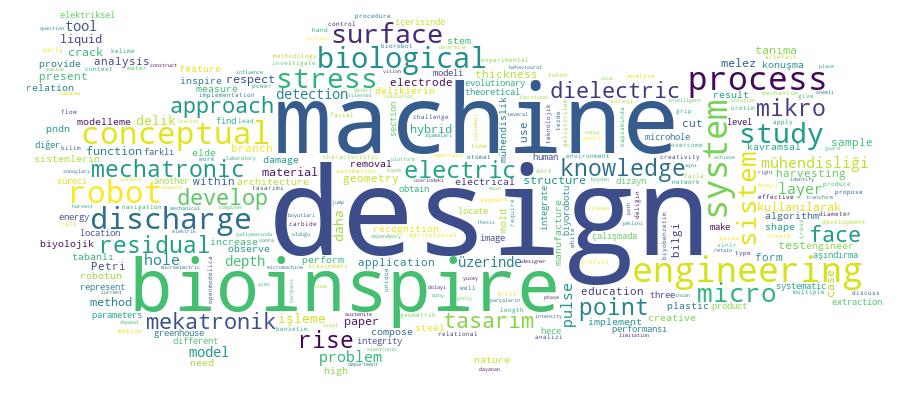
Competency Cloud

GCRIS Competency Cloud

Scholarly Output Search Results

Now showing 1 - 10 of 16
  • Master Thesis
    Böcek Hayvan Hareketleri için 'biyo-esinlenilmiş Tasarım Metodolojisinın' Bir Köpek – Istakoz Melez Robotun Tasarımı ve Üretimine Uygulanması
    (2014) Güner, Emre; Erden, Abdulkadir
    Bu tez çalışmasında melez robotun biyo – esinlenilmis dizayn metodolojisine dayanan tasarımı ve üretimi incelenmiştir. Bu tez Melez robot tasarım ve üretim aşamalarının tamamını içermektedir. Melez robotun tasarım süreci 3 parçaya ayrılmıştır. Bu parçalar konsept dizayn, ön dizayn ve detaylı dizayn diye adlandırılmıştır. Bu parçalarda hibrit robotun bütün üretim aşamaları detaylıca anlatılacaktır. Aynı zamanda bu tezde köpek ve istakoz yürüyüş hareketi çalışılmıstır. Son olarak test prosedürleri ve sonuçları tartışılmıştır. Bu tez çalışması boyunca dinamik kuvvetler ve diğer dış etkiler göz ardı edilmiştir ve robotun testleri bir taşıyıcı platform üzerinde yapılmıştır. Sonuç kısmında ise melez robotun diğer robotlarla karşılaştırılması ve performansı tartışılmıştır.
  • Article
    Citation - WoS: 5
    Citation - Scopus: 8
    Biological System Analysis in Bioinspired Conceptual Design (bicd) for Bioinspired Robots
    (Romanian Soc Control Tech informatics, 2011) Eroglu, Aylin Konez; Eroğlu, Aylin Konez; Erden, Zuhal; Erden, Zühal; Erden, Abdulkadir; Erden, Abdulkadir; Eroğlu, Aylin Konez; Erden, Zühal; Erden, Abdulkadir; Department of Mechatronics Engineering; Department of Mechatronics Engineering; Mechatronics Engineering; Mechatronics Engineering; Department of Mechatronics Engineering; Mechatronics Engineering
    Bioinspired design (BID) provides a systematic way for bioinspired applications. Although several BID approaches as well as some tools and databases are available in the literature, the studies on BID are still challenging for designers and/or engineers because of limitations of current BID approaches. There are mainly two directions related with these limitations. One of them is the representation of knowledge on biological systems and the second is the problem of transforming this knowledge into engineering domain. These limitations expose two questions; firstly, "What knowledge is required to describe biological systems?" and "How this knowledge is represented?" and secondly, "How this knowledge is transformed into the engineering domain?". This paper presents a study which aims to answer the first question about knowledge required to represent biological systems. This knowledge is obtained during "Analysis of Biological Systems" stage of a new suggested bioinspired conceptual design (BICD) procedure.
  • Article
    Creative Design Engineering Education for Human-Society Integrated Intelligent Systems
    (Sage Publications Inc, 2026) Erden, Zuhal; Erden, Abdulkadir
    The essence and vital roots of scientific activities create theoretical propositions and models that provide unique integrity of the associated concepts, definitions, approaches and methodological components. Design engineering education has made great progress to date by integrating modern methods and tools into the existing process models focused on unique curriculum programs for students' progress during various scientific and technical levels. Contemporary and integrated socio-scientific environments, however, are generally more productive and initiative for future success stories of engineering graduates with high qualifications and science/technology-motivated professional life. Today's global transition from the "industrial-digital age" to the "sustainable knowledge economy and digital society" opens a new path for design engineering education, enforcing a paradigm shift towards training creative professionals who develop and implement new knowledge in real-world social environments. This paper presents and discusses the models, methods and tools to establish a road-map into next-generation creative design engineering education paradigm.
  • Master Thesis
    Nesne-yönelimli Modelleme Yönteminin Openmodelıca Kullanılarak Mekatronik Sistemler için Uygulanması – Vaka İncelemeleri
    (2016) Coşkunoğlu, Sümeyye Betül; Erden, Abdulkadir
    Mekatronik mühendislik sistemlerinin benzetimi araştırmacılar için zorlu bir konudur. Benzetim modelleri için birçok alternatif yaklaşım olmasına karşın, Mekatronik sistemlerin karmaşık, çok disiplinli ve tümleşik yapısı göz önüne alındığında, nesne yönelimli modelleme yöntemleri kullanılarak sistem düzeyinde modelleme ve benzetim yapılması sistem gereksinimlerini ve sistem düzeyinde entegrasyonu anlamak açısından faydalı olacaktır. Bu çalışmada, nesne yönelimli bir modelleme dili olan Modelica kullanılarak farklı mekatronik sistemler üzerinde çeşitli vaka incelemeleri yapılmıştır. Mekanik, elektronik ve bilişim altsistemleri öncelikle girdi/çıktı ve işlem yapısına göre incelenmiş ve daha sonra bu altsistemler OpenModelica programı kullanılarak benzetim için modellenmiştir. Alt sistemlerin tümleştirmesi OpenModelica kullanılarak gerçekleştirilmiş ve ana sistemlerin benzetimi yapılmıştır. Bu vaka incelemelerine dayanarak, OpenModelica platformunun mekatronik sistem modelleme ve benzetiminde kısıtlamalar barındırmasına karşın, Modelica dilinin, bir modelleme dili olarak kolaylık sağlayan ve yararlı bir araç olabileceği anlaşılmıştır.
  • Conference Object
    Rose Stem Branch Point Detection and Cutting Point Location for Rose Harvesting Robot
    (Mechatronics and Machine Vision in Practice, 2015) Gürel,C.; Hassan,M.; Zadeh,G.; Erden,A.
    The primary objective of the study is to develop a method that can locate the proper location of cutting point of rose stem for robotic rose harvesting. Stem tracking and cutting operation are achieved using with the help of stereo vision techniques. The cutting point has a vital importance for cut rose harvesting in greenhouse which affects the efficiency of new shoot from the cut stem. In agricultural process, the cutting point depends on thickness of stem and eye on stem. Locating the eye is difficult by image processing thus another relation for cut point estimation was performed. The relation between thickness and cut length can lead to relation for cut point estimation. 239 data is collected from a greenhouse and linear relation with some deviation was acquired. To perform this relation, branch point location algorithm was developed. The proposed algorithm has three steps: branch point detection; thickness calculation; and cutting length estimation. The algorithm for branch detection performs quite well to detect and locate the position of the point when there occur no overlapping. The results of branch point detection are adequate for implementing to the robot. © 2015, Mechatronics and Machine Vision in Practice. All rights reserved.
  • Master Thesis
    Mekatronik Mühendisliği Bölüm Laboratuvarları için Rehber – Bekci Robot Sistem Tasarımı ve Prototip Geliştirilmesi
    (2015) Sadeghı, Amir Nobahar; Erden, Abdulkadir; Erden, Zühal
    Bu tez çalışmasının amacı Atılım Üniversitesi Mekatronik Mühendisliği laboratuvarlarında 'Rehber-Bekçi Robot' olarak görev yapacak olan akıllı bir hareketli robotun tasarlanması, üretilmesi ve laboratuvar ortamında dolaşmasının sağlanmasıdır. Bu amacı gerçekleştirmek üzere tümleşik bir sistem tasarlanmıştır. Robotun laboratuvarlarda dolaşması için geliştirilen kontrol mimarisi konumlandırma, engelden kaçınma, yol planlaması ve verilen bir başlangıç pozisyonundan rastgele belirlenen bir başka pozisyona gidişin yönetilmesini sağlamaktadır. Bu çalışmada, robota yüklenmiş bir haritaya dayalı olmayan davranış-temelli bir navigasyon algoritması kullanılmıştır. Buna göre robot, içinde bulunduğu laboratuvar ortamının çeşitli özelliklerini, üzerindeki sensörler yardımıyla algılayarak kendi konumunu belirlemekte ve böylece laboratuvar ortamında dolaşmaktadır. Bu çalışma kapsamında robotun tasarımı, imalatı, sistem entegrasyonu gerçekleştirilmiş ve laboratuvar ortamında dolaşması test edilmiştir.
  • Conference Object
    Developing an Analysis Process for Biological Systems To Design Biorobots - a Case Study of Human Hand Gripping Motion
    (2013) Eroǧlu,A.K.; Erden,Z.; Erden,A.
    The fundamental reasoning behind the use of bioinspired design (BID) is to increase creativity (novelty and usefulness) and innovation in engineering. Within the context of BID, development of systematic process for analyzing biological systems and transferring knowledge, which is obtained from the analysis of biological systems, into engineering is compulsory. This paper presents developing a process for the analysis of biological systems for design of biorobots. Preparing, collecting, and organizing are the main steps of this process and applied in a case study which involves gripping motion of a human hand. An experimental set-up with a high-speed camera is constructed to obtain the components of knowledge: morphology, function and behavior. This knowledge will be later used to design a wearable hand in prospective projects.
  • Conference Object
    Citation - Scopus: 4
    Bioinspired Conceptual Design (bicd): Conceptual Design of a Grasshopper-Like Jumping Mechanism as a Case Study
    (2011) Eroglu,A.K.; Erden,Z.; Erden,A.
    The evolution process of nature creates highly effective, power efficient, and perfectly structured biological systems. These excellent systems provide an inexhaustible source for engineers and scientists who desire to inspire ideas, processes, structures, functions, and behaviors from biological domain and implement them into engineering domain. This approach is called "Bioinspired" and challenging for engineers. However, some problems of the practical approaches are observed. One of the problems is "ad hoc" nature of the process. Each bioinspired design product has resulted in a differing design process and a generalization was not possible. Another problem rises due to the terminology difference between engineers and biologists. To overcome these problems, a need for a systematic bioinspired design (BID) process was realized in early 2000s and since then, considerable research on the BID methodology has been progressed. Within the context of BID, this paper introduces a new approach on bioinspired conceptual design (BICD) procedure for hybrid bioinspired robots which can be inspired from multiple biological systems. An illustrative case study is given in the paper.
  • Conference Object
    Face Detection Algorithm With Facial Feature Extraction for Face Recognition System
    (2013) Gürel,C.; Erden,A.
    A face recognition system is one of the biometric information processes, its applicability is easier and working range is wider than other systems like; fingerprint, iris scanning, signature, etc. The detection methods are designed to extract features of face region out of a digital image. The output face image of the detection algorithm should be similar to the recognition input image. Face detection is performed on live acquired images without any application field in mind. The developed system uses white balance correction, skin like region segmentation, facial feature extraction and face image extraction on a face candidate. System is also capable of detecting multiple faces in live acquired images.
  • Conference Object
    Citation - WoS: 2
    Citation - Scopus: 4
    CHARACTERISTICS OF SURFACE DAMAGE IN MICRO ELECTRIC DISCHARGE MAChinING OF MICRO HOLES
    (Trans Tech Publications Ltd, 2010) Ekmekci, Buelent; Sayar, Atakan; Opoz, T. Tecelli; Erden, Abdulkadir
    Micro Electric Discharge Machining is mostly used micromachining technique for manufacturing of micro holes and mini cavities. It is a thermal material removal process achieved by application of recursive electrical sparks between two conductive materials immersed in dielectric liquid. There are many electrical and technological parameters, which are effective in the machining characteristics and machined material surface integrity. In this study, effects of pulse energy on characteristics of surface damage in micro electric discharge machining of micro holes are investigated. To observe the influences of investigated pulse forms, a series of micro-holes were machined and cut from cross sections for metallurgical examinations. Unconventional etching agents were applied to examine the metallurgical transformations using optical and scanning electron microscopy. It was observed that heat-damaged segment is composed of three distinctive layers, have relatively high thicknesses (0.2 to 10 mu m) when compared with the size of the micro holes and varies noticeably with respect to drilling dept. Different morphological structures and deformations in the subsurface of micro-hole walls at several sections were illustrated. Finally, analyzed machining parameters and variation of hat damaged layer thicknesses were discussed in terms of drilling depth.