Kayhan, Erdem

Loading...
Profile Picture
Name Variants
Kayhan, E.
Erdem, Kayhan
E., Kayhan
Kayhan,E.
Kayhan, Erdem
K., Erdem
K.,Erdem
E.,Kayhan
Job Title
Öğretim Görevlisi
Email Address
erdem.kayhan@atilim.edu.tr
Main Affiliation
Airframe and Powerplant Maintenance
Status
Former Staff
Website
ORCID ID
Scopus Author ID
Turkish CoHE Profile ID
Google Scholar ID
WoS Researcher ID

Sustainable Development Goals

NO POVERTY1
NO POVERTY
0
Research Products
ZERO HUNGER2
ZERO HUNGER
0
Research Products
GOOD HEALTH AND WELL-BEING3
GOOD HEALTH AND WELL-BEING
1
Research Products
QUALITY EDUCATION4
QUALITY EDUCATION
0
Research Products
GENDER EQUALITY5
GENDER EQUALITY
0
Research Products
CLEAN WATER AND SANITATION6
CLEAN WATER AND SANITATION
0
Research Products
AFFORDABLE AND CLEAN ENERGY7
AFFORDABLE AND CLEAN ENERGY
0
Research Products
DECENT WORK AND ECONOMIC GROWTH8
DECENT WORK AND ECONOMIC GROWTH
0
Research Products
INDUSTRY, INNOVATION AND INFRASTRUCTURE9
INDUSTRY, INNOVATION AND INFRASTRUCTURE
0
Research Products
REDUCED INEQUALITIES10
REDUCED INEQUALITIES
0
Research Products
SUSTAINABLE CITIES AND COMMUNITIES11
SUSTAINABLE CITIES AND COMMUNITIES
0
Research Products
RESPONSIBLE CONSUMPTION AND PRODUCTION12
RESPONSIBLE CONSUMPTION AND PRODUCTION
0
Research Products
CLIMATE ACTION13
CLIMATE ACTION
0
Research Products
LIFE BELOW WATER14
LIFE BELOW WATER
0
Research Products
LIFE ON LAND15
LIFE ON LAND
0
Research Products
PEACE, JUSTICE AND STRONG INSTITUTIONS16
PEACE, JUSTICE AND STRONG INSTITUTIONS
0
Research Products
PARTNERSHIPS FOR THE GOALS17
PARTNERSHIPS FOR THE GOALS
0
Research Products
This researcher does not have a Scopus ID.
This researcher does not have a WoS ID.
Scholarly Output

4

Articles

2

Views / Downloads

9/20

Supervised MSc Theses

1

Supervised PhD Theses

1

WoS Citation Count

20

Scopus Citation Count

26

Patents

0

Projects

0

WoS Citations per Publication

5.00

Scopus Citations per Publication

6.50

Open Access Source

0

Supervised Theses

2

JournalCount
International Journal of Material Forming1
The International Journal of Advanced Manufacturing Technology1
Current Page: 1 / 1

Scopus Quartile Distribution

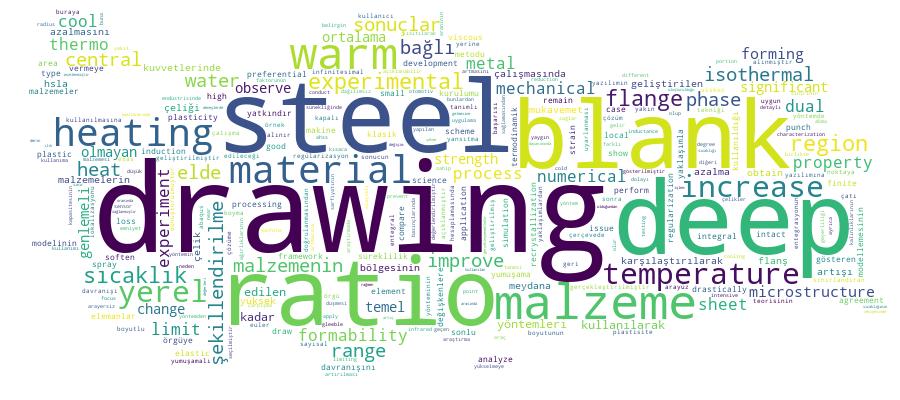
Competency Cloud

GCRIS Competency Cloud

Scholarly Output Search Results

Now showing 1 - 3 of 3
  • Article
    Citation - WoS: 13
    Citation - Scopus: 13
    Analysis of Non-Isothermal Warm Deep Drawing of Dual-Phase Dp600 Steel
    (Springer France, 2019) Pepelnjak, T.; Kayhan, E.; Kaftanoglu, B.
    Improving the formability of the material is a key issue in the deep drawing process. Heating the material above its recrystallization temperature drastically increases formability, but in the case of dual phase (DP) steels, it results in a loss of their mechanical properties. To improve the drawing ratio, only the heating of the flange region in the warm temperature range up to 573K was studied on DP600 sheet steel by numerical simulation. A thermo-elastic-plastic finite element method (FEM) analysis of deep drawing at several drawing ratios was performed and compared with experimental results. During the experiments, the flange area of the blank was heated by induction heating, and the central part over the punch was cooled with spray water. Experimental results showed that limiting drawing ratio could be increased by 25.58%. The microstructure of the DP 600 steel was analyzed before and after the warm forming process. No significant changes were observed, and the high strength properties of the DP 600 steel remained intact. There was good agreement between numerical and experimental results.
  • Doctoral Thesis
    Derin Çekme Sınır Oranın, Flanş Bölgesinin Isıtılarak Artırılması için Yöntem Geliştirilmesi
    (2015) Kayhan, Erdem; Kaftanoğlu, Bilgin; Kayhan, Erdem; Kaftanoğlu, Bilgin; Kayhan, Erdem; Kaftanoğlu, Bilgin; Konca, Erkan; Manufacturing Engineering; Airframe and Powerplant Maintenance; Manufacturing Engineering; Airframe and Powerplant Maintenance
    Bu tez çalışmasında geliştirilen yöntem kısaca, sac metal malzemelerin şekillendirilme oranının flanş bölgesinin eş sıcaklık dağılımsız ısıtılarak artırılması olarak açıklanabilir. Sıcaklık artışı malzemenin sünekliğinde belirgin bir yükselmeye ve buna bağlı olarak şekillendirilme kapasitesinin artmasına neden olur. Sıcaklık artışı ayrıca malzemenin akma sınırının düşmesi ile birlikte, uygulama kuvvetlerinde ve basınçlarında azalma meydana gelir. Otomotiv endüstrisinde en yaygın kullanıma sahip olan Yüksek Mukavemet Sac Çelik (AHSS) malzeme DP600 olup, araç ağırlıklarının azalmasını ve çarpışma emniyet faktörünün artmasını sağlamasından dolayı bu tez çalışmasında araştırma malzemesi olarak seçilmiştir. Adı geçen çelik malzemelerin kullanımı malzeme kalınlıklarının ve yakıt sarfiyatının azalmasını sağlar. Yapılan araştırmada geliştirilen yöntemin geçerliliği üç farklı tip malzeme, bunlardan iki tanesi Düşük Alaşımlı Yüksek Mukavemet çeliği (HSLA), diğeri ise IF (Arayersiz Çelikler) çeliği kullanılarak, incelenmiştir. Flanş bölgesinin sıcaklığının 180oC to 300oC değerleri arasında oluşturulduğu deneylerde derin çekme sınır oranında %25.58 kadar artış sağlanmıştır. Kullanılan sıcaklık ılık işlem sıcaklığı seviyesinde olduğundan, şekillendirilme kuvvetlerinde azalma meydana gelmesine rağmen malzemenin özelliklerinde ve dayanımında bir değişim gerçekleşmemektedir.
  • Article
    Citation - WoS: 7
    Citation - Scopus: 13
    Experimental Investigation of Non-Isothermal Deep Drawing of Dp600 Steel
    (Springer London Ltd, 2018) Kayhan, Erdem; Kaftanoglu, Bilgin
    To increase the limiting drawing ratio (LDR) in deep drawing, experiments are conducted on DP600, IF, and HSLA steels. The flange region of blank is heated up to temperatures in the warm range by inductance heating. During heating, the central portion of blank is cooled by water to prevent the reduction of the strength of the material in the central region. The temperature increase of flange region is observed by two infrared sensors focusing on two different points, one on the blank rim and the other near the die radius. An intensive cooling by cold water is applied to the bottom side of a blank during deep drawing. Increases up to 25.58% on LDR are obtained. There is no significant change in the microstructure of the material due to warm forming. Material characterization is obtained by a Gleeble 3800 thermo-mechanical testing machine for the temperature range 150-300 degrees C.