Lotfısadıgh, Bahram

Loading...
Profile Picture
Name Variants
Lotfisadigh, B.
Lotfısadıgh, Bahram
Bahram, Lotfısadıgh
Lotfisadigh, Bahram
L.,Bahram
B.,Lotfisadigh
L., Bahram
Bahram, Lotfisadigh
B., Lotfisadigh
B.,Lotfısadıgh
Lotfısadıgh,B.
Lotfisadigh,B.
Sadigh, Bahram Lotfi
Job Title
Doktor Öğretim Üyesi
Email Address
bahram.lotfisadigh@atilim.edu.tr
Main Affiliation
Manufacturing Engineering
Status
Former Staff
Website
ORCID ID
Scopus Author ID
Turkish CoHE Profile ID
Google Scholar ID
WoS Researcher ID

Sustainable Development Goals

NO POVERTY1
NO POVERTY
0
Research Products
ZERO HUNGER2
ZERO HUNGER
0
Research Products
GOOD HEALTH AND WELL-BEING3
GOOD HEALTH AND WELL-BEING
1
Research Products
QUALITY EDUCATION4
QUALITY EDUCATION
0
Research Products
GENDER EQUALITY5
GENDER EQUALITY
0
Research Products
CLEAN WATER AND SANITATION6
CLEAN WATER AND SANITATION
0
Research Products
AFFORDABLE AND CLEAN ENERGY7
AFFORDABLE AND CLEAN ENERGY
0
Research Products
DECENT WORK AND ECONOMIC GROWTH8
DECENT WORK AND ECONOMIC GROWTH
0
Research Products
INDUSTRY, INNOVATION AND INFRASTRUCTURE9
INDUSTRY, INNOVATION AND INFRASTRUCTURE
6
Research Products
REDUCED INEQUALITIES10
REDUCED INEQUALITIES
0
Research Products
SUSTAINABLE CITIES AND COMMUNITIES11
SUSTAINABLE CITIES AND COMMUNITIES
1
Research Products
RESPONSIBLE CONSUMPTION AND PRODUCTION12
RESPONSIBLE CONSUMPTION AND PRODUCTION
1
Research Products
CLIMATE ACTION13
CLIMATE ACTION
0
Research Products
LIFE BELOW WATER14
LIFE BELOW WATER
0
Research Products
LIFE ON LAND15
LIFE ON LAND
1
Research Products
PEACE, JUSTICE AND STRONG INSTITUTIONS16
PEACE, JUSTICE AND STRONG INSTITUTIONS
0
Research Products
PARTNERSHIPS FOR THE GOALS17
PARTNERSHIPS FOR THE GOALS
0
Research Products
This researcher does not have a Scopus ID.
This researcher does not have a WoS ID.
Scholarly Output

22

Articles

12

Views / Downloads

65/129

Supervised MSc Theses

5

Supervised PhD Theses

1

WoS Citation Count

241

Scopus Citation Count

292

Patents

0

Projects

0

WoS Citations per Publication

10.95

Scopus Citations per Publication

13.27

Open Access Source

5

Supervised Theses

6

JournalCount
Machining Science and Technology3
International Journal of Computer Integrated Manufacturing2
Procedia CIRP2
The International Journal of Advanced Manufacturing Technology2
Artificial Intelligence for Engineering Design, Analysis and Manufacturing: AIEDAM1
Current Page: 1 / 3

Scopus Quartile Distribution

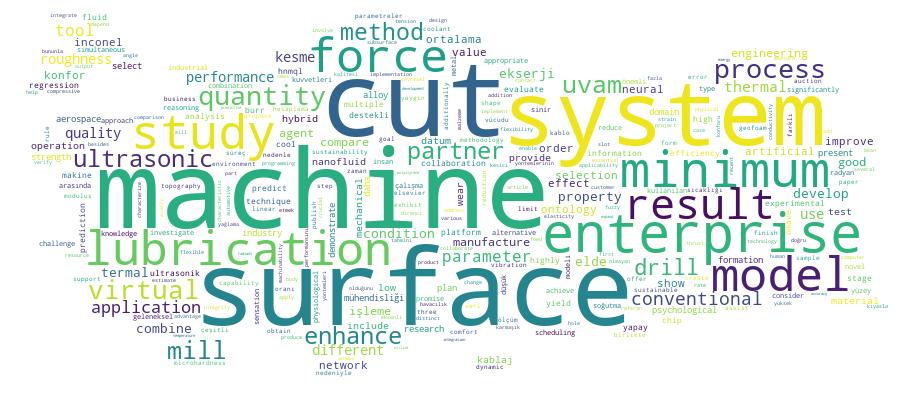
Competency Cloud

GCRIS Competency Cloud

Scholarly Output Search Results

Now showing 1 - 3 of 3
  • Conference Object
    Citation - WoS: 10
    Citation - Scopus: 13
    A Multi-Agent System Model for Partner Selection Process in Virtual Enterprise
    (Elsevier Science Bv, 2014) Sadigh, B. Lotfi; Arikan, F.; Ozbayoglu, A. M.; Unver, H. O.; Kilic, S. E.; Lotfi Sadigh, B.
    Virtual Enterprise (VE) is a collaboration model between multiple business partners in a value chain. VE information system deals with highly dynamic information from heterogeneous data sources. In order to manage and store dynamic VE information in the database, an ontology based VE model has been developed. To select winner enterprises in VE, a Multi Agent System (MAS) has been developed. Communication and data transition among agents and system entities are based on defined rules in VE ontology model. One of the most important contributions of agents in VE system is in partner selection step of VE formation phase. In this step several agents with different goals and strategies are collaborating and competing each other to win the negotiation procedure or maximize the profit for their assigned enterprise. Different strategies are developed for the agents depending on their appetite for winning the auction against maximizing the profit. Several simulations were run and the results are stored. These results are fed into a neural network in order to predict which enterprise will win the auction and what will be the profit margin. The motivation is to provide a forecasting agent for the customers about the outcomes of the auctions so that they can plan ahead and take the necessary action. Early results indicate such simulated multi-agent VE formations can be used in real systems. A Multi-Agent System Model for Partner Selection Process in Virtual Enterprise (C) 2014 Published by Elsevier B.V.
  • Article
    Citation - WoS: 8
    Citation - Scopus: 13
    An Ontology-Based Multi-Agent Virtual Enterprise System (omave): Part 2: Partner Selection
    (Taylor & Francis Ltd, 2017) Sadigh, Bahram Lotfi; Nikghadam, Shahrzad; Ozbayoglu, A. Murat; Unver, Hakki Ozgur; Dogdu, Erdogan; Kilic, S. Engin
    A virtual enterprise (VE) is a collaboration model between multiple business partners in a value chain. The VE model is particularly feasible and appropriate for small- and medium-sized enterprises (SMEs) and industrial parks containing multiple SMEs that have different vertical competencies. The VE consortium's success highly depends on its members. Therefore, it is crucial to select the most appropriate enterprises when forming a VE consortium. In this study, a new multi-agent hybrid partner selection algorithm is developed for application in the development of an ontology-based multi-agent virtual enterprise (OMAVE) system. In this platform, the agent's interactions are supported by agent ontology, which provides concepts, properties and all message formats for the agents. Different types of agents collaborate and compete with each other so that unqualified or inefficient enterprises are eliminated from the enterprise pool. Only the remaining enterprises would be allowed to enter the negotiation process and propose in the bidding. The agent-based auctioning platform is coupled with a fuzzy-AHP-TOPSIS algorithm to evaluate partners based on their proposals and background. Accordingly, the winning enterprise for each task is identified and the whole project can be accomplished by assigning tasks to the responsible partners. To test and verify the functionality of the developed OMAVE system, a sample module using OMAVE applications and tools was manufactured. The last section of this paper presents the results of this case study, which validate the applicability of the proposed technique.
  • Article
    Citation - WoS: 12
    Citation - Scopus: 19
    An Ontology-Based Multi-Agent Virtual Enterprise System (omave): Part 1: Domain Modelling and Rule Management
    (Taylor & Francis Ltd, 2017) Sadigh, Bahram Lotfi; Unver, Hakki Ozgur; Nikghadam, Shahrzad; Dogdu, Erdogan; Ozbayoglu, A. Murat; Kilic, S. Engin
    New advancements in computers and information technologies have yielded novel ideas to create more effective virtual collaboration platforms for multiple enterprises. Virtual enterprise (VE) is a collaboration model between multiple independent business partners in a value chain and is particularly suited to small and medium-sized enterprises (SMEs). The most challenging problem in implementing VE systems is ineffcient and inFLexible data storage and management techniques for VE systems. In this research, an ontology-based multi-agent virtual enterprise (OMAVE) system is proposed to help SMEs shift from the classical trend of manufacturing part pieces to producing high-value-added, high-tech, innovative products. OMAVE targets improvement in the FLexibility of VE business processes in order to enhance integration with available enterprise resource planning (ERP) systems. The architecture of OMAVE supports the requisite FLexibility and enhances the reusability of the data and knowledge created in a VE system. In this article, a detailed description of system features along with the rule-based reasoning and decision support capabilities of OMAVE system are presented. To test and verify the functionality and operation of this system, a sample product was manufactured using OMAVE applications and tools with the contribution of three SMEs.