Yılmaz, Meriç

Loading...
Profile Picture
Name Variants
M., Yilmaz
Yilmaz M.
Yilmaz,M.
Y.,Meric
Selamoglu M.
Meric, Yilmaz
Yilmaz, Meric
Y., Meriç
M., Yılmaz
Meriç Yılmaz
Apaydin M.
Meriç, Yılmaz
Yilmaz,Meric
Y.,Meriç
Yılmaz, Meriç
M.,Yilmaz
Yılmaz,M.
M.,Yılmaz
Y., Meric
Job Title
Doçent Doktor
Email Address
meric.yilmaz@atilim.edu.tr
Main Affiliation
Civil Engineering
Status
Website
Scopus Author ID
Turkish CoHE Profile ID
Google Scholar ID
WoS Researcher ID

Sustainable Development Goals

2

ZERO HUNGER
ZERO HUNGER Logo

0

Research Products

11

SUSTAINABLE CITIES AND COMMUNITIES
SUSTAINABLE CITIES AND COMMUNITIES Logo

2

Research Products

14

LIFE BELOW WATER
LIFE BELOW WATER Logo

0

Research Products

6

CLEAN WATER AND SANITATION
CLEAN WATER AND SANITATION Logo

0

Research Products

1

NO POVERTY
NO POVERTY Logo

0

Research Products

5

GENDER EQUALITY
GENDER EQUALITY Logo

0

Research Products

9

INDUSTRY, INNOVATION AND INFRASTRUCTURE
INDUSTRY, INNOVATION AND INFRASTRUCTURE Logo

0

Research Products

16

PEACE, JUSTICE AND STRONG INSTITUTIONS
PEACE, JUSTICE AND STRONG INSTITUTIONS Logo

0

Research Products

17

PARTNERSHIPS FOR THE GOALS
PARTNERSHIPS FOR THE GOALS Logo

0

Research Products

15

LIFE ON LAND
LIFE ON LAND Logo

0

Research Products

10

REDUCED INEQUALITIES
REDUCED INEQUALITIES Logo

0

Research Products

7

AFFORDABLE AND CLEAN ENERGY
AFFORDABLE AND CLEAN ENERGY Logo

0

Research Products

8

DECENT WORK AND ECONOMIC GROWTH
DECENT WORK AND ECONOMIC GROWTH Logo

0

Research Products

4

QUALITY EDUCATION
QUALITY EDUCATION Logo

0

Research Products

12

RESPONSIBLE CONSUMPTION AND PRODUCTION
RESPONSIBLE CONSUMPTION AND PRODUCTION Logo

0

Research Products

3

GOOD HEALTH AND WELL-BEING
GOOD HEALTH AND WELL-BEING Logo

0

Research Products

13

CLIMATE ACTION
CLIMATE ACTION Logo

0

Research Products
Documents

9

Citations

233

h-index

6

Documents

9

Citations

193

Scholarly Output

10

Articles

5

Views / Downloads

61/3146

Supervised MSc Theses

3

Supervised PhD Theses

0

WoS Citation Count

132

Scopus Citation Count

181

WoS h-index

3

Scopus h-index

5

Patents

0

Projects

0

WoS Citations per Publication

13.20

Scopus Citations per Publication

18.10

Open Access Source

3

Supervised Theses

3

Google Analytics Visitor Traffic

JournalCount
Communications in Computer and Information Science -- 29th European Systems, Software and Services Process Improvement, EuroSPI 2022 -- 31 August 2022 through 2 September 2022 -- Salzburg -- 2824491
Doğal Afetler ve Çevre Dergisi1
Environmental Science and Pollution Research1
Journal of Applied Water Engineering and Research1
Journal of the Croatian Association of Civil Engineers1
Current Page: 1 / 2

Scopus Quartile Distribution

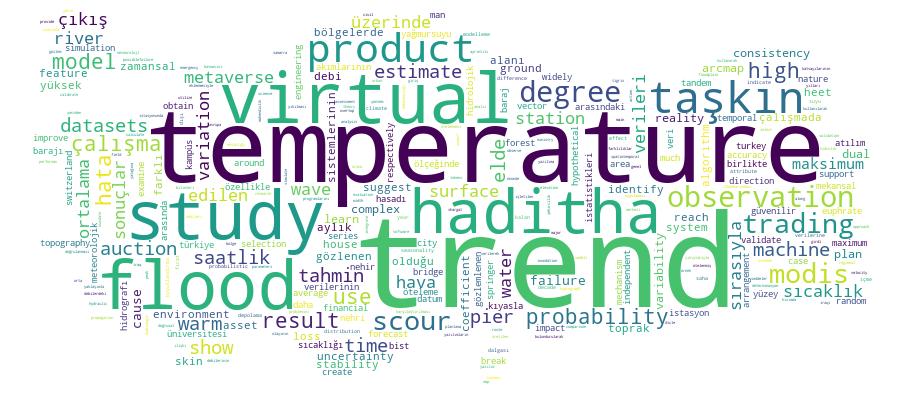
Competency Cloud

GCRIS Competency Cloud

Scholarly Output Search Results

Now showing 1 - 2 of 2
  • Article
    Citation - WoS: 6
    Citation - Scopus: 6
    Consistency of Spatiotemporal Variability of Modis and Era5-Land Surface Warming Trends Over Complex Topography
    (Springer Heidelberg, 2023) Yilmaz, Meric
    In this study, the trend of widely used MODIS MxD11 and MxD21 Land Surface Temperature (LST) and ERA5-Land Skin Temperature (SKT) and 2 m air temperature products were validated using 2 m air temperature trends obtained by ground observations from 266 stations in 2000-2021 over Turkey, known to have complex topography. The results show that colder regions have substantially higher temporal temperature variability than warmer ones. MxD21 and MxD11 products are 4.4 & DEG;C and 2.9 & DEG;C warmer than ERA5-Land products, respectively, while ERA5-Land products (SKT and 2 m) have nearly similar averages (12.5 & DEG;C). The consistency between MODIS and ERA5-Land data is significantly lower over areas with more complex topography and irrigation activities, despite the fact that the products show a high linear relationship over the study area. While February trends are consistently much higher than other months (2.2 and 1.4 & DEG;C/decade for MODIS and ERA5-Land, respectively), overall MODIS skin temperature products (0.7 & DEG;C/decade) generally exhibit smaller trends than ERA5-Land skin and air temperature trends (0.94 & DEG;C/decade). The results suggested that MODIS and ERA5-Land trends, which are highly consistent with observations, might replace observations in the absence of long-term station-based records.
  • Article
    Citation - WoS: 112
    Citation - Scopus: 129
    Accuracy Assessment of Temperature Trends From Era5 and Era5-Land
    (Elsevier, 2023) Yilmaz, Meric
    Many environmental processes and ecological systems are being affected by the warming temperatures as a result of climate change. To correctly identify and attribute the uncertainty estimates in these systems, an investigation of tem-perature trend signal existing in the datasets that are used to study such systems is necessary. In this study, the trend of widely used ERA5 and ERA5-Land temperature estimates between 1951 and 2020 were validated using temperature trends from ground station-based observations in Turkey. The investigation included datasets obtained over 540 stations, and the seasonality and spatio-temporal variability of the trend accuracy was also investigated. On average, the trends of observations over all stations were 0.82 degrees C/decade and 0.30 degrees C/decade for the periods 2001-2020 and 1951-2020, respectively, indicating strong evidence of climate change. When the model datasets used spatially and temporally continuous datasets, the trends identified were 0.91 degrees C/decade and 0.21 degrees C/decade over the entire Turkey for the years 2001-2020 and 1951-2020, respectively. The difference in the 70-year trends of the two esti-mates was attributed to the missing datasets in observations. The differences between the trends of model estimates and observations were higher for the first decade than for the last two decades, stressing the impact of improved model estimates over time. All products showed heavy seasonality, suggesting that winter trends (1.3 degrees C/decade on average) are much higher than the summer (0.3 degrees C/decade) between 2001 and 2020. The results indicated a high degree of consistency between the trends of ERA5/ERA5-Land and observations, implying they may be used as a replacement to observations.