Namlu, Ramazan Hakkı

Loading...
Profile Picture
Name Variants
Ramazan Hakki, Namlu
Ramazan Hakkı Namlu
N., Ramazan Hakkı
Namlu,R.H.
R.H.Namlu
N.,Ramazan Hakkı
Namlu, Ramazan Hakki
Ramazan Hakkı, Namlu
R. H. Namlu
R.,Namlu
Namlu R.
N., Ramazan Hakki
N.,Ramazan Hakki
Namlu, Ramazan Hakkı
R., Namlu
Namlu,Ramazan Hakki
Job Title
Doktor Öğretim Üyesi
Email Address
ramazan.namlu@atilim.edu.tr
Main Affiliation
Mechanical Engineering
Status
Scopus Author ID
Turkish CoHE Profile ID
Google Scholar ID
WoS Researcher ID

Sustainable Development Goals

2

ZERO HUNGER
ZERO HUNGER Logo

0

Research Products

14

LIFE BELOW WATER
LIFE BELOW WATER Logo

0

Research Products

17

PARTNERSHIPS FOR THE GOALS
PARTNERSHIPS FOR THE GOALS Logo

0

Research Products

5

GENDER EQUALITY
GENDER EQUALITY Logo

0

Research Products

16

PEACE, JUSTICE AND STRONG INSTITUTIONS
PEACE, JUSTICE AND STRONG INSTITUTIONS Logo

0

Research Products

8

DECENT WORK AND ECONOMIC GROWTH
DECENT WORK AND ECONOMIC GROWTH Logo

0

Research Products

4

QUALITY EDUCATION
QUALITY EDUCATION Logo

0

Research Products

6

CLEAN WATER AND SANITATION
CLEAN WATER AND SANITATION Logo

0

Research Products

7

AFFORDABLE AND CLEAN ENERGY
AFFORDABLE AND CLEAN ENERGY Logo

0

Research Products

10

REDUCED INEQUALITIES
REDUCED INEQUALITIES Logo

0

Research Products

11

SUSTAINABLE CITIES AND COMMUNITIES
SUSTAINABLE CITIES AND COMMUNITIES Logo

0

Research Products

9

INDUSTRY, INNOVATION AND INFRASTRUCTURE
INDUSTRY, INNOVATION AND INFRASTRUCTURE Logo

8

Research Products

1

NO POVERTY
NO POVERTY Logo

0

Research Products

3

GOOD HEALTH AND WELL-BEING
GOOD HEALTH AND WELL-BEING Logo

2

Research Products

12

RESPONSIBLE CONSUMPTION AND PRODUCTION
RESPONSIBLE CONSUMPTION AND PRODUCTION Logo

3

Research Products

13

CLIMATE ACTION
CLIMATE ACTION Logo

0

Research Products

15

LIFE ON LAND
LIFE ON LAND Logo

1

Research Products
Documents

19

Citations

208

h-index

8

Documents

15

Citations

173

Scholarly Output

22

Articles

13

Views / Downloads

14/0

Supervised MSc Theses

2

Supervised PhD Theses

1

WoS Citation Count

172

Scopus Citation Count

206

WoS h-index

7

Scopus h-index

8

Patents

0

Projects

1

WoS Citations per Publication

7.82

Scopus Citations per Publication

9.36

Open Access Source

6

Supervised Theses

3

Google Analytics Visitor Traffic

JournalCount
Procedia CIRP4
Machining Science and Technology3
Cirp Annals-Manufacturing Technology1
International Journal of Advanced Manufacturing Technology1
International Journal of Machining and Machinability of Materials1
Current Page: 1 / 3

Scopus Quartile Distribution

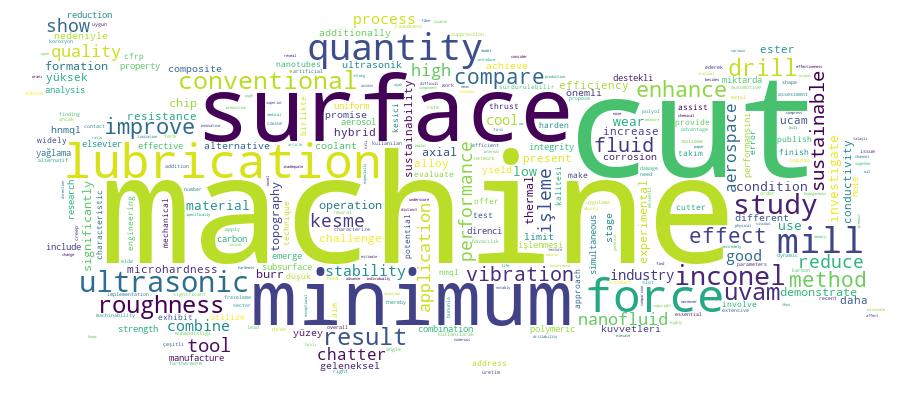
Competency Cloud

GCRIS Competency Cloud

Scholarly Output Search Results

Now showing 1 - 1 of 1
  • Article
    Citation - WoS: 41
    Citation - Scopus: 41
    Enhancing Machining Efficiency of Ti-6al Through Multi-Axial Ultrasonic Vibration-Assisted Machining and Hybrid Nanofluid Minimum Quantity Lubrication
    (Elsevier Sci Ltd, 2024) Namlu, Ramazan Hakki; Lotfi, Bahram; Kilic, S. Engin
    Ti-6Al-4V offers a balance of good strength with lightweight properties. Yet, Ti-6Al-4V poses machining challenges, including low thermal conductivity, chemical adhesion to cutting tools, and chip removal difficulties. To improve machining efficiency, Ultrasonic Vibration-Assisted Machining (UVAM) has emerged as a promising approach. UVAM has demonstrated reduced tool wear, cutting forces, and improved surface quality compared to Conventional Machining (CM). Additionally, Minimum Quantity Lubrication (MQL) methods offer sustainable coolant alternatives, with recent research focusing on Nanofluid-MQL (NMQL) and Hybrid Nanofluid-MQL (HNMQL) for enhanced performance. Although there exists a body of literature showcasing the promising effects of UVAM and MQL methods individually, comprehensive investigations into the synergistic effects of these methodologies remain limited. This study addresses these critical research gaps by conducting a systematic examination of combined application of multi-axial UVAM and HNMQL. Specifically, it delves into the comparison of different vibration directions within UVAM, evaluates the effectiveness of UVAM when combined with cutting fluids incorporating Al2O3 and CuO nanoparticles in NMQLs and HNMQLs, and contrasts these novel approaches with conventional machining methods. The study unfolds in three distinct stages. The first stage examines the ultrasonic cutting mechanism and its combined application with the MQL technique. In the second stage, the study investigates the physical properties of the cutting fluids, including contact angle and surface tension. The final stage encompasses slot milling operations, where an array of parameters such as cutting forces, surface roughness, surface topography, surface texture, and the occurrence of burr formations are rigorously analyzed. The results demonstrate that the combination of multi-axial UVAM with HNMQL yields substantial advantages over traditional machining methods. Notably, it leads to a remarkable reduction in cutting forces (up to 37.6 %) and surface roughness (up to 37.4 %). Additionally, this combination engenders the production of highly homogeneous and uniform surface textures, characterized by minimal surface defects and a significantly diminished occurrence of burr formations. These findings underscore the potential of multi-axial UVAM combined with HNMQL as a promising approach in enhancing the machining of Ti-6Al-4V, thus offering a pathway to enhance the efficiency and precision of aerospace component manufacturing processes.