Namlu, Ramazan Hakkı

Loading...
Profile Picture
Name Variants
Ramazan Hakki, Namlu
Ramazan Hakkı Namlu
N., Ramazan Hakkı
Namlu,R.H.
R.H.Namlu
N.,Ramazan Hakkı
Namlu, Ramazan Hakki
Ramazan Hakkı, Namlu
R. H. Namlu
R.,Namlu
Namlu R.
N., Ramazan Hakki
N.,Ramazan Hakki
Namlu, Ramazan Hakkı
R., Namlu
Namlu,Ramazan Hakki
Job Title
Doktor Öğretim Üyesi
Email Address
ramazan.namlu@atilim.edu.tr
Main Affiliation
Mechanical Engineering
Status
Scopus Author ID
Turkish CoHE Profile ID
Google Scholar ID
WoS Researcher ID

Sustainable Development Goals

9

INDUSTRY, INNOVATION AND INFRASTRUCTURE
INDUSTRY, INNOVATION AND INFRASTRUCTURE Logo

8

Research Products

5

GENDER EQUALITY
GENDER EQUALITY Logo

0

Research Products

2

ZERO HUNGER
ZERO HUNGER Logo

0

Research Products

4

QUALITY EDUCATION
QUALITY EDUCATION Logo

0

Research Products

11

SUSTAINABLE CITIES AND COMMUNITIES
SUSTAINABLE CITIES AND COMMUNITIES Logo

0

Research Products

17

PARTNERSHIPS FOR THE GOALS
PARTNERSHIPS FOR THE GOALS Logo

0

Research Products

16

PEACE, JUSTICE AND STRONG INSTITUTIONS
PEACE, JUSTICE AND STRONG INSTITUTIONS Logo

0

Research Products

3

GOOD HEALTH AND WELL-BEING
GOOD HEALTH AND WELL-BEING Logo

2

Research Products

12

RESPONSIBLE CONSUMPTION AND PRODUCTION
RESPONSIBLE CONSUMPTION AND PRODUCTION Logo

3

Research Products

15

LIFE ON LAND
LIFE ON LAND Logo

1

Research Products

8

DECENT WORK AND ECONOMIC GROWTH
DECENT WORK AND ECONOMIC GROWTH Logo

0

Research Products

14

LIFE BELOW WATER
LIFE BELOW WATER Logo

0

Research Products

10

REDUCED INEQUALITIES
REDUCED INEQUALITIES Logo

0

Research Products

7

AFFORDABLE AND CLEAN ENERGY
AFFORDABLE AND CLEAN ENERGY Logo

0

Research Products

1

NO POVERTY
NO POVERTY Logo

0

Research Products

6

CLEAN WATER AND SANITATION
CLEAN WATER AND SANITATION Logo

0

Research Products

13

CLIMATE ACTION
CLIMATE ACTION Logo

0

Research Products
Documents

19

Citations

208

h-index

8

Documents

15

Citations

174

Scholarly Output

22

Articles

13

Views / Downloads

14/0

Supervised MSc Theses

2

Supervised PhD Theses

1

WoS Citation Count

173

Scopus Citation Count

208

WoS h-index

7

Scopus h-index

8

Patents

0

Projects

1

WoS Citations per Publication

7.86

Scopus Citations per Publication

9.45

Open Access Source

6

Supervised Theses

3

Google Analytics Visitor Traffic

JournalCount
Procedia CIRP4
Machining Science and Technology3
Cirp Annals-Manufacturing Technology1
International Journal of Advanced Manufacturing Technology1
International Journal of Machining and Machinability of Materials1
Current Page: 1 / 3

Scopus Quartile Distribution

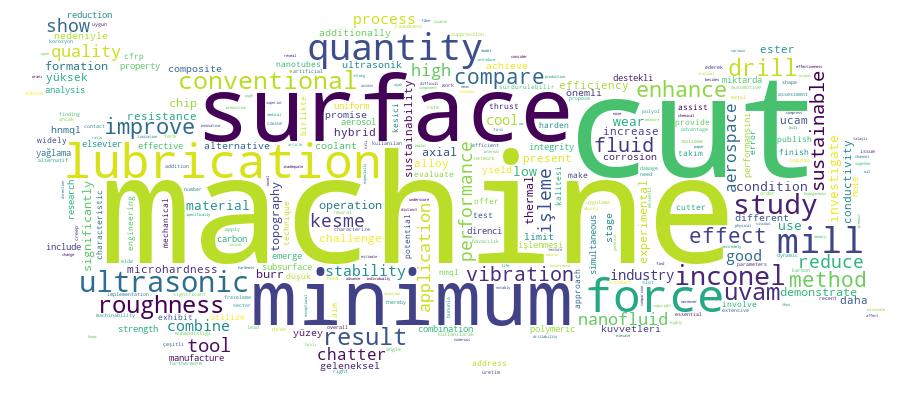
Competency Cloud

GCRIS Competency Cloud

Scholarly Output Search Results

Now showing 1 - 4 of 4
  • Conference Object
    Citation - WoS: 5
    Citation - Scopus: 6
    Investigation of the Effects of Axial Ultrasonic Vibrations on Chatter Stability in Milling with Bull Nose Cutters
    (Elsevier Science BV, 2023) Namlu, Ramazan Hakki; Kilic, Zekai Murat; Lorain, Raphael; Kilic, Sadik Engin
    Ultrasonic vibrations-assisted machining has positive effects on the chatter stability and surface integrity of the process. Radial vibration-assisted milling is effective but it needs an advanced control of vibration trajectory hence is not easy to implement. The aim of this paper is to investigate the effects of axial ultrasonic vibrations on stability through disturbing the chip regeneration. A simple way of predicting the stability increase is proposed using missed-cut effect that reduces the effective number of teeth in cut. The axial vibrations are shown to introduce radial runout such that a regular cutter will show the characteristics of a serrated tool. For a 2-tooth bull nose cutter, the proposed method was verified by milling of Ti-6Al-4V material. The results showed that the axial ultrasonic vibrations increased limit axial depth of cut by more than 40%. Therefore, applying axial vibrations would be a simple solution to improve chatter resistance in machining difficult-to-cut materials while avoiding the cost and complexity of serrated rounded edges. The attention on using axial ultrasonic vibrations in milling is increasing, hence further research on modelling the machining dynamics combined with the velocity effects will be needed following this study. (c) 2023 The Authors. Published by Elsevier B.V. This is an open access article under the CC BY-NC-ND license (https://creativecommons.org/licenses/by-nc-nd/4.0)
  • Conference Object
    Citation - WoS: 12
    Citation - Scopus: 12
    Multi-Axial Ultrasonic Vibration-Assisted Machining of Inconel 718 Using Al2O3-CuO Hybrid Nanofluid MQL
    (Elsevier Science BV, 2024) Namlu, Ramazan Hakki; Lotfi, Bahram; Kilic, Sadik Engin
    Inconel 718 is a widely used superalloy in the aerospace industry, owing to its exceptional creep and corrosion resistance, as well as its ability to retain strength at elevated temperatures. However, its machinability presents challenges due to its low thermal conductivity and high work hardening rate during conventional machining, resulting in inadequate surface quality. To address this issue, a recent technique known as Ultrasonic Vibration-Assisted Machining (UVAM) has emerged. UVAM involves applying high-frequency, low-amplitude vibrations to the cutting tool or workpiece. Additionally, Minimum Quantity Lubrication (MQL) has been considered as an alternative cooling technique to enhance machining performance. Optimizing the performance of UVAM can be achieved by employing various vibration axes. Additionally, the effectiveness of MQL can be enhanced through the utilization of nanofluids. This study investigates the combined application of multi-axis UVAM and Al2O3-CuO added Hybrid Nanofluid MQL (HNMQL) during the milling of Inconel 718. The evaluation parameters include surface roughness, topography, burr formations, and cutting forces. The results demonstrate that the simultaneous use of multi-axis UVAM and HNMQL significantly improves the machining performance of Inconel 718. This combination leads to better surface quality and overall process efficiency, offering promising prospects for the aerospace industry and other applications involving difficult-to-cut materials. (c) 2024 The Authors. Published by Elsevier B.V.
  • Article
    Citation - WoS: 1
    Citation - Scopus: 1
    An Experimental Study on Ultrasonic-Assisted Drilling of CFRP Composites with Minimum Quantity Lubrication
    (MDPI, 2025) Namlu, Ramazan Hakki; Sagener, Mustafa Burak; Kilic, Zekai Murat; Colak, Oguz; Kilic, Sadik Engin
    The increasing use of carbon fiber reinforced polymer (CFRP) composites in industries such as aerospace, due to its high strength-to-weight ratio, durability, and resistance to corrosion has led to a growing demand for more efficient machining processes. However, the multilayered structure of CFRP composites, composed of densely packed fibers, presents significant challenges during machining. Additionally, when cutting fluids are used to improve effective cooling and lubrication, the material tends to absorb the fluid, causing damage and leading to problem of weaking of composite structure. To address these issues, this study compares ultrasonic-assisted drilling (UAD) and minimum quantity lubrication (MQL) techniques with conventional drilling (CD) and dry cutting to improve the performance of CFRP composite drilling. The results show that using UAD and MQL together reduced thrust force by up to 27%, improved surface roughness inside the holes by up to 31%, reduced improved hole diameter, cylindricity, roundness, and delamination.
  • Article
    Citation - WoS: 28
    Citation - Scopus: 33
    An Experimental Investigation on the Effects of Combined Application of Ultrasonic Assisted Milling (uam) and Minimum Quantity Lubrication (mql) on Cutting Forces and Surface Roughness of Ti-6al
    (Taylor & Francis inc, 2021) Namlu, Ramazan Hakki; Sadigh, Bahram Lotfi; Kilic, Sadik Engin
    Ti-6Al-4V is widely used in aerospace, medical and defense industries where materials with superior characteristics are needed. However, Ti-6Al-4V is categorized as a difficult-to-cut material, and machining of this alloy is highly challenging. Ultrasonic Assisted Milling (UAM) is a quite recent method to facilitate the machining of difficult-to-cut materials. This method has numerous advantages over the Conventional Milling (CM) method, such as reduced cutting forces and increased surface quality. Besides, Minimum Quantity Lubrication (MQL) is an alternative cooling method to enhance the process efficiency with respect to conventional cooling methods. Cutting force and surface roughness are essential measures to evaluate the cutting performance of a machining process. However, the simultaneous effects of implementing MQL and ultrasonic vibrations in milling operations are not much researched yet. In this study, the combined effects of UAM and MQL on cutting forces and surface roughness during the machining of Ti-6AL-4V are investigated. Results show that the combination of MQL and UAM enhances the cutting forces in rough cutting operations and the surface roughness in both finish and rough cutting operations significantly compared to conventional processes. Consequently, it is concluded that simultaneous implementation of UAM and MQL enhances overall cutting performance in end-milling operation of Ti-6Al-4V.