Namlu, Ramazan Hakkı

Loading...
Profile Picture
Name Variants
Ramazan Hakki, Namlu
Ramazan Hakkı Namlu
N., Ramazan Hakkı
Namlu,R.H.
R.H.Namlu
N.,Ramazan Hakkı
Namlu, Ramazan Hakki
Ramazan Hakkı, Namlu
R. H. Namlu
R.,Namlu
Namlu R.
N., Ramazan Hakki
N.,Ramazan Hakki
Namlu, Ramazan Hakkı
R., Namlu
Namlu,Ramazan Hakki
Job Title
Doktor Öğretim Üyesi
Email Address
ramazan.namlu@atilim.edu.tr
Main Affiliation
Mechanical Engineering
Status
Scopus Author ID
Turkish CoHE Profile ID
Google Scholar ID
WoS Researcher ID

Sustainable Development Goals

NO POVERTY1
NO POVERTY
0
Research Products
ZERO HUNGER2
ZERO HUNGER
0
Research Products
GOOD HEALTH AND WELL-BEING3
GOOD HEALTH AND WELL-BEING
2
Research Products
QUALITY EDUCATION4
QUALITY EDUCATION
0
Research Products
GENDER EQUALITY5
GENDER EQUALITY
0
Research Products
CLEAN WATER AND SANITATION6
CLEAN WATER AND SANITATION
0
Research Products
AFFORDABLE AND CLEAN ENERGY7
AFFORDABLE AND CLEAN ENERGY
0
Research Products
DECENT WORK AND ECONOMIC GROWTH8
DECENT WORK AND ECONOMIC GROWTH
0
Research Products
INDUSTRY, INNOVATION AND INFRASTRUCTURE9
INDUSTRY, INNOVATION AND INFRASTRUCTURE
8
Research Products
REDUCED INEQUALITIES10
REDUCED INEQUALITIES
0
Research Products
SUSTAINABLE CITIES AND COMMUNITIES11
SUSTAINABLE CITIES AND COMMUNITIES
0
Research Products
RESPONSIBLE CONSUMPTION AND PRODUCTION12
RESPONSIBLE CONSUMPTION AND PRODUCTION
3
Research Products
CLIMATE ACTION13
CLIMATE ACTION
0
Research Products
LIFE BELOW WATER14
LIFE BELOW WATER
0
Research Products
LIFE ON LAND15
LIFE ON LAND
1
Research Products
PEACE, JUSTICE AND STRONG INSTITUTIONS16
PEACE, JUSTICE AND STRONG INSTITUTIONS
0
Research Products
PARTNERSHIPS FOR THE GOALS17
PARTNERSHIPS FOR THE GOALS
0
Research Products
Documents

19

Citations

218

h-index

8

Documents

15

Citations

181

Scholarly Output

22

Articles

13

Views / Downloads

86/79

Supervised MSc Theses

2

Supervised PhD Theses

1

WoS Citation Count

180

Scopus Citation Count

218

Patents

0

Projects

1

WoS Citations per Publication

8.18

Scopus Citations per Publication

9.91

Open Access Source

6

Supervised Theses

3

JournalCount
Procedia CIRP4
Machining Science and Technology3
Cirp Annals-Manufacturing Technology1
International Journal of Advanced Manufacturing Technology1
International Journal of Machining and Machinability of Materials1
Current Page: 1 / 3

Scopus Quartile Distribution

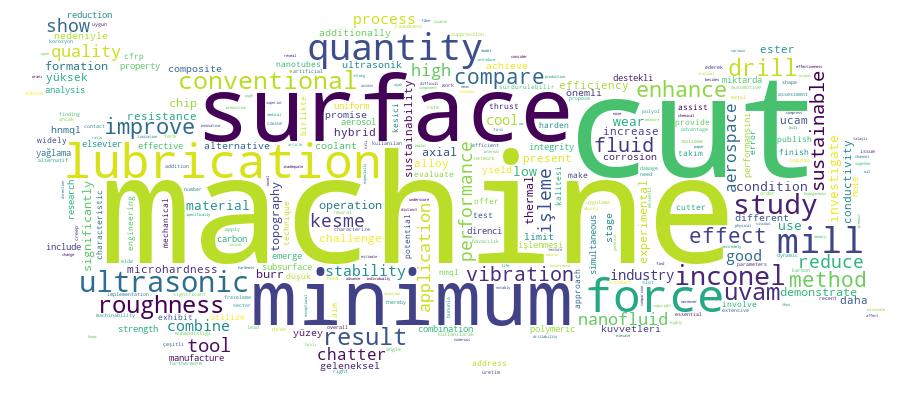
Competency Cloud

GCRIS Competency Cloud

Scholarly Output Search Results

Now showing 1 - 1 of 1
  • Article
    Citation - WoS: 1
    Citation - Scopus: 1
    Enhancing Machining Efficiency and Sustainability of Ti-6Al-4V Through Minimum Quantity Lubrication With Ester-Based Oils
    (Taylor & Francis Ltd, 2025) Namlu, Ramazan Hakki; Kavut, Kuebra; Tom, Hanife Gulen
    Ti-6Al-4 V is known as difficult-to-cut due to its low thermal conductivity and high chemical reactivity. While cutting fluids aid lubrication and reduce friction, Conventional Cutting Fluids (CCF) have high consumption, limited efficiency gains and negative environmental and health effects. Therefore, there is an ongoing search for more sustainable alternatives to CCF that do not adversely affect machining performance. Minimum Quantity Lubrication (MQL), which delivers compressed air - oil aerosol, has emerged as a promising solution by drastically reducing fluid use and associated risks. Selecting the right MQL fluid is key to optimising machining performance. This study evaluates MQL fluids based on polyol and polymeric esters for Ti-6Al-4 V machining and compares their performance with CCF. Cutting forces, surface roughness and topography are examined. Results show that MQL reduces cutting forces up to 21.7% and surface roughness up to 57.6% compared to CCF, with more uniform surface topography. Among MQL oils, polymeric esters perform better than polyol esters, with a reduction in cutting force up to 14.6% and surface roughness up to 47.7%. High viscosity indexed polymeric esters showed the best overall performance due to their thermal stability. Moreover, according to the sustainability assessment analysis polymeric esters were identified as the most sustainable option.