Şaşmazel, Hilal Türkoğlu

Loading...
Profile Picture
Name Variants
S.,Hilal Turkoglu
Sasmazel, Hilal Tuerkoglu
Sasmazel, Hilal Turkoglu
H. T. Şaşmazel
Turkoglu Sasmazel H.
Sasmazel,H.T.
Şaşmazel,H.T.
Hilal Türkoğlu, Şaşmazel
H., Sasmazel
Şasmazel H.
S., Hilal Turkoglu
Ş.,Hilal Türkoğlu
Ş., Hilal Türkoğlu
Turkoğlu Şaşmazel H.
Hilal Turkoglu, Sasmazel
H.T.Sasmazel
H.T.Şaşmazel
Sasmazel H.
Sasmazel, H. T.
Türkoglu, H
Turkoglu, Hilal
Sasmazel, H. Turkoglu
Sasmazel, Hilal T.
H. T. Sasmazel
Şaşmazel, Hilal Türkoğlu
H.,Şaşmazel
Şaşmazel H.
Sasmazel, H. Tuerkodlu
Türkoǧlu Şaşmazel,H.
Şaşmazel, Hilal
Job Title
Profesor Doktor
Email Address
hilal.sasmazel@atilim.edu.tr
Main Affiliation
Metallurgical and Materials Engineering
Status
Website
Scopus Author ID
Turkish CoHE Profile ID
Google Scholar ID
WoS Researcher ID

Sustainable Development Goals

14

LIFE BELOW WATER
LIFE BELOW WATER Logo

1

Research Products

2

ZERO HUNGER
ZERO HUNGER Logo

0

Research Products

11

SUSTAINABLE CITIES AND COMMUNITIES
SUSTAINABLE CITIES AND COMMUNITIES Logo

0

Research Products

1

NO POVERTY
NO POVERTY Logo

0

Research Products

12

RESPONSIBLE CONSUMPTION AND PRODUCTION
RESPONSIBLE CONSUMPTION AND PRODUCTION Logo

0

Research Products

7

AFFORDABLE AND CLEAN ENERGY
AFFORDABLE AND CLEAN ENERGY Logo

0

Research Products

5

GENDER EQUALITY
GENDER EQUALITY Logo

0

Research Products

3

GOOD HEALTH AND WELL-BEING
GOOD HEALTH AND WELL-BEING Logo

27

Research Products

9

INDUSTRY, INNOVATION AND INFRASTRUCTURE
INDUSTRY, INNOVATION AND INFRASTRUCTURE Logo

0

Research Products

13

CLIMATE ACTION
CLIMATE ACTION Logo

0

Research Products

6

CLEAN WATER AND SANITATION
CLEAN WATER AND SANITATION Logo

1

Research Products

10

REDUCED INEQUALITIES
REDUCED INEQUALITIES Logo

0

Research Products

4

QUALITY EDUCATION
QUALITY EDUCATION Logo

0

Research Products

15

LIFE ON LAND
LIFE ON LAND Logo

0

Research Products

16

PEACE, JUSTICE AND STRONG INSTITUTIONS
PEACE, JUSTICE AND STRONG INSTITUTIONS Logo

0

Research Products

17

PARTNERSHIPS FOR THE GOALS
PARTNERSHIPS FOR THE GOALS Logo

0

Research Products

8

DECENT WORK AND ECONOMIC GROWTH
DECENT WORK AND ECONOMIC GROWTH Logo

0

Research Products
Documents

45

Citations

1387

h-index

20

Documents

50

Citations

1276

Scholarly Output

55

Articles

38

Views / Downloads

9/0

Supervised MSc Theses

10

Supervised PhD Theses

0

WoS Citation Count

968

Scopus Citation Count

1022

WoS h-index

18

Scopus h-index

18

Patents

0

Projects

0

WoS Citations per Publication

17.60

Scopus Citations per Publication

18.58

Open Access Source

11

Supervised Theses

10

Google Analytics Visitor Traffic

JournalCount
Journal of Nanoscience and Nanotechnology4
Bio-Medical Materials and Engineering3
International Journal of Biological Macromolecules2
Molecules2
Nanomaterials2
Current Page: 1 / 7

Scopus Quartile Distribution

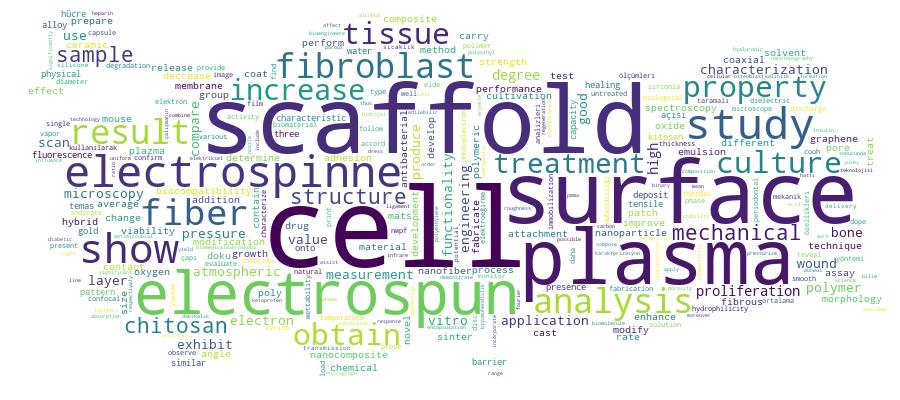
Competency Cloud

GCRIS Competency Cloud

Scholarly Output Search Results

Now showing 1 - 5 of 5
  • Article
    Citation - WoS: 11
    Development of Antibacterial Composite Electrospun Chitosan-Coated Polypropylene Materials
    (Amer Scientific Publishers, 2018) Gozutok, Melike; Basar, Ahmet Ozan; Sasmazel, Hilal Turkoglu
    In this study, a natural antibacterial substance chitosan was coated with/without potassium sorbate (KS) (0.8% (w/w) of KS, 8% (w/v) chitosan) onto the polypropylene (PP) film by using electrospinning technique to obtain novel antibacterial composite materials for various applications such as wound dressing, tissue engineering, drug delivery and food packaging. Atmospheric pressure plasma surface treatment was applied onto polypropylene films in order to increase its wettability thus enhancing the adhesion capacity of the films and the optimum CA value was determined as 42.75 +/- 0.80 degrees. Scanning Electron Microscope (SEM) and X-ray Photoelectron Spectroscopy (XPS) analyses were realized to observe the morphological changes and chemical properties of the samples, respectively. Contact angle measurements, tensile testing, oxygen and water vapor transmission rate analyses were performed to obtain wettability values, mechanical properties and WVTRs, respectively. The WVTR was increased by plasma treatment and addition of KS (from 14.264 +/- 0.214% to 21.020 +/- 0.659%). The desired antibacterial performance of the samples was assessed with Staphylococcus aureus and Escherichia coli by inhibition ratio calculation and disc diffusion assay. The highest inhibition ratios were found as 64% for S. aureus and 92% for E. coli for plasma-treated CS-KS-PP films.
  • Article
    Citation - WoS: 58
    Citation - Scopus: 77
    Electrospun Oxygen Scavenging Films of Poly(3-Hydroxybutyrate) Containing Palladium Nanoparticles for Active Packaging Applications
    (Mdpi, 2018) Cherpinski, Adriane; Gozutok, Melike; Sasmazel, Hilal Turkoglu; Torres-Giner, Sergio; Lagaron, Jose M.
    This paper reports on the development and characterization of oxygen scavenging films made of poly(3-hydroxybutyrate) (PHB) containing palladium nanoparticles (PdNPs) prepared by electrospinning followed by annealing treatment at 160 degrees C. The PdNPs were modified with the intention to optimize their dispersion and distribution in PHB by means of two different surfactants permitted for food contact applications, i.e., hexadecyltrimethylammonium bromide (CTAB) and tetraethyl orthosilicate (TEOS). Analysis of the morphology and characterization of the chemical, thermal, mechanical, and water and limonene vapor barrier properties and the oxygen scavenging capacity of the various PHB materials were carried out. From the results, it was seen that a better dispersion and distribution was obtained using CTAB as the dispersing aid. As a result, the PHB/PdNP nanocomposites containing CTAB provided also the best oxygen scavenging performance. These films offer a significant potential as new active coating or interlayer systems for application in the design of novel active food packaging structures.
  • Article
    Citation - WoS: 22
    Citation - Scopus: 24
    Mechanical and Biological Properties of Al2o3< and Tio2 Co-Doped Zirconia Ceramics
    (Elsevier Sci Ltd, 2017) Agac, Ozlem; Gozutok, Melike; Sasmazel, Hilal Turkoglu; Ozturk, Abdullah; Park, Jongee
    Various amounts (ranging from 0 to 2 wt%) of TiO2 and Al2O3 were mono and co-doped to tetragonal zirconia ceramic containing 3 mol% yttria (3Y-TZP) by mechanical ball milling. Powders were compacted by uniaxial pressing at a pressure of 23 MPa. The compacts were pressureless sintered at 1450 degrees C for 2 h. Density, hardness, fracture toughness, and cell attachment of the co-doped 3Y-TZP ceramics were measured with respect to dopant addition to determine the effects of the kind and amount of dopants on the properties. The results show that density decreased gradually as the amount of dopant was increased. The mechanical properties showed the maximum value when 0.5 wt% TiO2 and 1.0 wt% Al2O3 were co-doped to 3Y-TZP. Crystalline phase formation and microstructural morphology were investigated by XRD and SEM analyses to explain the variations in the properties. Co-doping of TiO2 and Al2O3 to 3Y-TZP did not have an influence on the phases present, but decreased the grain size. The co-doping also affected the cell attachment and the growth on the surface of the zirconia ceramics.
  • Article
    Citation - Scopus: 1
    Biocompatibility of Electrospun Pva-Based Nanocomposite With Chemical Vapor Deposition-Derived Graphene Monolayer
    (Lukasiewicz Research Network-industrial Chemistry inst, 2024) Sasmazel, Hilal Turkoglu; Alazzawi, Marwa; Sadhu, Verra; Gozutok, Melike
    The biocompatibility of electrospun PVA with monolayer graphene obtained by chemical vapor deposition (PVA/CVD-grown MLG) nanocomposite was investigated. The properties of PVA/ CVD-grown MLG nanocomposite were compared with those of electrospun PVA mat. Raman analysis confirmed the presence of graphene monolayer on PVA. Although no significant changes in tensile properties were observed, the electrical conductivity increased from 0.1 (PVA mat) to 0.4 mu S/cm (PVA/ CVD-grown MLG). Thermal stability was also increased, as evidenced by the higher onset temperature and temperature of maximum decomposition rate determined by TGA. The contact angle decreased slightly, which resulted in higher PBS absorption and degradation of the nanocomposite. Water vapor transmission rate (WVTR) decreased from 40 (PVA mat) to 37 g/m2 h (PVA/CVD-grown MLG). Cell culture studies showed better cell viability, population, and growth in the case of PVA/CVD-grown MLG nanocomposite due to improved physical, chemical and mechanical properties.
  • Article
    Citation - WoS: 21
    Development of Poly(vinyl Alcohol) (pva)/Reduced Graphene Oxide (rgo) Electrospun Mats
    (Amer Scientific Publishers, 2019) Gozutok, Melike; Sadhu, Veera; Sasmazel, Hilal Turkoglu
    In this study, electrospun reduced graphene oxide (rGO) and poly(vinyl alcohol) (PVA) nanocomposites were developed with the concentration of rGO as 0.5 and 1.0 wt% by dispersing rGO in the PVA solution without using any co-solvent which may cause toxic effect for possible applications like packaging and tissue engineering. Water solubility of PVA was eliminated by UV-radiation crosslinking method. SEM analysis proved that continuous and bead-free nanofibers were obtained by electrospinning process and all electrospun mats had similar fiber characteristics with homogeneous fiber morphology. The average fiber diameter (nm), inter-fiber pore size (mu m) and the porosity (%) were increased with rGO incorporation. Additionally, enhanced tensile properties was achieved by rGO addition as the highest tensile strength was obtained as similar to 5 MPa for electrospun PVA+ 1.0 wt% rGO nanocomposites. ATR-FTIR analyses showed that there was a relatively strong interfacial interaction between rGO and PVA. Moreover, the thermal stability of obtained nanocomposites was enhanced by rGO addition without changing the crystal structure of PVA proved by XRD analyses. Also, improved electrical conductivity of the nanocomposites was obtained by rGO content as the highest conductivity (similar to 11 mu S.cm(-1)) was measured for electrospun PVA+ 1.0 wt% rGO.