Şaşmazel, Hilal Türkoğlu

Loading...
Profile Picture
Name Variants
S.,Hilal Turkoglu
Sasmazel, Hilal Tuerkoglu
Sasmazel, Hilal Turkoglu
H. T. Şaşmazel
Turkoglu Sasmazel H.
Sasmazel,H.T.
Şaşmazel,H.T.
Hilal Türkoğlu, Şaşmazel
H., Sasmazel
Şasmazel H.
S., Hilal Turkoglu
Ş.,Hilal Türkoğlu
Ş., Hilal Türkoğlu
Turkoğlu Şaşmazel H.
Hilal Turkoglu, Sasmazel
H.T.Sasmazel
H.T.Şaşmazel
Sasmazel H.
Sasmazel, H. T.
Türkoglu, H
Turkoglu, Hilal
Sasmazel, H. Turkoglu
Sasmazel, Hilal T.
H. T. Sasmazel
Şaşmazel, Hilal Türkoğlu
H.,Şaşmazel
Şaşmazel H.
Sasmazel, H. Tuerkodlu
Türkoǧlu Şaşmazel,H.
Şaşmazel, Hilal
Job Title
Profesor Doktor
Email Address
hilal.sasmazel@atilim.edu.tr
Main Affiliation
Metallurgical and Materials Engineering
Status
Website
Scopus Author ID
Turkish CoHE Profile ID
Google Scholar ID
WoS Researcher ID

Sustainable Development Goals

14

LIFE BELOW WATER
LIFE BELOW WATER Logo

1

Research Products

2

ZERO HUNGER
ZERO HUNGER Logo

0

Research Products

11

SUSTAINABLE CITIES AND COMMUNITIES
SUSTAINABLE CITIES AND COMMUNITIES Logo

0

Research Products

1

NO POVERTY
NO POVERTY Logo

0

Research Products

12

RESPONSIBLE CONSUMPTION AND PRODUCTION
RESPONSIBLE CONSUMPTION AND PRODUCTION Logo

0

Research Products

7

AFFORDABLE AND CLEAN ENERGY
AFFORDABLE AND CLEAN ENERGY Logo

0

Research Products

5

GENDER EQUALITY
GENDER EQUALITY Logo

0

Research Products

3

GOOD HEALTH AND WELL-BEING
GOOD HEALTH AND WELL-BEING Logo

27

Research Products

9

INDUSTRY, INNOVATION AND INFRASTRUCTURE
INDUSTRY, INNOVATION AND INFRASTRUCTURE Logo

0

Research Products

13

CLIMATE ACTION
CLIMATE ACTION Logo

0

Research Products

6

CLEAN WATER AND SANITATION
CLEAN WATER AND SANITATION Logo

1

Research Products

10

REDUCED INEQUALITIES
REDUCED INEQUALITIES Logo

0

Research Products

4

QUALITY EDUCATION
QUALITY EDUCATION Logo

0

Research Products

15

LIFE ON LAND
LIFE ON LAND Logo

0

Research Products

16

PEACE, JUSTICE AND STRONG INSTITUTIONS
PEACE, JUSTICE AND STRONG INSTITUTIONS Logo

0

Research Products

17

PARTNERSHIPS FOR THE GOALS
PARTNERSHIPS FOR THE GOALS Logo

0

Research Products

8

DECENT WORK AND ECONOMIC GROWTH
DECENT WORK AND ECONOMIC GROWTH Logo

0

Research Products
Documents

45

Citations

1389

h-index

20

Documents

50

Citations

1279

Scholarly Output

55

Articles

38

Views / Downloads

9/0

Supervised MSc Theses

10

Supervised PhD Theses

0

WoS Citation Count

971

Scopus Citation Count

1024

WoS h-index

18

Scopus h-index

18

Patents

0

Projects

0

WoS Citations per Publication

17.65

Scopus Citations per Publication

18.62

Open Access Source

11

Supervised Theses

10

Google Analytics Visitor Traffic

JournalCount
Journal of Nanoscience and Nanotechnology4
Bio-Medical Materials and Engineering3
International Journal of Biological Macromolecules2
Molecules2
Nanomaterials2
Current Page: 1 / 7

Scopus Quartile Distribution

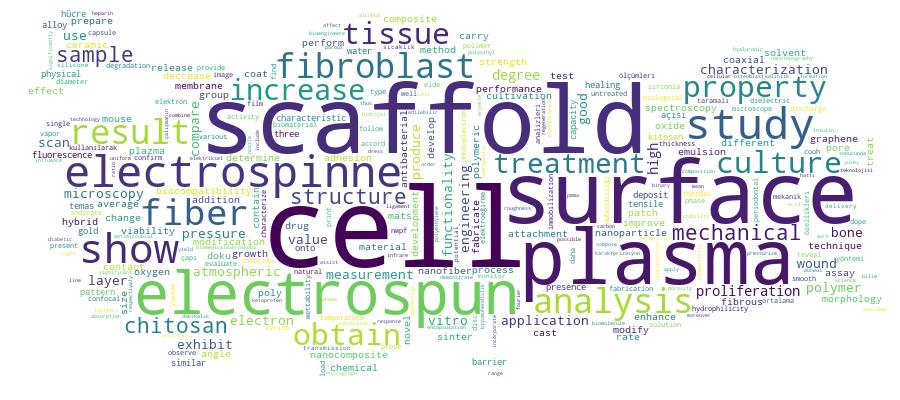
Competency Cloud

GCRIS Competency Cloud

Scholarly Output Search Results

Now showing 1 - 2 of 2
  • Article
    Citation - WoS: 14
    Citation - Scopus: 15
    Core/Shell Glycine-Polyvinyl Alcohol/Polycaprolactone Nanofibrous Membrane Intended for Guided Bone Regeneration: Development and Characterization
    (Mdpi, 2021) Alazzawi, Marwa; Alsahib, Nabeel Kadim Abid; Sasmazel, Hilal Turkoglu
    Glycine (Gly), which is the simplest amino acid, induces the inflammation response and enhances bone mass density, and particularly its beta polymorph has superior mechanical and piezoelectric properties. Therefore, electrospinning of Gly with any polymer, including polyvinyl alcohol (PVA), has a great potential in biomedical applications, such as guided bone regeneration (GBR) application. However, their application is limited due to a fast degradation rate and undesirable mechanical and physical properties. Therefore, encapsulation of Gly and PVA fiber within a poly(epsilon-caprolactone) (PCL) shell provides a slower degradation rate and improves the mechanical, chemical, and physical properties. A membrane intended for GBR application is a barrier membrane used to guide alveolar bone regeneration by preventing fast-proliferating cells from growing into the bone defect site. In the present work, a core/shell nanofibrous membrane, composed of PCL as shell and PVA:Gly as core, was developed utilizing the coaxial electrospinning technique and characterized morphologically, mechanically, physically, chemically, and thermally. Moreover, the characterization results of the core/shell membrane were compared to monolithic electrospun PCL, PVA, and PVA:Gly fibrous membranes. The results showed that the core-shell membrane appears to be a good candidate for GBR application with a nano-scale fiber of 412 +/- 82 nm and microscale pore size of 6.803 +/- 0.035 mu m. Moreover, the wettability of 47.4 +/- 2.2 degrees contact angle (C.A) and mechanical properties of 135 +/- 3.05 MPa average modulus of elasticity, 4.57 +/- 0.04 MPa average ultimate tensile stress (UTS), and 39.43% +/- 0.58% average elongation at break are desirable and suitable for GBR application. Furthermore, the X-ray diffraction (XRD) and transmission electron microscopy (TEM) results exhibited the formation of beta-Gly.
  • Article
    Citation - Scopus: 1
    Biocompatibility of Electrospun Pva-Based Nanocomposite With Chemical Vapor Deposition-Derived Graphene Monolayer
    (Lukasiewicz Research Network-industrial Chemistry inst, 2024) Sasmazel, Hilal Turkoglu; Alazzawi, Marwa; Sadhu, Verra; Gozutok, Melike
    The biocompatibility of electrospun PVA with monolayer graphene obtained by chemical vapor deposition (PVA/CVD-grown MLG) nanocomposite was investigated. The properties of PVA/ CVD-grown MLG nanocomposite were compared with those of electrospun PVA mat. Raman analysis confirmed the presence of graphene monolayer on PVA. Although no significant changes in tensile properties were observed, the electrical conductivity increased from 0.1 (PVA mat) to 0.4 mu S/cm (PVA/ CVD-grown MLG). Thermal stability was also increased, as evidenced by the higher onset temperature and temperature of maximum decomposition rate determined by TGA. The contact angle decreased slightly, which resulted in higher PBS absorption and degradation of the nanocomposite. Water vapor transmission rate (WVTR) decreased from 40 (PVA mat) to 37 g/m2 h (PVA/CVD-grown MLG). Cell culture studies showed better cell viability, population, and growth in the case of PVA/CVD-grown MLG nanocomposite due to improved physical, chemical and mechanical properties.