Darama, Yakup

Loading...
Profile Picture
Name Variants
D., Yakup
Yakup Darama
Yakup, Darama
Darama,Y.
Darama Y.
Y., Darama
D.,Yakup
Darama,Yakup
Darama, Yakup
Y.,Darama
Darama, Y.
Job Title
Profesör Doktor
Email Address
yakup.darama@atilim.edu.tr
Main Affiliation
Civil Engineering
Status
Website
Scopus Author ID
Turkish CoHE Profile ID
Google Scholar ID
WoS Researcher ID

Sustainable Development Goals

2

ZERO HUNGER
ZERO HUNGER Logo

1

Research Products

11

SUSTAINABLE CITIES AND COMMUNITIES
SUSTAINABLE CITIES AND COMMUNITIES Logo

4

Research Products

14

LIFE BELOW WATER
LIFE BELOW WATER Logo

0

Research Products

6

CLEAN WATER AND SANITATION
CLEAN WATER AND SANITATION Logo

5

Research Products

1

NO POVERTY
NO POVERTY Logo

0

Research Products

5

GENDER EQUALITY
GENDER EQUALITY Logo

0

Research Products

9

INDUSTRY, INNOVATION AND INFRASTRUCTURE
INDUSTRY, INNOVATION AND INFRASTRUCTURE Logo

0

Research Products

16

PEACE, JUSTICE AND STRONG INSTITUTIONS
PEACE, JUSTICE AND STRONG INSTITUTIONS Logo

0

Research Products

17

PARTNERSHIPS FOR THE GOALS
PARTNERSHIPS FOR THE GOALS Logo

0

Research Products

15

LIFE ON LAND
LIFE ON LAND Logo

0

Research Products

10

REDUCED INEQUALITIES
REDUCED INEQUALITIES Logo

0

Research Products

7

AFFORDABLE AND CLEAN ENERGY
AFFORDABLE AND CLEAN ENERGY Logo

2

Research Products

8

DECENT WORK AND ECONOMIC GROWTH
DECENT WORK AND ECONOMIC GROWTH Logo

0

Research Products

4

QUALITY EDUCATION
QUALITY EDUCATION Logo

0

Research Products

12

RESPONSIBLE CONSUMPTION AND PRODUCTION
RESPONSIBLE CONSUMPTION AND PRODUCTION Logo

0

Research Products

3

GOOD HEALTH AND WELL-BEING
GOOD HEALTH AND WELL-BEING Logo

0

Research Products

13

CLIMATE ACTION
CLIMATE ACTION Logo

2

Research Products
Documents

12

Citations

196

h-index

9

Documents

9

Citations

96

Scholarly Output

12

Articles

6

Views / Downloads

100/623

Supervised MSc Theses

5

Supervised PhD Theses

0

WoS Citation Count

69

Scopus Citation Count

95

WoS h-index

5

Scopus h-index

5

Patents

0

Projects

0

WoS Citations per Publication

5.75

Scopus Citations per Publication

7.92

Open Access Source

3

Supervised Theses

5

Google Analytics Visitor Traffic

JournalCount
Natural Hazards2
Environmental Earth Sciences1
Hydrological Research Letters1
IOP Conference Series: Materials Science and Engineering -- 3rd International Conference on Sustainable Engineering Techniques, ICSET 2020 -- 15 April 2020 -- Baghdad, Vitrual -- 1622331
Journal of Hydrologic Engineering1
Current Page: 1 / 2

Scopus Quartile Distribution

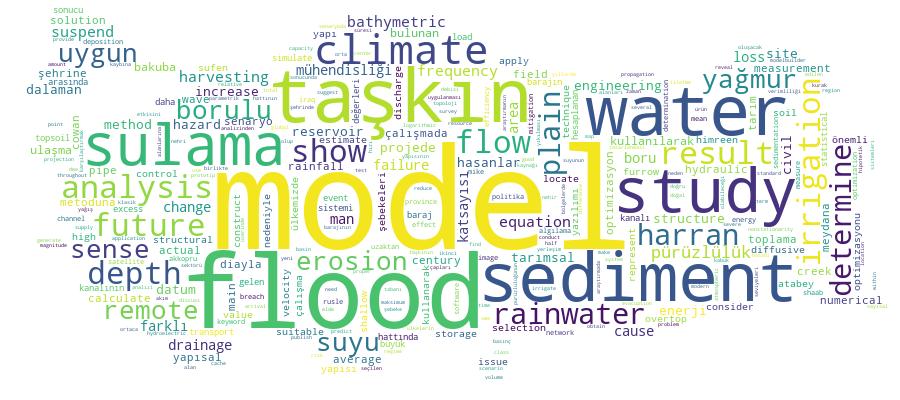
Competency Cloud

GCRIS Competency Cloud

Scholarly Output Search Results

Now showing 1 - 2 of 2
  • Article
    Citation - WoS: 9
    Citation - Scopus: 10
    Land Degradation by Erosion Occurred After Irrigation Development in the Harran Plain, Southeastern Turkey
    (Springer, 2021) Darama, Yakup; Yilmaz, Kutay; Melek, A. Berhan
    A study was made to determine the erosion problem and determine the amount of suspended sediment transport in the drainage channels of the Harran Plain by conducting periodic suspended sediment sampling and discharge measurements in the field between 1997 and 2017. When irrigation in the Harran Plain started in 1990, the production of the agricultural goods quadrupled within a few years. Unfortunately, excessive amounts of irrigation water supplied to irrigate crops also led to the erosion of the soil in the fields by surface runoff. Furthermore, the mixture of clay, silt, and fine sand in the topsoil from certain areas accumulated in the tertiary and secondary drainage systems and reduced the effectiveness of the drainage system. Analysis of the suspended sediment measurements between 1997 and 2017 showed that the yearly averaged sediment transported to Syria by the main drainage canal of the Harran Plain varied between 128 ton.day(-1) to 1268 ton.day(-1), and the average of the 21-year measurement is about 682 ton.day(-1). The logarithmic plot of the suspended sediment rating curve showed that as the discharge of the Cullap Creek increases, the sediment transport rate also increases linearly. It means excess furrow irrigation could cause substantial topsoil loss. Sediment erosion resulting from rainfall events in the Harran Plain is also computed using Revised Universal Soil Loss Equation (RUSLE). The results showed that rainfall erosion from the Harran Plain is 131.5 ton.day(-1). A comparison of this value with the 21-year value of average sediment erosion by irrigation shows that approximately 20% of sediment erosion from the Harran Plain was caused by rainfall events, and the remaining 80% was caused by excess irrigation water in the area. A 2D numerical model was constructed with MIKE 21 software applying Van Rijn Method to calculate suspended sediment load due to irrigation, and it allowed to calculate the load with a 6.47% error. Grouping the irrigated and non-irrigated periods and applying independent t test, a statistical approach constituted and resulted in 79.2% of suspended sediment load is caused by irrigation. The numerical model and statistical analysis supported the findings of field data and RUSLE Model results. The study showed that the main reason of the topsoil loss in the Harran Plain is the excess furrow irrigation.
  • Conference Object
    Citation - Scopus: 48
    Locating Site Selection for Rainwater Harvesting Structure Using Remote Sensing and Gis
    (Institute of Physics Publishing, 2020) Khudhair,M.A.; Sayl,K.N.; Darama,Y.
    Rainfall is a key source to diminish the problem of water scarcity in the arid and semi-arid regions. Rainwater harvesting is considered an imperious tool for rainwater conservation. Locating the appropriate location for rainwater harvesting structure plays an important role to increase water availability and improve water resources planning. The main goal of this paper is to recognize the proper location for a rainwater harvesting structure using a suitability model generated with ModelBuilder in ArcGIS. Six thematic layers i.e. soil structure, slope, drainage density, vegetation cover, distance to the roads, and runoff depth, are considered to find the proper site for rainwater harvesting structure. The result shows that 12% represents the suitable zone of the total study area, 42% represents the medium suitable area, and 46% represents not suitable areas to implement rainwater harvesting structure. The application of this scheme should maintain any policy adoption for site selection for rainwater harvesting. © 2020 Published under licence by IOP Publishing Ltd.