Albostan, Ayhan

Loading...
Profile Picture
Name Variants
A., Ayhan
Albostan, Ayhan
A., Albostan
A.,Albostan
Ayhan, Albostan
A.,Ayhan
Albostan,A.
Job Title
Profesor Doktor
Email Address
ayhan.albostan@atilim.edu.tr
Main Affiliation
Energy Systems Engineering
Status
Website
ORCID ID
Scopus Author ID
Turkish CoHE Profile ID
Google Scholar ID
WoS Researcher ID

Sustainable Development Goals

NO POVERTY1
NO POVERTY
0
Research Products
ZERO HUNGER2
ZERO HUNGER
0
Research Products
GOOD HEALTH AND WELL-BEING3
GOOD HEALTH AND WELL-BEING
0
Research Products
QUALITY EDUCATION4
QUALITY EDUCATION
0
Research Products
GENDER EQUALITY5
GENDER EQUALITY
0
Research Products
CLEAN WATER AND SANITATION6
CLEAN WATER AND SANITATION
0
Research Products
AFFORDABLE AND CLEAN ENERGY7
AFFORDABLE AND CLEAN ENERGY
9
Research Products
DECENT WORK AND ECONOMIC GROWTH8
DECENT WORK AND ECONOMIC GROWTH
1
Research Products
INDUSTRY, INNOVATION AND INFRASTRUCTURE9
INDUSTRY, INNOVATION AND INFRASTRUCTURE
1
Research Products
REDUCED INEQUALITIES10
REDUCED INEQUALITIES
0
Research Products
SUSTAINABLE CITIES AND COMMUNITIES11
SUSTAINABLE CITIES AND COMMUNITIES
2
Research Products
RESPONSIBLE CONSUMPTION AND PRODUCTION12
RESPONSIBLE CONSUMPTION AND PRODUCTION
0
Research Products
CLIMATE ACTION13
CLIMATE ACTION
3
Research Products
LIFE BELOW WATER14
LIFE BELOW WATER
1
Research Products
LIFE ON LAND15
LIFE ON LAND
0
Research Products
PEACE, JUSTICE AND STRONG INSTITUTIONS16
PEACE, JUSTICE AND STRONG INSTITUTIONS
0
Research Products
PARTNERSHIPS FOR THE GOALS17
PARTNERSHIPS FOR THE GOALS
0
Research Products
Documents

14

Citations

768

h-index

10

Documents

11

Citations

658

Scholarly Output

10

Articles

4

Views / Downloads

66/0

Supervised MSc Theses

0

Supervised PhD Theses

0

WoS Citation Count

635

Scopus Citation Count

729

Patents

0

Projects

0

WoS Citations per Publication

63.50

Scopus Citations per Publication

72.90

Open Access Source

0

Supervised Theses

0

JournalCount
4th International Conference on Nuclear and Renewable Energy Resources (NURER) -- OCT 26-29, 2014 -- Antalya, TURKEY3
2nd International Symposium on Materials for Energy Storage and Conversion (mESC-IS) -- SEP 26-28, 2017 -- TURKEY1
3rd International Conference on Nuclear and Renewable Energy Resources (NURER) -- MAY 20-23, 2012 -- Istanbul, TURKEY1
12th International Symposium on Hydrogen Power Theoretical and Engineering Solutions (HYPOTHESIS) -- JUN 28-30, 2017 -- Syracuse, ITALY1
Energy Conversion and Management1
Current Page: 1 / 2

Scopus Quartile Distribution

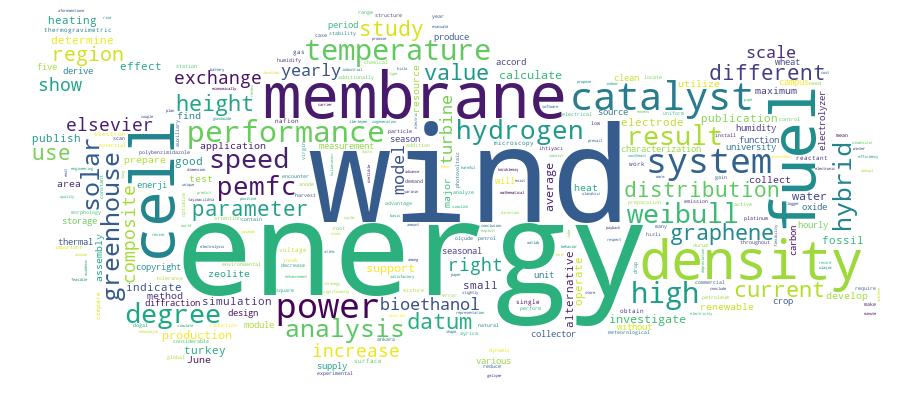
Competency Cloud

GCRIS Competency Cloud

Scholarly Output Search Results

Now showing 1 - 4 of 4
  • Article
    Citation - WoS: 14
    Citation - Scopus: 16
    Bioethanol Production and Potential of Turkey
    (Gazi Univ, Fac Engineering Architecture, 2011) Melikoglu, Mehmet; Albostan, Ayhan; Energy Systems Engineering
    The ever increasing demand in global energy consumption makes it inevitable for the development of new energy resources. Turkey imports nearly all of its petroleum and this causes major economical problems. In Turkey, a major cereal producer, production of energy crops will decrease the dependence of petroleum and greenhouse gas emissions. In this context, bioethanol production in Turkey becomes a major alternative to petroleum. According to the results find in this study, with the current agricultural output, none of the crops can be adequate for bioethanol production even 100% of crop harvests were utilized. However, with 4% and 7% of current wheat harvest bioethanol required for the production of E5 and E10 can be achieved. In addition, by utilizing the unused land available for agriculture and planting potato, sugar beet, and wheat (each 100%), 5.8, 8.7 and 13.7 billion litres of bioethanol can be produced and this production will be more than enough to supply Turkey's current demand for gasoline.
  • Article
    YARININ ENERJİSİ-HİDROJEN
    (2013) Devrim, Yılser; Albostan, Ayhan
    Günümüzde hızla ilerleyen teknolojik gelişme enerji kullanımını körüklemiş ve enerji olmaksızın yaşamak olanaksız bir hal almıştır. Özellikle ulaşım ve taşımacılıkta kullanılan benzin ve mazotun hammaddesi olan ham petrolun tükenmeye başladığı yaygın olarak kabul görmüştür. Dünyamızın her yıl artan % 4-5 oranındaki enerji ihtiyacına karşılık, bu ihtiyacı karşılayan fosil-yakıt rezervleri çok daha hızlı bir şekilde azalmaktadır. En iyimser tahminler bile, en geç 2030-2050 yılları arasında petrol rezervlerinin büyük ölçüde tükeneceğini ve ihtiyacı karşılayamayacağını göstermektedir. Kömür ve doğal gaz için de benzer bir durum söz konusudur. Ayrıca fosil yakıtların kullanımı dünya ortalama sıcaklığını son bin yılın en yüksek değerlerine ulaştırmıştır. Bu durum ise, yoğun hava kirliliğinin yanı sıra milyonlarca liralık zarara yol açan sel, fırtına gibi doğal felaketlerin gözle görülür şekilde artmasına neden olmaktadır. Ayrıca, ham petrol ve doğalgaz fiyatlarının son yıllardaki hızlı artışı ülkelerin ve tüketicilerin bu alandaki harcamalarını önemli ölçüde artırmıştır.
  • Article
    Citation - WoS: 44
    Citation - Scopus: 52
    Graphene-Supported Platinum Catalyst-Based Membrane Electrode Assembly for Pem Fuel Cell
    (Springer, 2016) Devrim, Yilser; Albostan, Ayhan
    The aim of this study is the preparation and characterization of a graphene-supported platinum (Pt) catalyst for proton exchange membrane fuel cell (PEMFC) applications. The graphene-supported Pt catalysts were prepared by chemical reduction of graphene and chloroplatinic acid (H2PtCl6) in ethylene glycol. X-ray powder diffraction, thermogravimetric analysis (TGA) and scanning electron microscopy have been used to analyze structure and surface morphology of the graphene-supported catalyst. The TGA results showed that the Pt loading of the graphene-supported catalyst was 31%. The proof of the Pt particles on the support surfaces was also verified by energy-dispersive x-ray spectroscopy analysis. The commercial carbon-supported catalyst and prepared Pt/graphene catalysts were used as both anode and cathode electrodes for PEMFC at ambient pressure and 70 degrees C. The maximum power density was obtained for the Pt/graphene-based membrane electrode assembly (MEA) with H-2/O-2 reactant gases as 0.925 W cm(2). The maximum current density of the Pt/graphene-based MEA can reach 1.267 and 0.43 A/cm(2) at 0.6 V with H-2/O-2 and H-2/air, respectively. The MEA prepared by the Pt/graphene catalyst shows good stability in long-term PEMFC durability tests. The PEMFC cell voltage was maintained at 0.6 V without apparent voltage drop when operated at 0.43 A/cm(2) constant current density and 70 degrees C for 400 h. As a result, PEMFC performance was found to be superlative for the graphene-supported Pt catalyst compared with the Pt/C commercial catalyst. The results indicate the graphene-supported Pt catalyst could be utilized as the electrocatalyst for PEMFC applications.
  • Article
    Citation - WoS: 102
    Citation - Scopus: 122
    An Investigation on Wind Energy Potential and Small Scale Wind Turbine Performance at Incek Region - Ankara, Turkey
    (Pergamon-elsevier Science Ltd, 2015) Bilir, Levent; Imir, Mehmet; Devrim, Yilser; Albostan, Ayhan
    Renewable energy resources increased their importance in the last decades due to environmental pollution problems. Additionally, the fact that fossil fuels such as oil, coal, and natural gas will be depleted in near future encourages researchers to make investigations on alternative energy resources. Wind energy, which is one of the most used alternative resources, has a great potential. In this study, Weibull parameters at Incek region of Ankara (the capital city of Turkey), where /intim University campus is located, were determined for four different seasons and for twelve months in order to accomplish wind speed characterization at the region. Wind speed data at 20 m and 30 m heights were collected from. a measurement station installed at Atilim University campus area. The data were taken as 1 min average values for a one year period between June 2012 and June 2013. Hourly average wind speed values for each height were derived using the collected wind data. Weibull parameters were calculated with five different methods using the derived hourly average wind speed values. According to root mean square error analyses, the best methods for which Weibull distribution fits the actual wind data were determined as power density and empirical methods. The power and energy density values for the region were also calculated for each season and each month. It was revealed that the maximum power density is encountered in March with about 98 (W/m(2)). Since this power density indicates that large scale wind turbine use is not a good option at the region, the performances of three different small scale wind turbines were evaluated. According to the results, two of the investigated wind turbines were found to be capable to generate all yearly energy need of an average household in Turkey. (C) 2015 Elsevier Ltd. All rights reserved.