Türkarslan, Kutlu Kağan

Loading...
Profile Picture
Name Variants
K., Turkarslan
T.,Kutlu Kagan
Türkarslan,K.K.
T., Kutlu Kagan
Turkarslan, Kutlu Kagan
T.,Kutlu Kağan
TURKARSLAN, Kutlu Kagan
Türkarslan, Kutlu Kağan
TURKARSLAN K.
K. K. Turkarslan
Kutlu Kağan, Türkarslan
K.K.Türkarslan
Kutlu Kagan, Turkarslan
K. K. Türkarslan
Turkarslan,K.K.
K.,Türkarslan
T., Kutlu Kağan
K.K.Turkarslan
Job Title
Doktor Öğretim Üyesi
Email Address
kutlu.turkarslan@atilim.edu.tr
Main Affiliation
Department of Psychology
Status
Website
Scopus Author ID
Turkish CoHE Profile ID
Google Scholar ID
WoS Researcher ID

Sustainable Development Goals

NO POVERTY1
NO POVERTY
0
Research Products
ZERO HUNGER2
ZERO HUNGER
0
Research Products
GOOD HEALTH AND WELL-BEING3
GOOD HEALTH AND WELL-BEING
0
Research Products
QUALITY EDUCATION4
QUALITY EDUCATION
0
Research Products
GENDER EQUALITY5
GENDER EQUALITY
0
Research Products
CLEAN WATER AND SANITATION6
CLEAN WATER AND SANITATION
0
Research Products
AFFORDABLE AND CLEAN ENERGY7
AFFORDABLE AND CLEAN ENERGY
0
Research Products
DECENT WORK AND ECONOMIC GROWTH8
DECENT WORK AND ECONOMIC GROWTH
0
Research Products
INDUSTRY, INNOVATION AND INFRASTRUCTURE9
INDUSTRY, INNOVATION AND INFRASTRUCTURE
0
Research Products
REDUCED INEQUALITIES10
REDUCED INEQUALITIES
0
Research Products
SUSTAINABLE CITIES AND COMMUNITIES11
SUSTAINABLE CITIES AND COMMUNITIES
0
Research Products
RESPONSIBLE CONSUMPTION AND PRODUCTION12
RESPONSIBLE CONSUMPTION AND PRODUCTION
0
Research Products
CLIMATE ACTION13
CLIMATE ACTION
1
Research Products
LIFE BELOW WATER14
LIFE BELOW WATER
0
Research Products
LIFE ON LAND15
LIFE ON LAND
0
Research Products
PEACE, JUSTICE AND STRONG INSTITUTIONS16
PEACE, JUSTICE AND STRONG INSTITUTIONS
1
Research Products
PARTNERSHIPS FOR THE GOALS17
PARTNERSHIPS FOR THE GOALS
1
Research Products
Documents

19

Citations

74

h-index

4

This researcher does not have a WoS ID.
Scholarly Output

15

Articles

10

Views / Downloads

56/9

Supervised MSc Theses

0

Supervised PhD Theses

0

WoS Citation Count

42

Scopus Citation Count

42

Patents

0

Projects

0

WoS Citations per Publication

2.80

Scopus Citations per Publication

2.80

Open Access Source

6

Supervised Theses

0

JournalCount
Cognitive Therapy and Research2
International Conference on Management Innovation and Business Innovation (ICMIBI) -- APR 21-22, 2013 -- Singapore, SINGAPORE2
Journal of Environmental Psychology1
Journal of Turkish Sleep Medicine-Türk Uyku Tıbbi Dergisi1
Klinik Psikoloji Dergisi1
Current Page: 1 / 3

Scopus Quartile Distribution

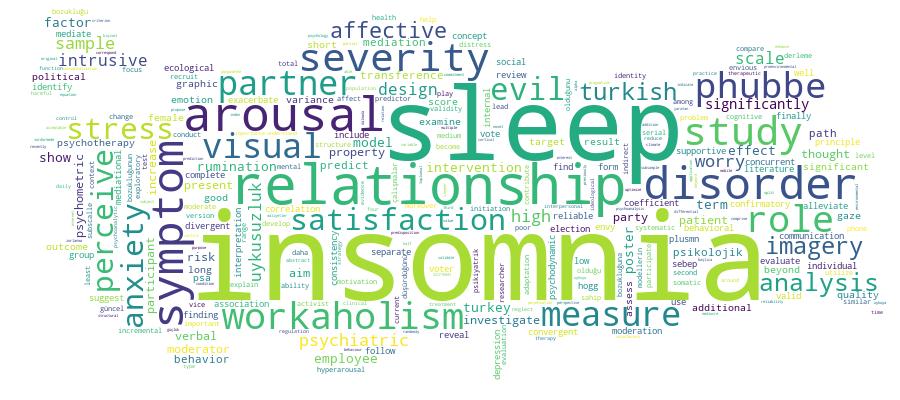
Competency Cloud

GCRIS Competency Cloud

Scholarly Output Search Results

Now showing 1 - 2 of 2
  • Article
    Citation - WoS: 5
    Citation - Scopus: 3
    The Roles of Intrusive Visual Imagery and Verbal Thoughts in Pre-Sleep Arousal of Patients With Insomnia Disorder: a Path Model
    (Springer/plenum Publishers, 2023) Turkarslan, Kutlu Kagan; Cinarbas, Deniz Canel; Perogamvros, Lampros
    Purpose Researchers have proposed that multiple factors such as hyperarousal, conditioning, worrying, or cortical arousal play roles in the predisposition to, initiation, and perpetuation of insomnia disorder. Previously, only a few studies investigated the differential effects of intrusive visual imagery (IVI) and intrusive verbal thoughts (IVT) on pre-sleep arousal or insomnia severity. The aim of the current cross-sectional study was to examine these effects as well as the moderator role of visual imagery ability (VIA) on the relationship between IVI and pre-sleep arousal.Methods A path model comprising the variables of IVI, IVT, pre-sleep arousal, and insomnia severity was tested with 166 of 1444 participants (M-age = 25.5, SD = 5.26) who were identified as having insomnia disorder based on a 12-question form corresponding to DSM-5 criteria for insomnia disorder and Insomnia Severity Index scores (>= 8). The moderator role of VIA on the relationship between IVI and pre-sleep arousal was evaluated with a moderation analysis.Results It was found that IVI (beta = 0.44, p < .001), but not IVT (beta = 0.15, p = .12), significantly predicted pre-sleep arousal and pre-sleep arousal (beta = 0.44, p < .001) significantly predicted insomnia severity. In addition, the indirect effect of IVI via pre-sleep arousal (IE = 0.19, p < .001) on insomnia severity was significant. Finally, the moderator role of VIA on the relationship between IVI and pre-sleep arousal (p = .07) was not significant.Conclusions IVI may play a more important role in insomnia disorder than IVT. Interventions targeting pre-sleep visual imagery can help poor sleepers alleviate insomnia severity.
  • Article
    Citation - WoS: 5
    Citation - Scopus: 5
    The psychometric properties of the Turkish version of the Pre-sleep Arousal Scale
    (Springer Japan Kk, 2024) Turkarslan, Kutlu Kagan; Canel cinarbas, Deniz; Nicassio, Perry M.
    PurposeThe aim of the present study was to examine the psychometric properties of the Turkish version of the Pre-sleep Arousal Scale (PSAS), which measures pre-sleep arousal, a significant predictor of insomnia symptoms.Methods651 participants were recruited via social media and the Internet. Confirmatory factor analysis was conducted in the total sample (65.28% females; M-age1 = 28.09 & PLUSMN; 14.00). Convergent, divergent, incremental, and known-groups validity and internal consistency coefficients were assessed in a subsample of 556 participants (62.77% females; M-age2 = 29.25 & PLUSMN; 14.81). A second separate sample of 88 participants (80.68% females; M-age3 = 22.19 & PLUSMN; 4.98) was used to evaluate three-week test-retest reliability.ResultsThe results of factor analysis confirmed the two-factor structure of the Turkish PSAS with cognitive (PSAS-C) and somatic (PSAS-S), similar to the original scale. The correlations of the PSAS with convergent and divergent measures showed that the Turkish form had good convergent and acceptable divergent validity. PSAS-C and PSAS-S were able to explain an 18% additional variance in insomnia severity beyond depression and anxiety, an 18% additional variance in depression beyond insomnia severity, and a 35% additional variance in anxiety beyond insomnia severity. Moreover, insomnia patients had significantly higher PSAS-C and PSAS-S scores than good sleepers. Finally, the PSAS, PSAS-C, and PSAS-S had satisfactory internal consistency coefficients (& alpha; = 0.92, 0.91, and 0.86, respectively) and three-week test-retest correlations (ICC = 0.82, 0.82, and 0.71, respectively).ConclusionThe Turkish form of the PSAS was a valid and reliable measure of pre-sleep arousal and can be utilized in sleep studies.