Kalem, Güler

Loading...
Profile Picture
Name Variants
G., Kalem
Kalem, Guler
K.,Güler
Kalem,G.
Güler, Kalem
Guler, Kalem
Kalem G.
Kalem, Güler
G.,Kalem
K., Güler
K., Guler
K.,Guler
Job Title
Doktor Öğretim Üyesi
Email Address
guler.kalem@atilim.edu.tr
Main Affiliation
Software Engineering
Status
Website
ORCID ID
Scopus Author ID
Turkish CoHE Profile ID
Google Scholar ID
WoS Researcher ID

Sustainable Development Goals

NO POVERTY1
NO POVERTY
0
Research Products
ZERO HUNGER2
ZERO HUNGER
0
Research Products
GOOD HEALTH AND WELL-BEING3
GOOD HEALTH AND WELL-BEING
0
Research Products
QUALITY EDUCATION4
QUALITY EDUCATION
1
Research Products
GENDER EQUALITY5
GENDER EQUALITY
0
Research Products
CLEAN WATER AND SANITATION6
CLEAN WATER AND SANITATION
0
Research Products
AFFORDABLE AND CLEAN ENERGY7
AFFORDABLE AND CLEAN ENERGY
0
Research Products
DECENT WORK AND ECONOMIC GROWTH8
DECENT WORK AND ECONOMIC GROWTH
0
Research Products
INDUSTRY, INNOVATION AND INFRASTRUCTURE9
INDUSTRY, INNOVATION AND INFRASTRUCTURE
0
Research Products
REDUCED INEQUALITIES10
REDUCED INEQUALITIES
0
Research Products
SUSTAINABLE CITIES AND COMMUNITIES11
SUSTAINABLE CITIES AND COMMUNITIES
2
Research Products
RESPONSIBLE CONSUMPTION AND PRODUCTION12
RESPONSIBLE CONSUMPTION AND PRODUCTION
0
Research Products
CLIMATE ACTION13
CLIMATE ACTION
0
Research Products
LIFE BELOW WATER14
LIFE BELOW WATER
0
Research Products
LIFE ON LAND15
LIFE ON LAND
0
Research Products
PEACE, JUSTICE AND STRONG INSTITUTIONS16
PEACE, JUSTICE AND STRONG INSTITUTIONS
0
Research Products
PARTNERSHIPS FOR THE GOALS17
PARTNERSHIPS FOR THE GOALS
1
Research Products
Documents

5

Citations

28

h-index

2

Documents

4

Citations

29

Scholarly Output

10

Articles

5

Views / Downloads

53/124

Supervised MSc Theses

1

Supervised PhD Theses

1

WoS Citation Count

30

Scopus Citation Count

28

Patents

0

Projects

0

WoS Citations per Publication

3.00

Scopus Citations per Publication

2.80

Open Access Source

4

Supervised Theses

2

JournalCount
International Journal of Engineering Education2
Afet ve Risk Dergisi1
IEEE Access1
21st Signal Processing and Communications Applications Conference (SIU) -- APR 24-26, 2013 -- CYPRUS1
Journal of Disaster and Risk1
Current Page: 1 / 2

Scopus Quartile Distribution

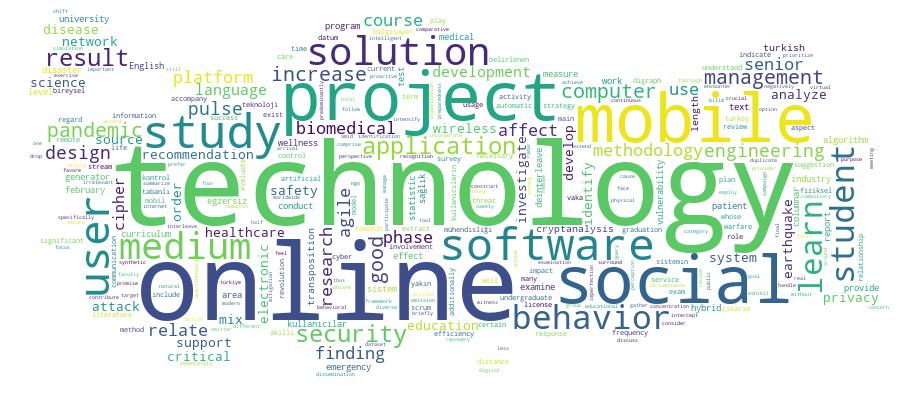
Competency Cloud

GCRIS Competency Cloud

Scholarly Output Search Results

Now showing 1 - 3 of 3
  • Conference Object
    The Efficiency of Software Methodologies Used in Artificial Intelligence-Based Biomedical Projects
    (Springer Science and Business Media Deutschland GmbH, 2024) Kalem,G.; Vesek,M.C.; Yalim,H.K.
    Safety critical software usage areas are increasing day by day, and biomedical software applications are one of them which is a promising and ever-evolving branch. This study is designed to investigate the efficiency of software methodologies used in artificial intelligence-based biomedical projects. To identify issues and controversies regarding the agile development of safety critical software and key features, this research compares and identifies which methodology, waterfall or agile, is more effective for safety critical systems. A literature has been reviewed with a research design of find, evaluate, extract, and comprehend the findings of the studies. Research findings show that there are central points of interest and recommendations which is extracted from literature and then combined into conceptual model in order to understand the key difficulties of agile software development in safety critical systems. The software development methodologies such as Scrum and Extreme Programming, that are agile strategies adopt an iterative and incremental approach, are deemed appropriate in the development of biomedical software projects. © 2024, The Author(s), under exclusive license to Springer Nature Singapore Pte Ltd.
  • Conference Object
    Citation - WoS: 1
    Design of a Scenario-Based Synthetic Mixed Pulse Generator
    (Ieee, 2013) Gencol, Kenan; Kara, Ali; At, Nuray
    Electronic Support Measures (ESM) plays an important role in modern Electronic Warfare (EW) systems. The main purpose of an ESM system is to intercept as many emissions as it can, and then to deinterleave mixed streams of pulses that are interleaved in natural time of arrival order, and thus to identify surrounding emissions. In real life, such systems may encounter with a continuous stream of pulses accompanied by many imperfections, and it should work on real-time basis. In order to handle such circumstances and to develop better deinterleaving algorithms, a simulation tool is needed. In this study, design of a scenario-based mixed pulse generator (simulator) is presented.
  • Conference Object
    Citation - WoS: 15
    Mobile Technology Applications in the Healthcare Industry for Disease Management and Wellness
    (Elsevier Science Bv, 2015) Kalem, Guler; Turhan, Cigdem
    Technology is an unavoidable fact of today's life. Attractive advantages of wireless technology accelerated the rapid development of mobile applications. With the increase of the usage of mobile devices in the recent years, new solutions come to mind including mobile technologies to fulfill requirements or suggest better solutions in the vast area of medical informatics to the existing ones. Augmentation in the area of wireless technology positively affects the medical applications. In the healthcare industry, mobile applications provide better personalized health care, disease management and services to patients and their relatives, as well as a better and flexible way of communicating with physicians, patients and medical suppliers. It is obvious that the applications using mobile technologies has the potential to bring better conditions both for the patients for their disease management and for the humanity for checking their self wellness. In this paper, the current mobile technology utilized in healthcare such as relapse prevention in schizophrenia, aged people's care and wellness, diagnosis and management of attention-deficit etc. is reviewed in detail outlining the current mobile technologies and wireless revolution of today and examining some of the outstanding applications using these technologies in the clinical area. The results of this study can provide clues to researchers to further the mobile technology in healthcare. (C) 2015 The Authors. Published by Elsevier Ltd. This is an open access article under the CC BY-NC-ND license (http://creativecommons.org/licenses/by-nc-nd/4.0/).