Kalem, Güler

Loading...
Profile Picture
Name Variants
G., Kalem
Kalem, Guler
K.,Güler
Kalem,G.
Güler, Kalem
Guler, Kalem
Kalem G.
Kalem, Güler
G.,Kalem
K., Güler
K., Guler
K.,Guler
Job Title
Doktor Öğretim Üyesi
Email Address
guler.kalem@atilim.edu.tr
Main Affiliation
Software Engineering
Status
Website
ORCID ID
Scopus Author ID
Turkish CoHE Profile ID
Google Scholar ID
WoS Researcher ID

Sustainable Development Goals

5

GENDER EQUALITY
GENDER EQUALITY Logo

0

Research Products

14

LIFE BELOW WATER
LIFE BELOW WATER Logo

0

Research Products

10

REDUCED INEQUALITIES
REDUCED INEQUALITIES Logo

0

Research Products

3

GOOD HEALTH AND WELL-BEING
GOOD HEALTH AND WELL-BEING Logo

0

Research Products

2

ZERO HUNGER
ZERO HUNGER Logo

0

Research Products

9

INDUSTRY, INNOVATION AND INFRASTRUCTURE
INDUSTRY, INNOVATION AND INFRASTRUCTURE Logo

0

Research Products

16

PEACE, JUSTICE AND STRONG INSTITUTIONS
PEACE, JUSTICE AND STRONG INSTITUTIONS Logo

0

Research Products

11

SUSTAINABLE CITIES AND COMMUNITIES
SUSTAINABLE CITIES AND COMMUNITIES Logo

2

Research Products

8

DECENT WORK AND ECONOMIC GROWTH
DECENT WORK AND ECONOMIC GROWTH Logo

0

Research Products

13

CLIMATE ACTION
CLIMATE ACTION Logo

0

Research Products

4

QUALITY EDUCATION
QUALITY EDUCATION Logo

1

Research Products

6

CLEAN WATER AND SANITATION
CLEAN WATER AND SANITATION Logo

0

Research Products

1

NO POVERTY
NO POVERTY Logo

0

Research Products

15

LIFE ON LAND
LIFE ON LAND Logo

0

Research Products

17

PARTNERSHIPS FOR THE GOALS
PARTNERSHIPS FOR THE GOALS Logo

1

Research Products

7

AFFORDABLE AND CLEAN ENERGY
AFFORDABLE AND CLEAN ENERGY Logo

0

Research Products

12

RESPONSIBLE CONSUMPTION AND PRODUCTION
RESPONSIBLE CONSUMPTION AND PRODUCTION Logo

0

Research Products
Documents

5

Citations

28

h-index

2

Documents

4

Citations

29

Scholarly Output

10

Articles

5

Views / Downloads

5/0

Supervised MSc Theses

1

Supervised PhD Theses

1

WoS Citation Count

30

Scopus Citation Count

28

WoS h-index

3

Scopus h-index

2

Patents

0

Projects

0

WoS Citations per Publication

3.00

Scopus Citations per Publication

2.80

Open Access Source

4

Supervised Theses

2

Google Analytics Visitor Traffic

JournalCount
21st Signal Processing and Communications Applications Conference (SIU) -- APR 24-26, 2013 -- CYPRUS1
Afet ve Risk Dergisi1
IEEE Access1
International Journal of Engineering Education1
Journal of Disaster and Risk1
Current Page: 1 / 2

Scopus Quartile Distribution

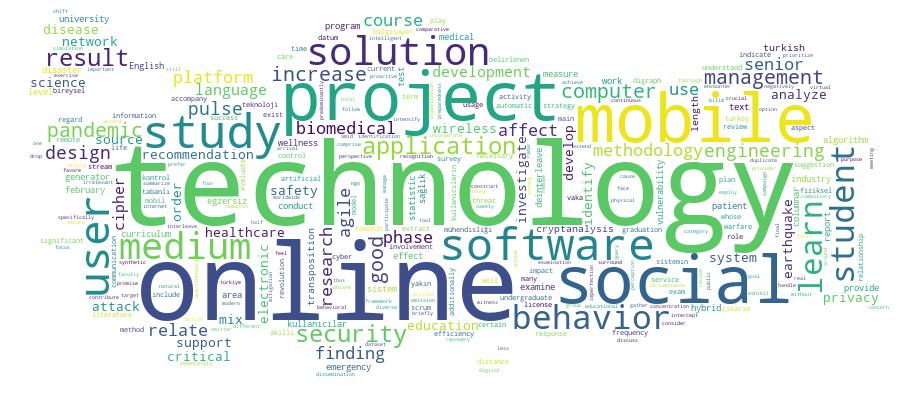
Competency Cloud

GCRIS Competency Cloud

Scholarly Output Search Results

Now showing 1 - 4 of 4
  • Article
    Post-Pandemic Hybrid Curriculum Recommendations for an Undergraduate Ict Senior Project Course
    (Tempus Publications, 2023) Tirkes, Guzin; Kalem, Guler; Kilic, Hurevren; Cagiltay, Nergiz Ercil
    Among the numerous aspects of everyday life affected by the COVID-19 pandemic, education stands out as one of those deeply impacted. In this context within university settings, the ICT senior project courses were no exception either. This study presents the recommendations for a hybrid curriculum based on the online implementation of a senior project course in the ICT departments of an engineering faculty. The data were collected to better understand the impact of this re-structured course on 99 undergraduate IT students and their projects during three semesters, and later analyzed qualitatively and quantitatively to obtain some insights. The results indicate that, during the pandemic, the students adapted their senior project studies to the related restrictions by changing certain aspects related to the project, improving their teamwork, and increasing the level of communication. However, they also reported certain problems related to their overall psychology as well as social interactions. In light of the pandemic effect on the software industry towards remote working environments, further suggestions are provided to eliminate the drawbacks of remote working reported by the students and to equip them with the necessary skills. The resulting recommendations could be used by other higher -education institutions and be further adjusted for application in other disciplines.
  • Conference Object
    Citation - WoS: 15
    Mobile Technology Applications in the Healthcare Industry for Disease Management and Wellness
    (Elsevier Science Bv, 2015) Kalem, Guler; Turhan, Cigdem
    Technology is an unavoidable fact of today's life. Attractive advantages of wireless technology accelerated the rapid development of mobile applications. With the increase of the usage of mobile devices in the recent years, new solutions come to mind including mobile technologies to fulfill requirements or suggest better solutions in the vast area of medical informatics to the existing ones. Augmentation in the area of wireless technology positively affects the medical applications. In the healthcare industry, mobile applications provide better personalized health care, disease management and services to patients and their relatives, as well as a better and flexible way of communicating with physicians, patients and medical suppliers. It is obvious that the applications using mobile technologies has the potential to bring better conditions both for the patients for their disease management and for the humanity for checking their self wellness. In this paper, the current mobile technology utilized in healthcare such as relapse prevention in schizophrenia, aged people's care and wellness, diagnosis and management of attention-deficit etc. is reviewed in detail outlining the current mobile technologies and wireless revolution of today and examining some of the outstanding applications using these technologies in the clinical area. The results of this study can provide clues to researchers to further the mobile technology in healthcare. (C) 2015 The Authors. Published by Elsevier Ltd. This is an open access article under the CC BY-NC-ND license (http://creativecommons.org/licenses/by-nc-nd/4.0/).
  • Article
    Citation - WoS: 11
    Citation - Scopus: 24
    The Effect of Social Media User Behaviors on Security and Privacy Threats
    (Ieee-inst Electrical Electronics Engineers inc, 2022) Cengiz, Aslihan Banu; Kalem, Guler; Boluk, Pinar Sarisaray
    The number of online social network (OSN) users is increasing daily and attacks and threats against over the time spent on online networks has been increasing equally. Attacks against OSN users exploit not only system vulnerabilities but also user-induced vulnerabilities, which naturally affect the hacker's attack strategy as well. This study is designed to investigate the effect of social media user behaviors on their vulnerability level in terms of security and privacy. The study was conducted survey methods, which was applied to social media users in two countries - Turkey and Iraq. This study documents and analyzes the behaviors of 700 OSN users in two countries. This study examines the behaviors of social media users from two nationalities, investigating whether there is a relationship between social media users' behaviors and security and privacy threats. Research findings demonstrate that there is a significant relationship between OSN users' behaviors and their attitudes towards security and privacy. Additionally, Turkish social media users pay more attention to their behaviors in terms of privacy and security awareness than Iraq users.
  • Article
    Citation - WoS: 3
    Citation - Scopus: 3
    Online Learning Perceptions Amid Covid-19 Pandemic: the Engineering Undergraduates' Perspective
    (Tempus Publications, 2022) Eryilmaz, Meltem; Kalem, Guler; Kilic, Hurevren; Tirkes, Guzin; Topalli, Damla; Turhan, Cigdem; Yazici, Ali; Information Systems Engineering; Computer Engineering; Software Engineering
    The COVID-19 pandemic caused face-to-face education in just about all universities worldwide to shift to online education. For most students, this educational model was a compulsory first experience. In this study, the survey results are analyzed and discussed related to a group of students in the Engineering Faculty of a university in Turkey regarding their online education perceptions. Briefly summarized, the findings of the study indicate that: (a) most of the students still prefer face-to-face learning, which is also favored if accompanied by distance learning; (b) the concentration level of the students has dropped due to the concerns about the COVID-19 pandemic which affects their learning negatively; and (c) around half of the students participating in the study feel that the online exams conducted without a secure exam software, is considered unsafe. Additionally, the study's results were further extended to evaluate the questionnaire results and reported along with the suggestions of necessary actions in emergency online learning (EOL).