
Özbey, Mehmet Furkan
Loading...
Profile URL
Name Variants
M. F. Ozbey
Özbey, Mehmet Furkan
Ö.,Mehmet Furkan
Mehmet Furkan, Ozbey
O., Mehmet Furkan
Ö., Mehmet Furkan
O.,Mehmet Furkan
M.F.Özbey
M.,Özbey
M., Ozbey
Mehmet Furkan, Özbey
Mehmet Furkan Özbey
Özbey,M.F.
Ozbey, Mehmet Furkan
Ozbey,M.F.
M. F. Özbey
Ozbey,Mehmet Furkan
M.F.Ozbey
Özbey, Mehmet Furkan
Ö.,Mehmet Furkan
Mehmet Furkan, Ozbey
O., Mehmet Furkan
Ö., Mehmet Furkan
O.,Mehmet Furkan
M.F.Özbey
M.,Özbey
M., Ozbey
Mehmet Furkan, Özbey
Mehmet Furkan Özbey
Özbey,M.F.
Ozbey, Mehmet Furkan
Ozbey,M.F.
M. F. Özbey
Ozbey,Mehmet Furkan
M.F.Ozbey
Job Title
Araştırma Görevlisi
Email Address
furkan.ozbey@atilim.edu.tr
Main Affiliation
Mechanical Engineering
Status
ORCID ID
Scopus Author ID
Turkish CoHE Profile ID
Google Scholar ID
WoS Researcher ID
Sustainable Development Goals
 1
1NO POVERTY
0
Research Products
 2
2ZERO HUNGER
0
Research Products
 3
3GOOD HEALTH AND WELL-BEING
0
Research Products
 4
4QUALITY EDUCATION
3
Research Products
 5
5GENDER EQUALITY
1
Research Products
 6
6CLEAN WATER AND SANITATION
0
Research Products
 7
7AFFORDABLE AND CLEAN ENERGY
1
Research Products
 8
8DECENT WORK AND ECONOMIC GROWTH
0
Research Products
 9
9INDUSTRY, INNOVATION AND INFRASTRUCTURE
0
Research Products
 10
10REDUCED INEQUALITIES
1
Research Products
 11
11SUSTAINABLE CITIES AND COMMUNITIES
7
Research Products
 12
12RESPONSIBLE CONSUMPTION AND PRODUCTION
1
Research Products
 13
13CLIMATE ACTION
0
Research Products
 14
14LIFE BELOW WATER
0
Research Products
 15
15LIFE ON LAND
0
Research Products
 16
16PEACE, JUSTICE AND STRONG INSTITUTIONS
0
Research Products
 17
17PARTNERSHIPS FOR THE GOALS
0
Research Products

Documents
16
Citations
173
h-index
8

Documents
13
Citations
167

Scholarly Output
18
Articles
15
Views / Downloads
99/478
Supervised MSc Theses
1
Supervised PhD Theses
0
WoS Citation Count
164
Scopus Citation Count
184
Patents
0
Projects
0
WoS Citations per Publication
9.11
Scopus Citations per Publication
10.22
Open Access Source
6
Supervised Theses
1
| Journal | Count |
|---|---|
| Buildings | 2 |
| Energy and Buildings | 2 |
| E3S Web of Conferences -- 11th International Conference on Indoor Air Quality, Ventilation and Energy Conservation in Buildings, IAQVE C2023 -- 20 May 2023 through 23 May 2023 -- Tokyo -- 189404 | 1 |
| Indoor Air | 1 |
| Indoor and Built Environment | 1 |
Current Page: 1 / 3
Scopus Quartile Distribution
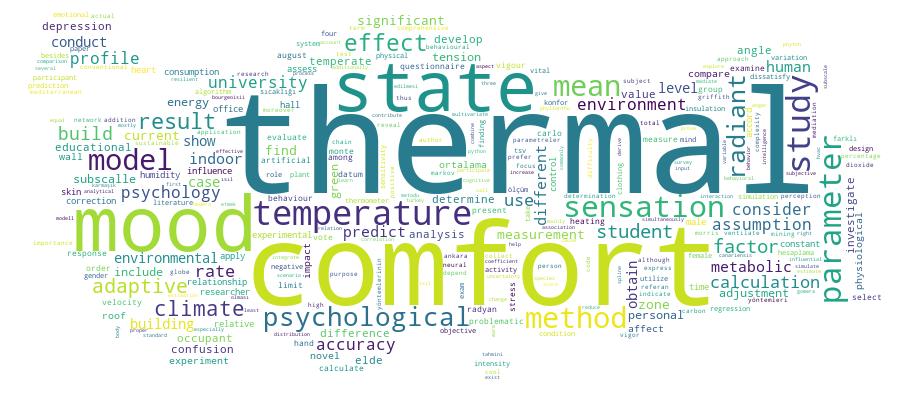
Competency Cloud
5 results
Scholarly Output Search Results
Now showing 1 - 5 of 5
Master Thesis İç Ortamda Ortalama Radyan Sıcaklığını Elde Etmek için Farklı Yöntemlerin Doğruluğunun Karşılaştırılması(2021) Özbey, Mehmet Furkan; Turhan, Cihan; Lotfısadıgh, BahramAmerikan Isıtma Soğutma ve Klima Mühendisleri Birliği (ASHRAE), ısıl konforu bir kişinin bulunduğu ortamdaki memnuniyetini ifade eden öznel ve zihinsel değerlendirme ile elde edilen zihin koşulları olarak tanımlanmıştır. Isıl konfor, geleneksel olarak Fanger'in Ortalama Tahmini Oy (PMV) / Memnuniyetsizliklerin Tahmini Yüzdesi (PPD) metodu ve kişilerin davranışlarını da içeren adaptif ısıl konfor metotları ile elde edilmektedir. Isıl konfor parametreleri kişisel parametreler (giysi değeri ve metabolizma hızı) ve çevresel parametreler (hava sıcaklığı, bağıl nem, hava hızı ve ortalama radyan sıcaklığı) olarak üzere iki farklı kategoride ele almaktadır. Bu parametreler arasında, Ortalama Radyan Sıcaklık ölçülmesinin ve hesaplanmasının karmaşık olmasından dolayı elde edilmesi zor bir faktördür. İç ortamlarda ortalama radyan sıcaklığı elde etme yaklaşımları hesaplama yöntemleri, ölçüm yöntemleri ve varsayımlar gibi farklı yöntemlere dayanmaktadır. Ancak hesaplama yöntemlerinin karmaşık olması ve ölçüm yöntemleri için kullanılacak ölçüm aletlerinin pahalı ve elde edilmesi zor araçlar olması araştırmacıları doğruluğu kesin olmayan varsayımlara yönlendirmektedir. Bu nedenle, bu çalışmanın amacı ortalama radyan sıcaklığın elde edilme yöntemlerinin ölçüm yöntemlerinden birisi olan ve bu çalışma için üretilen küre termometresini referans alıp diğer metotlar ile karşılaştırılarak tüm yöntemlerin doğruluğunu bulmaktır. Bu çalışmada Köppen- Geiger sınıflandırmasına göre Csb tipi iklim bölgesinde bulunan bir test odası seçilmiştir ve ortalama radyatif sıcaklığı elde etmek için kullanılan 2 farklı hesaplama yöntemi ve 8 farklı varsayım yerinde ölçümle referans metodu ile karşılaştırılmıştır. Sonuçlar, ortalama radyan sıcaklığı elde etmek için varsayımların veya hesaplama yöntemlerinin kullanılmasının, referans yönteme kıyasla %9,1'e varan bir hataya neden olduğunu ortaya koydu.Article Citation - WoS: 2Citation - Scopus: 4Latent Psychological Pathways in Thermal Comfort Perception: The Mediating Role of Cognitive Uncertainty on Depression and Vigour(MDPI, 2025) Ozbey, Mehmet Furkan; Turhan, Cihan; Alkan, Nese; Akkurt, Gulden GokcenThermal comfort is the condition of mind that expresses satisfaction with the thermal environment, and it is assessed through subjective evaluation, according to the American Society of Heating, Refrigerating, and Air-Conditioning Engineers. While research has traditionally emphasised physical factors, growing evidence highlights the role of the state of mind in shaping thermal perception. In a prior Monte Carlo sensitivity analysis, six mood subscales-Anger, Confusion, Vigour, Tension, Depression, and Fatigue-were examined for how they affect the absolute difference between actual and predicted thermal sensation. Depression and vigour were found to be the most influential, while confusion appeared least impactful. However, to accurately assess the role of confusion, it is necessary to consider its potential interactions with other mood subscales. To this end, a mediation analysis was conducted using Hayes' PROCESS tool. The mediation analyses revealed that confusion partially mediated depression's effect in males and vigour's effect in females. These results suggest that, despite a weak direct impact, confusion critically influences thermal perception by altering the effects of key mood states. Accounting for the indirect effects of mood states may lead to more accurate predictions of human sensory experiences and improve the design of occupant-centred environments.Article Citation - WoS: 32Citation - Scopus: 33A Novel Data-Driven Model for the Effect of Mood State on Thermal Sensation(Mdpi, 2023) Turhan, Cihan; Ozbey, Mehmet Furkan; Ceter, Aydin Ege; Akkurt, Gulden GokcenThermal comfort has an important role in human life, considering that people spend most of their lives in indoor environments. However, the necessity of ensuring the thermal comfort of these people presents an important problem, calculating the thermal comfort accurately. The assessment of thermal comfort has always been problematic, from past to present, and the studies conducted in this field have indicated that there is a gap between thermal comfort and thermal sensation. Although recent studies have shown an effort to take human psychology into account more extensively, these studies just focused on the physiological responses of the human body under psychological disturbances. On the other hand, the mood state of people is one of the most significant parameters of human psychology. Thus, this paper investigated the effect of occupants' mood states on thermal sensation; furthermore, it introduced a novel "Mood State Correction Factor" (MSCF) to the existing thermal comfort model. To this aim, experiments were conducted at a mixed-mode building in a university between 15 August 2021 and 15 August 2022. Actual Mean Vote (AMV) and Profile of Mood States (POMS) were used to examine the effect of mood state on thermal sensation. The outcomes of this study showed that in the mood states of very pessimistic and very optimistic, the occupants felt warmer than the calculated one and the MSCFs are calculated as -0.125 and -0.114 for the very pessimistic and very optimistic mood states, respectively. It is worth our time to note that the experiments in this study were conducted during the COVID-19 Global Pandemic and the results of this study could differ in different cultural backgrounds.Article Citation - WoS: 19Citation - Scopus: 21Gender Inequity in Thermal Sensation Based on Emotional Intensity for Participants in a Warm Mediterranean Climate Zone(Elsevier France-editions Scientifiques Medicales Elsevier, 2023) Ceter, Aydin Ege; Ozbey, Mehmet Furkan; Turhan, CihanThe deficiencies of the one of the most preferred conventional thermal comfort models, the Predicted Mean Vote/ Percentage of Predicted Dissatisfied (PMV/PPD) method have emerged over time since the model does not take psychological parameters such as personal traits, mood states and adaptation into account. Therefore, re-searchers have focused on Adaptive Thermal Comfort models that integrate human behaviours into the model for better prediction of thermal comfort. In addition to the influence of the behaviours of occupants, thermal comfort may be evaluated as a subjective term, thus, the effect of one of the psychological parameters, current mood state, on thermal sensation cannot be ignored for predictions. Although, the effect of current mood state on thermal sensation is a vital concept, the findings of the studies are not effective and comprehensive in the literature. For this reason, the aim of this study is to examine the relationship between current mood state and thermal sensation in gender difference aspect. Therefore, a series of experiments were conducted in a university study hall between August 16th, 2021 and August 1st, 2022. The current mood states of the participants were evaluated with the Profile of Mood States (POMS) questionnaire and the results were represented by a novel approach called Emotional Intensity Score (EIS). One tailed t-test was applied for investigating the relationship between the EIS and the thermal sensation. Findings of the research showed that a significant association exists between the EIS and thermal sensation for male participants while no relationship was found for female.Article Citation - WoS: 8Citation - Scopus: 9Modeling the Mood State on Thermal Sensation With a Data Mining Algorithm and Testing the Accuracy of Mood State Correction Factor(Pergamon-elsevier Science Ltd, 2025) Yerlikaya-Ozkurt, Fatma; Ozbey, Mehmet Furkan; Turhan, CihanPsychology is proven as an influencing factor on thermal sensation. On the other hand, mood state is one of the significant parameters in psychology field. To this aim, in the literature, mood state correction factor on thermal sensation (Turhan and Ozbey coefficients) is derived utilizing with data-driven black-box model. However, novel models which present analytical form of the mood state correction factor should be derived based on the several descriptive variables on thermal sensation. Moreover, the result of this factor should also be checked with analytical model results. Therefore, this study investigates the modelling of mood state correction factor with a data mining algorithm, called Multivariate Adaptive Regression Splines (MARS). Additionally, the mood state is also taken as a thermal sensation parameter besides environmental parameters in this algorithm. The same data, which are collected from a university study hall in a temperate climate zone, are used and the model results are compared with the thermal sensation results based on mood state correction factor which is driven via black-box model. The results show that coefficient of correlation "r" between the MARS and black-box model is found as 0.9426 and 0.9420 for training and testing. Hence, the mood state is also modelled via a data mining algorithm with a high accuracy, besides the black-box model.