
Çamalan, Özge
Loading...
Profile URL
Name Variants
Ç., Özge
Camalan, Ozge
C., Ozge
Ö.,Çamalan
Özge, Çamalan
C.,Ozge
Ozge, Camalan
Camalan,O.
Çamalan, Özge
O.,Camalan
Ç.,Özge
Çamalan,Ö.
O., Camalan
Ö., Çamalan
Camalan, Ozge
C., Ozge
Ö.,Çamalan
Özge, Çamalan
C.,Ozge
Ozge, Camalan
Camalan,O.
Çamalan, Özge
O.,Camalan
Ç.,Özge
Çamalan,Ö.
O., Camalan
Ö., Çamalan
Job Title
Araştırma Görevlisi
Email Address
ozge.camalan@atilim.edu.tr
Main Affiliation
Economics
Status
Website
ORCID ID
Scopus Author ID
Turkish CoHE Profile ID
Google Scholar ID
WoS Researcher ID
Sustainable Development Goals
 1
1NO POVERTY
1
Research Products
 2
2ZERO HUNGER
0
Research Products
 3
3GOOD HEALTH AND WELL-BEING
0
Research Products
 4
4QUALITY EDUCATION
0
Research Products
 5
5GENDER EQUALITY
0
Research Products
 6
6CLEAN WATER AND SANITATION
0
Research Products
 7
7AFFORDABLE AND CLEAN ENERGY
0
Research Products
 8
8DECENT WORK AND ECONOMIC GROWTH
1
Research Products
 9
9INDUSTRY, INNOVATION AND INFRASTRUCTURE
0
Research Products
 10
10REDUCED INEQUALITIES
1
Research Products
 11
11SUSTAINABLE CITIES AND COMMUNITIES
1
Research Products
 12
12RESPONSIBLE CONSUMPTION AND PRODUCTION
1
Research Products
 13
13CLIMATE ACTION
0
Research Products
 14
14LIFE BELOW WATER
0
Research Products
 15
15LIFE ON LAND
0
Research Products
 16
16PEACE, JUSTICE AND STRONG INSTITUTIONS
0
Research Products
 17
17PARTNERSHIPS FOR THE GOALS
0
Research Products

This researcher does not have a Scopus ID.

This researcher does not have a WoS ID.

Scholarly Output
6
Articles
5
Views / Downloads
21/0
Supervised MSc Theses
1
Supervised PhD Theses
0
WoS Citation Count
6
Scopus Citation Count
8
Patents
0
Projects
0
WoS Citations per Publication
1.00
Scopus Citations per Publication
1.33
Open Access Source
5
Supervised Theses
1
| Journal | Count |
|---|---|
| Ankara Hacı Bayram Veli Üniversitesi İktisadi ve İdari Bilimler Fakültesi Dergisi (Online) | 1 |
| Computational Economics | 1 |
| İşletme Araştırmaları Dergisi | 1 |
| Sustainability | 1 |
| World Journal of Applied Economics | 1 |
Current Page: 1 / 1
Scopus Quartile Distribution
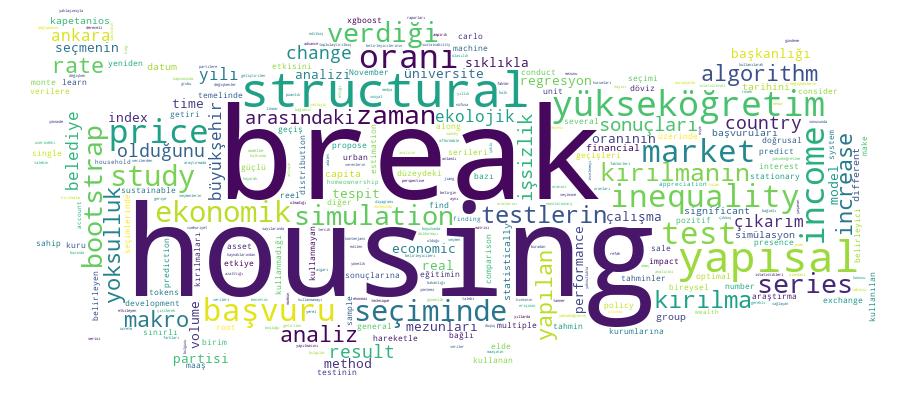
Competency Cloud
5 results
Scholarly Output Search Results
Now showing 1 - 5 of 5
Article Citation - WoS: 3Citation - Scopus: 3Comparison of the Performance of Structural Break Tests in Stationary and Nonstationary Series: a New Bootstrap Algorithm(Springer, 2024) Camalan, Ozge; Hasdemir, Esra; Omay, Tolga; Kucuker, Mustafa CanStructural breaks are considered as permanent changes in the series mainly because of shocks, policy changes, and global crises. Hence, making estimations by ignoring the presence of structural breaks may cause the biased parameter value. In this context, it is vital to identify the presence of the structural breaks and the break dates in the series to prevent misleading results. Accordingly, the first aim of this study is to compare the performance of unit root with structural break tests allowing a single break and multiple structural breaks. For this purpose, firstly, a Monte Carlo simulation study has been conducted through using a generated homoscedastic and stationary series in different sample sizes to evaluate the performances of these tests. As a result of the simulation study, Zivot and Andrews (J Bus Econ Stat 20(1):25-44, 1992) are the best-performing tests in capturing a single break. The most powerful tests for the multiple break setting are those developed by Kapetanios (J Time Ser Anal 26(1):123-133, 2005) and Perron (Palgrave Handb Econom 1:278-352, 2006). A new Bootstrap algorithm has been proposed along with the study's primary aim. This newly proposed Bootstrap algorithm calculates the optimal number of statistically significant structural breaks under more general assumptions. Therefore, it guarantees finding an accurate number of optimal breaks in real-world data. In the empirical part, structural breaks in the real interest rate data of the US and Australia resulting from policy changes have been examined. The results concluded that the bootstrap sequential break test is the best-performing approach due to the general assumption made to cover real-world data.Article Using Advanced Machine Learning Techniques To Predict the Sales Volume of Non-Fungible Tokens(2024) Çamalan, Özge; Gökmen, Şahika; Atan, SibelNon-fungible tokens (NFTs) are a type of digital asset based on blockchain that contain unique codes verifying the authenticity and ownership of different assets such as art pieces, music, gaming items, collections, and so on. This phenomenon and its markets have grown significantly since the beginning of 2021. This study, using daily data between November 2017 and November 2022, predicts the volume of NFT sales by utilising Random Forest (RF), GBM, XGBoost, and LightGBM methods from the community machine learning methods. In the predictions, several financial variables, including Gold, Bitcoin/USD, Ethereum/USD, S&P 500 index, Nasdaq 100, Oil/USD, Euro/USD, and CDS data, are treated as independent variables. According to the results, XGBoost is found to be the best prediction method for NFT market volume estimation concerning several statistical criteria, e.g., MAE, MAPE, and RMSE, and the most significant influential feature in determining prices is the Ethereum/USD exchange rate.Article Türkiye’de Yükseköğrenim Başvuru Oranının Belirleyicileri(2025) Üner, Mehmet Mithat; Çamalan, Özge; Karatepe, TunaAmaç - Bu araştırma, Türkiye'de 2006-2024 döneminde yükseköğretim kurumlarına başvuru oranlarını etkileyen makro ekonomik faktörleri incelemeyi amaçlamaktadır. Son yıllarda Yükseköğretim Kurumları Sınavı'na (YKS) başvuru sayılarında yaşanan belirgin düşüş, yükseköğretime olan talebin belirleyicilerinin analizini gerekli kılmaktadır. Çalışma, medya tarafından sıklıkla gündeme getirilen yoksulluk, üniversite mezunları arasındaki işsizlik ve maaş farkları gibi makro ekonomik değişkenlerin yükseköğretim talebi üzerindeki etkisini ampirik olarak ortaya koyarak alandaki boşluğu doldurmayı hedeflemektedir. Yöntem- Araştırmada 2006-2024 dönemi yıllık zaman serisi verileri kullanılarak çoklu doğrusal regresyon analizi gerçekleştirilmiştir. Bağımlı değişken olarak yükseköğretim kurumlarına başvuru oranı (YKS başvuru sayısının 15-24 yaş grubu nüfusa oranı), bağımsız değişkenler olarak ise yoksulluk oranı, yükseköğretim mezunu işsizlik oranı (15-24 yaş grubu) ve eğitimin ekonomik getiri oranı (9/1 dereceli memur maaşının net asgari ücrete oranı) kullanılmıştır. Veriler ÖSYM raporları, TÜİK istatistikleri ve Çalışma ve Sosyal Güvenlik Bakanlığı kaynaklarından elde edilmiştir. Bulgular - Regresyon analizi sonuçları, her üç makro ekonomik değişkenin de yükseköğretim başvuru oranları üzerinde istatistiksel olarak anlamlı etkiye sahip olduğunu ortaya koymuştur. Yoksulluk oranı en güçlü belirleyici faktör olarak öne çıkmış (β=-2.524, p<0.001), yoksullukta 1 puanlık artışın başvuru oranını 2,5 puan azalttığı tespit edilmiştir. Üniversite mezunları arasındaki işsizlik oranı da başvuruları olumsuz etkilemekte (β=-0.481, p=0.020), \"diplomalı işsizlik\" olgusunun caydırıcı etkisini göstermektedir. Eğitimin ekonomik getiri oranı ise sınırlı da olsa pozitif etki göstermektedir (β=0.202, p=0.036). Model, yükseköğretim talebindeki toplam değişkenliğin %77,7'sini açıklamaktadır. Tartışma- Araştırma bulguları, yoksulluk oranının yükseköğretim başvuruları üzerinde en güçlü belirleyici etkiye sahip olduğunu göstermektedir. Üniversite mezunları arasındaki işsizlik oranı da başvuruları negatif yönde etkilemektedir. Maaş oranının pozitif ancak sınırlı etkisi bulunmaktadır. Model, Türkiye'de yükseköğretim talebinin makro ekonomik değişkenlerle açıklanabildiğini ortaya koymaktadır.Article Citation - WoS: 3Citation - Scopus: 5The Impact of Increases in Housing Prices on Income Inequality: a Perspective on Sustainable Urban Development(Mdpi, 2025) Unalan, Gokhan; Camalan, Ozge; Yilmaz, Hakki HakanThis study examines the impact of housing price increases on income inequality using the dynamic system GMM for OECD countries (2010-2021). We test the hypothesis that housing price appreciation affects income distribution differently based on economic development levels and homeownership patterns. The analysis is conducted both for the entire sample and by dividing countries into two groups based on per capita income, Group 1 (16 countries) with below-median per capita GDP and Group 2 (17 countries) with above-median per capita GDP, to account to account for structural differences in housing markets, financial systems, and wealth accumulation mechanisms. The findings show that rising housing prices help reduce income inequality, especially in countries that are relatively low-income and where more low-income households own their homes. Specifically, our estimates indicate that a one-point increase in the housing price index leads to a statistically significant (p < 0.05) 0.21 percentage point reduction in the Gini change rate in lower-income countries. However, in higher-income countries, the effect of housing prices on inequality is statistically insignificant, suggesting that the relationship between housing markets and income inequality varies across different economic contexts. This insignificance likely stems from countervailing forces: while housing appreciation increases wealth for homeowners, higher housing costs may disproportionately burden lower-income households through rental markets in these economies. The findings highlight the importance of country-specific housing programs that consider homeownership patterns and financial market access in tackling inequality, along with comprehensive public social policies. Our study has implications for policymakers seeking to address inequality through housing market interventions, particularly during the post-2008 recovery period and into the early pandemic phase.Article Ekolojik Çıkarım Yöntemi: 2024 Yılı Ankara Büyükşehir Belediye Başkanlığı Seçimi Oy Geçiş Analizi(2024) Hasdemir, Esra; Çamalan, Özge; Üner, Mehmet MithatEkolojik çıkarım yöntemi, bireysel verilere erişimin mümkün olmadığı ya da çok zor olduğu durumlarda, toplulaştırılmış düzeydeki verilerden hareketle bireysel düzeydeki verilere yönelik tahminler yapılmasını sağlayan bir yaklaşımdır. Buradan hareketle, çalışma kapsamında, 2024 yılında yapılan Ankara Büyükşehir Belediye Başkanlığı seçimine ait oy geçişleri Rosen, Jiang, King ve Tanner (2001) tarafından geliştirilen ekolojik çıkarım yaklaşımıyla analiz edilmiştir. Söz konusu oy geçişleri, 8×8 boyutunda kontenjans tablosu temelinde yapılan analiz sonucunda hem seçmen sayısı hem de geçiş olasılık matrisi bazında tahmin edilmiş ve yorumlanmıştır. Elde edilen tahminler, Sankey diyagramı çizilerek görselleştirilmiştir. Ankara Büyükşehir Belediye Başkanlığı seçimi temelinde yapılan analiz sonuçlarına göre, 2019 seçimlerinde Adalet ve Kalkınma Partisi (AK Parti) için oy kullanan seçmenin %54’ünün 2024 seçiminde de AK Parti’ye oy verdiği, 2019 yılı seçiminde AK Parti’ye oy verenlerin yaklaşık %20’sinin 2024 seçiminde oy kullanmadığı, %16,6’sının ise Cumhuriyet Halk Partisi (CHP)’ ne oy verdiği tahmin edilmiştir. Aynı analiz sonuçlarına göre, 2019 seçimlerinde CHP yönünde oy kullanan seçmenin %82,7’sinin yeniden CHP’ye oy verdiği, %10,5’inin oy kullanmadığı, %2,1’inin AK Parti’ye oy verdiği belirlenmiştir. Analizin bir diğer bulgusu ise, 2019 seçiminde oy kullanmayan seçmenin %58,8’inin 2024 yerel seçiminde de oy kullanmamayı tercih ettiği, 2019 yılı seçiminde oy kullanmayan seçmenlerin geriye kalan kısmının %23,5’inin CHP’ye, %1,9’unun AK Parti’ye, %7,8’inin diğer partilere, %2,3’ünün Yeniden Refah Partisi (YRP)’ne, %1,1’i ise İYİ Parti’ye oy verdiği şeklindedir.
