
Kaftanoğlu, Bilgin
Loading...
Profile URL
Name Variants
Bilgin, Kaftanoğlu
Kaftanoglu, Bilgin
Bilgin Kaftanoğlu
K., Bilgin
Kaftanoğlu,B.
Kaftanoğlu, Bilgin
K.,Bilgin
B.,Kaftanoglu
KAFTANOGLU B.
Kaftanoğlu B.
B.,Kaftanoğlu
Kaftanoglu,B.
Bilgin, Kaftanoglu
Kaftanoglu B.
Kaftanoglu,Bilgin
B., Kaftanoğlu
B., Kaftanoglu
Kaftanoglu, B.
Kaftanoglu, Bilgin
Bilgin Kaftanoğlu
K., Bilgin
Kaftanoğlu,B.
Kaftanoğlu, Bilgin
K.,Bilgin
B.,Kaftanoglu
KAFTANOGLU B.
Kaftanoğlu B.
B.,Kaftanoğlu
Kaftanoglu,B.
Bilgin, Kaftanoglu
Kaftanoglu B.
Kaftanoglu,Bilgin
B., Kaftanoğlu
B., Kaftanoglu
Kaftanoglu, B.
Job Title
Profesör Doktor
Email Address
bilgin.kaftanoglu@atilim.edu.tr
Main Affiliation
Manufacturing Engineering
Status
Website
ORCID ID
Scopus Author ID
Turkish CoHE Profile ID
Google Scholar ID
WoS Researcher ID
Sustainable Development Goals
 1
1NO POVERTY
0
Research Products
 2
2ZERO HUNGER
0
Research Products
 3
3GOOD HEALTH AND WELL-BEING
1
Research Products
 4
4QUALITY EDUCATION
0
Research Products
 5
5GENDER EQUALITY
0
Research Products
 6
6CLEAN WATER AND SANITATION
0
Research Products
 7
7AFFORDABLE AND CLEAN ENERGY
2
Research Products
 8
8DECENT WORK AND ECONOMIC GROWTH
0
Research Products
 9
9INDUSTRY, INNOVATION AND INFRASTRUCTURE
4
Research Products
 10
10REDUCED INEQUALITIES
0
Research Products
 11
11SUSTAINABLE CITIES AND COMMUNITIES
1
Research Products
 12
12RESPONSIBLE CONSUMPTION AND PRODUCTION
0
Research Products
 13
13CLIMATE ACTION
0
Research Products
 14
14LIFE BELOW WATER
0
Research Products
 15
15LIFE ON LAND
0
Research Products
 16
16PEACE, JUSTICE AND STRONG INSTITUTIONS
0
Research Products
 17
17PARTNERSHIPS FOR THE GOALS
0
Research Products

This researcher does not have a Scopus ID.

This researcher does not have a WoS ID.

Scholarly Output
49
Articles
25
Views / Downloads
280/2936
Supervised MSc Theses
10
Supervised PhD Theses
5
WoS Citation Count
753
Scopus Citation Count
839
Patents
0
Projects
0
WoS Citations per Publication
15.37
Scopus Citations per Publication
17.12
Open Access Source
9
Supervised Theses
15
| Journal | Count |
|---|---|
| Makina Tasarım ve Imalat Dergisi | 3 |
| International Journal of Thermodynamics | 2 |
| CIRP Annals | 2 |
| Applied Energy | 2 |
| International Journal of Refrigeration | 2 |
Current Page: 1 / 5
Scopus Quartile Distribution
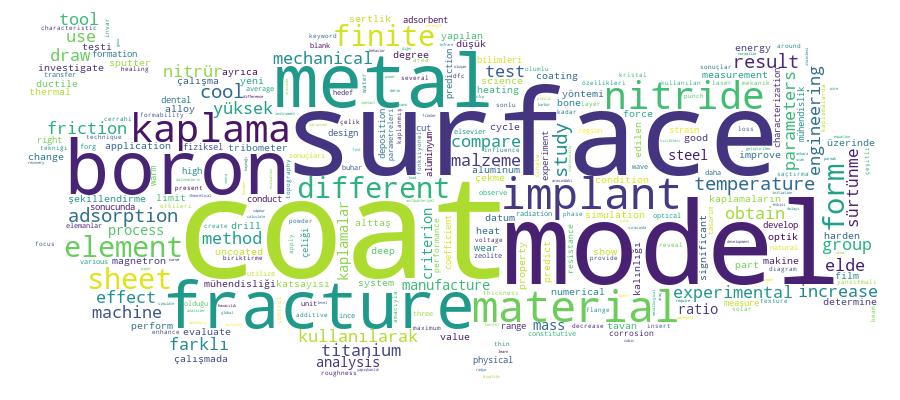
Competency Cloud
8 results
Scholarly Output Search Results
Now showing 1 - 8 of 8
Conference Object Citation - WoS: 3Citation - Scopus: 3On the Fracture Prediction of 304l Stainless Steel Sheets Utilizing Different Hardening Models(Iop Publishing Ltd, 2016) Dizaji, S. A.; Darendeliler, H.; Kaftanoglu, B.Fracture prediction is one of the challenging problems in sheet metals. Forming limit curves at fracture (FLCF), as a tool to determine fracture in sheet metal processes, are obtained through the use of numerical analyses. As one of the approaches, the ductile fracture criteria (DFCs) represent the fracture initiation of the sheets formed by different loading histories. In this study, the effects of three different hardening models on different DFCs to predict the fracture for stainless steel 304L have been investigated. The results show that most of DFCs work better in the region. epsilon(2)< 0 especially with the kinematic hardening model. However, for the region. epsilon(2)> 0 where the stretching conditions are dominant, none of them could precisely estimate the fracture initiation.Conference Object Citation - WoS: 1Citation - Scopus: 1Finite Element Analysis of Non-Isothermal Warm Deep Drawing of Dual Phase Steel(E D P Sciences, 2016) Pepelnjak, T.; Kaftanoglu, B.Improving the formability of the material is an important issue in the deep drawing process. Heating the material above its recrystallization temperature drastically increases formability but in the case of dual phase (DP) steels it results in the loss of their mechanical properties. To improve the drawing ratio, only the heating of the flange region in the warm temperature range up to 300 degrees C was studied on DP600 sheet steel by numerical simulation. Thermo-elastic-plastic FEM analysis of deep drawing at several drawing ratios was performed and compared with experimental results.Conference Object Citation - WoS: 7Citation - Scopus: 7Effect of Hardening Models on Different Ductile Fracture Criteria in Sheet Metal Forming(Springer France, 2016) Dizaji, Shahram Abbasnejad; Darendeliler, Haluk; Kaftanoglu, Bilgin; Abbasnejad Dizaji, ShahramPrediction of the fracture is one of the challenging issues which gains attention in sheet metal forming as numerical analyses are being extensively used to simulate the process. To have better results in predicting the sheet metal fracture, appropriate ductile fracture criterion (DFC), yield criterion and hardening rule should be chosen. In this study, the effects of different hardening models namely isotropic, kinematic and combined hardening rules on the various uncoupled ductile fracture criteria are investigated using experimental and numerical methods. Five different ductile fracture criteria are implemented to a finite element code by the user subroutines. The criterion constants of DFCs are obtained by the related experimental tests. The in-plane principle strains obtained by the finite element analyses for different DFCs are compared with the experimental results. Also, the experimental results are used to evaluate the principle strain values calculated by the finite element analysis for different combinations of DFCs and hardening rules. It is shown that some DFCs give better predictions if the appropriate hardening model is employed.Conference Object A Study on the Constitutive Equation Effects in the Fracture Initiation of Aa5450 Sheets(Pleiades journals, 2019) Dizaji,S.A.; Darendeliler,H.; Kaftanoğlu,B.Determination of the fracture initiation in the sheet metal forming applications can be achieved successfully using ductile fracture criteria (DFCs) and finite element codes together. In this study three different uncoupled, energy based ductile fracture criteria have been employed to predict the onset of the fracture in the AA5450 aluminum alloy sheets. Also, two different constitutive models namely, isotropic von-Mises and anisotropic Hill, have been implemented to the finite element code ABAQUS through VUMAT subroutine to investigate the effect of constitutive equations on the applicability of the utilized DFCs. It was shown that the constitutive model has significant influence on the estimation of the time and place of the fracture initiation in the sheets. © Springer Nature Singapore Pte Ltd. 2019.Conference Object Antibacterial Activity of Cubic Boron Nitride (cbn) Coatings on Stainless Steel Grade 316 (316l)(Amer Chemical Soc, 2010) Uzunoglu, Emel; Sengonul, Merih; Derici, Kursat; Biriken, Derya; Kaftanoglu, Bilgin; Sengonul, Merih[No Abstract Available]Conference Object Investigation of Influence Parameters on Forming Limit Diagrams of Aluminum Alloy-Aa2024(Trans Tech Publications Ltd, 2011) Celik, Gokhan; Kaftanoglu, Bilgin; Karadogan, CelalettinSheet metal forming technology is the keyword for many industries such as aerospace, aeronautics and automobile industries. Customer expectations, quality and safety requirements and market competitions require sheet metal forming operations to be well analyzed before the process to fulfill all these requirements. In this study, combination of FEA (finite element analysis) and mechanical material characterization were used in order to improve sheet metal forming operations while considering cost and quality. On the material characterization side of the studies, simple uniaxial tensile tests were conducted to obtain anisotropy parameters and yield points along different directions and hydraulic bulge test (HBT) was performed to obtain plastic behavior of the material up to 0.7 strains. Deformation measurements were conducted using optical measurement system GOM-ARAMIS while a 60-ton hydraulic press; Zwick/Roell BUP600 was used to deform the sheet part AA2024-0 aluminum alloy. Effects of process parameters, which are initial material thickness, lubrication and punch speed, on sheet metal formability and forming limit diagrams (FLDs) were investigated. On the study of thickness effects, sheet metals those having 0.81mm, 1.27mm and 1.60mm thickness were tested. Punch velocities of 250mm/min, 500mm/min and 750mm/min were used to investigate effect of punch speed on formability of sheet metals. Finally, PTFE (Polytetrafluoroethylene), paraffin lubricated and dry conditions were presented to obtain friction effects. FE analyses were performed to simulate experiments and to obtain friction coefficients of different lubricants. Good correlations were observed between numerical simulations and experimental results.Conference Object Citation - WoS: 178Citation - Scopus: 221Investigations on the Effects of Multi-Layered Coated Inserts in Machining Ti-6al Alloy With Experiments and Finite Element Simulations(Elsevier Science Bv, 2010) Ozel, T.; Sima, M.; Srivastava, A. K.; Kaftanoglu, B.This paper presents investigations on turning Ti-6Al-4V alloy with multi-layer coated inserts. Turning of Ti-6Al-4V using uncoated, TiAlN coated, and TiAlN + cBN coated single and multi-layer coated tungsten carbide inserts is conducted, forces and tool wear are measured. 3D finite element modelling is utilized to predict chip formation, forces, temperatures and tool wear on these inserts. Modified material models with strain softening effect are developed to simulate chip formation with finite element analysis and investigate temperature fields for coated inserts. Predicted forces and tool wear contours are compared with experiments. The temperature distributions and tool wear contours demonstrate some advantages of coated insert designs. (C) 2010 CIRP.Conference Object Prediction of plastic instability and forming limits in sheet metal forming(2011) Şanay,B.; Kaftanoglu,B.In this study, FLD's are predicted by simulating Nakazima test using a finite element software. Strain propagation instability criterion is used to evaluate the limit strains from the finite element simulations. SAE 1006, material is used in this study and 7 different specimen geometries are analyzed. Furthermore, FLD's are also predicted by theoretical approaches namely; Keeler's model, maximum load instability criterion, Swift-Hill model and Storen-Rice model. At the end of the study, the calculated FLD's are compared with the experimental results. © 2011 IBF (RWTH Aachen) & IUL (TU Dortmund).
