Sönmez, Münevver

Loading...
Profile Picture
Name Variants
Münevver, Sönmez
S., Munevver
S.,Munevver
Sonmez M.
S., Münevver
Sönmez,M.
M., Sonmez
Münevver Sönmez
Sonmez,Munevver
S.,Münevver
Munevver, Sonmez
Sonmez,M.
M.,Sonmez
Sonmez, Munevver
M.,Sönmez
Sönmez, Münevver
M., Sönmez
Sonmez, Muenevver
Job Title
Doçent Doktor
Email Address
munevver.sonmez@atilim.edu.tr
Main Affiliation
Nursing
Status
Website
Scopus Author ID
Turkish CoHE Profile ID
Google Scholar ID
WoS Researcher ID

Sustainable Development Goals

NO POVERTY1
NO POVERTY
0
Research Products
ZERO HUNGER2
ZERO HUNGER
0
Research Products
GOOD HEALTH AND WELL-BEING3
GOOD HEALTH AND WELL-BEING
3
Research Products
QUALITY EDUCATION4
QUALITY EDUCATION
5
Research Products
GENDER EQUALITY5
GENDER EQUALITY
0
Research Products
CLEAN WATER AND SANITATION6
CLEAN WATER AND SANITATION
0
Research Products
AFFORDABLE AND CLEAN ENERGY7
AFFORDABLE AND CLEAN ENERGY
0
Research Products
DECENT WORK AND ECONOMIC GROWTH8
DECENT WORK AND ECONOMIC GROWTH
0
Research Products
INDUSTRY, INNOVATION AND INFRASTRUCTURE9
INDUSTRY, INNOVATION AND INFRASTRUCTURE
0
Research Products
REDUCED INEQUALITIES10
REDUCED INEQUALITIES
0
Research Products
SUSTAINABLE CITIES AND COMMUNITIES11
SUSTAINABLE CITIES AND COMMUNITIES
0
Research Products
RESPONSIBLE CONSUMPTION AND PRODUCTION12
RESPONSIBLE CONSUMPTION AND PRODUCTION
0
Research Products
CLIMATE ACTION13
CLIMATE ACTION
0
Research Products
LIFE BELOW WATER14
LIFE BELOW WATER
0
Research Products
LIFE ON LAND15
LIFE ON LAND
0
Research Products
PEACE, JUSTICE AND STRONG INSTITUTIONS16
PEACE, JUSTICE AND STRONG INSTITUTIONS
0
Research Products
PARTNERSHIPS FOR THE GOALS17
PARTNERSHIPS FOR THE GOALS
0
Research Products
Documents

24

Citations

283

h-index

9

Documents

0

Citations

0

Scholarly Output

20

Articles

18

Views / Downloads

138/992

Supervised MSc Theses

1

Supervised PhD Theses

0

WoS Citation Count

78

Scopus Citation Count

85

Patents

0

Projects

0

WoS Citations per Publication

3.90

Scopus Citations per Publication

4.25

Open Access Source

9

Supervised Theses

1

JournalCount
Journal of Tissue Viability7
Balıkesir Sağlık Bilimleri Dergisi (BSBD)2
Hacettepe Üniversitesi Sağlık Bilimleri Fakültesi Dergisi1
International Wound Journal1
Journal of Infusion Nursing1
Current Page: 1 / 3

Scopus Quartile Distribution

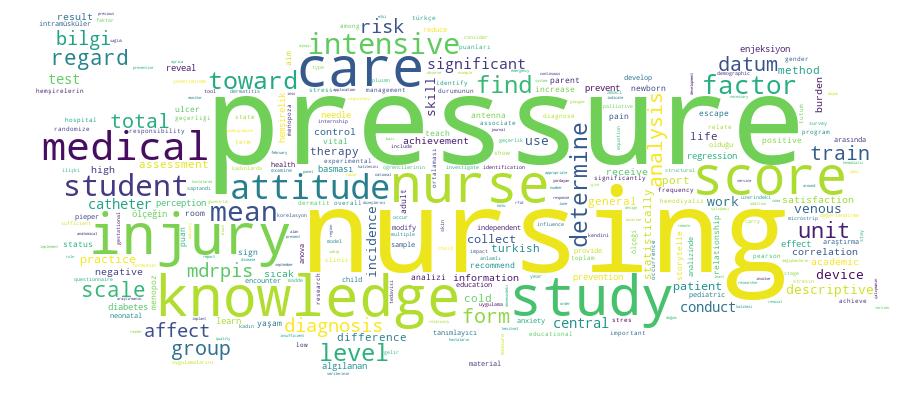
Competency Cloud

GCRIS Competency Cloud

Scholarly Output Search Results

Now showing 1 - 1 of 1
  • Article
    Citation - WoS: 3
    Citation - Scopus: 3
    Turkish Nurses' Knowledge, Attitudes and Practices in the Management of Incontinence Associated Dermatitis: a Descriptive and Cross-Sectional Study
    (Elsevier Sci Ltd, 2025) Sonmez, Munevver; Kisacik, Oznur Gurlek; Korkmaz, Serap; Gürlek Kısacık, Öznur
    Objective: This study aimed to determine nurses' current knowledge, attitudes, and practices in adult intensive care units and palliative care clinics regarding incontinence-associated dermatitis (IAD). Materials and methods: This descriptive cross-sectional study was conducted with 355 nurses in adult intensive care and palliative services at two hospitals. Data were collected between 5.03.2022 and 15.06.2022 using the" Nurse Demographic Form" and the "Knowledge, Attitude and Practice of Nurses in Managing Incontinence- Associated Dermatitis Questionnaire". Results: The nurses' mean scores for "Knowledge of IAD Etiology and Diagnosis" were 19.11 (SD 3.29), mean scores for "Knowledge of IAD Risk Factors" were 23.82 (SD 4.27), mean scores for "Attitude Toward IAD Prevention" were 10.1 (SD 2.49), and mean scores for "Practices for IAD Prevention" were 23.71 (SD 3.97). It was found that nurses who used a risk assessment tool to diagnose IAD (p = 0.001), had a procedure or protocol (p = 0.001), and received training on IAD (p < 0.001) had significantly higher "Attitude Towards Prevention of IAD" scores. There was a positive correlation between the number of patients with IAD cared for by the nurses participating in the study and the scores of "Practices to Prevent IAD"and "Knowledge of IAD Risk Factors", "Knowledge of IAD Etiology and Diagnosis"and "Attitude Towards Preventing IAD"(p < 0.001). Conclusion: This study found that intensive care and palliative care nurses' knowledge, attitudes, and practices regarding IAD were insufficient. Considering that IAD is encountered more frequently in these units, it is essential to provide continuous and practical training to nurses about IAD, use risk assessment tools to prevent and treat IAD, determine protocols, establish clinical guidelines, and implement and standardize them.